

Shanghai’s Public Security Bureau Enhances Its Combat Effectiveness Through Technology, Ensuring “Silent” Safety with Tangible Results
Date: April 18, 2025
Reporter: Wu Linhua
In the first quarter of this year, the number of emergency calls to Shanghai’s 110 hotline decreased by 2.1%. The number of criminal cases reported fell by 7.1%, while the success rate of electric fraud cases and the reported amounts dropped by 14.1% and 21.4%, respectively. Additionally, the congestion delay index for key areas during peak hours decreased by 4.01%, and the average vehicle speed during these times increased by 4.97%. Beyond the data, citizens have noticed significant changes in Shanghai’s safety governance.
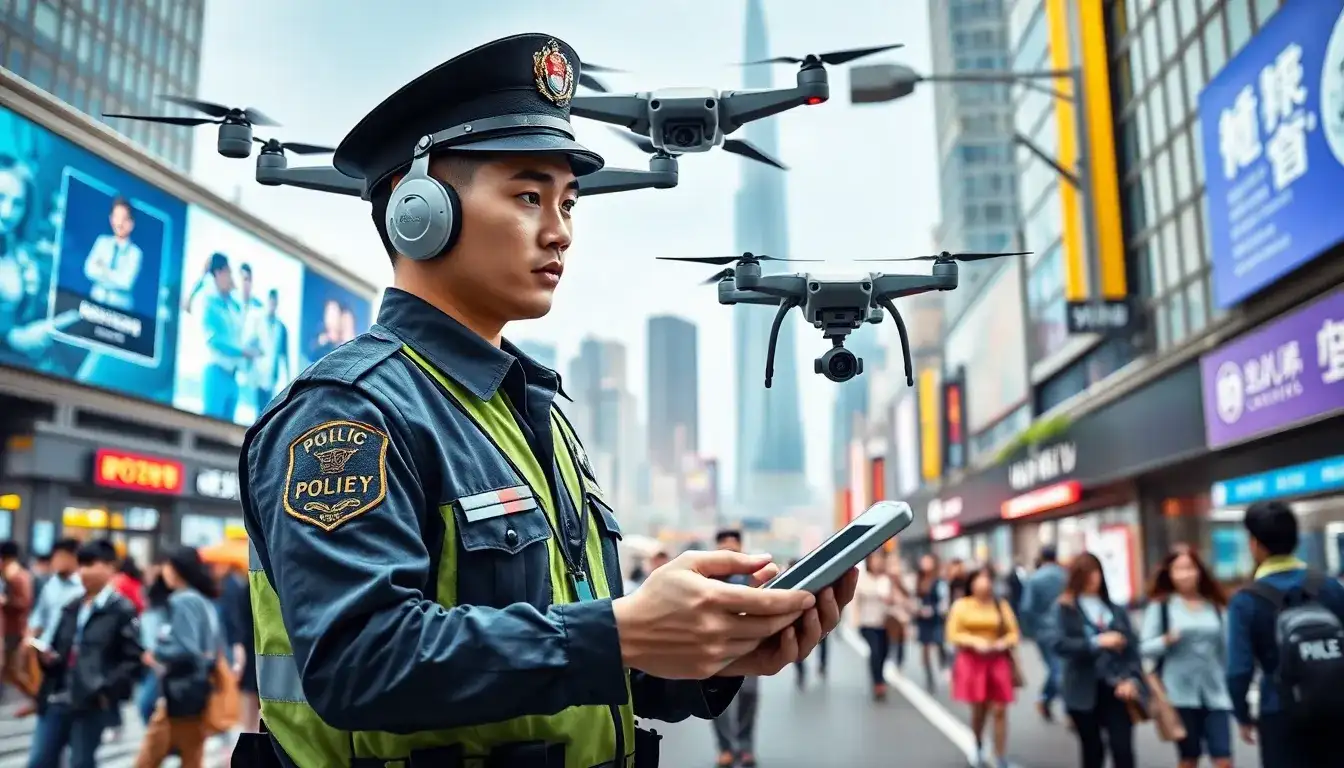
“The Yangpu traffic management has started using drones to assist in handling traffic accidents. Not only is it faster, but drivers no longer need to get out of their vehicles to take pictures, which is safer,” said Mr. Wang, a citizen who experienced the Shanghai Police’s new “drone accountability” feature, remarking, “It’s already next level.”
The changes taking place are well-documented. The Shanghai Public Security Bureau is committed to the goals of becoming a “world-class safe city, with a world-class policing model and a world-class police image.” Through technological empowerment and institutional reforms, they are continuously enhancing their combat effectiveness to ensure “silent” safety with a tangible sense of security.
Technological Empowerment: Optimizing Policing Models
In February of this year, leveraging the comprehensive incident analysis system developed by the municipal police department, the Pudong Public Security Bureau command center identified a recurring police incident. A couple in the Meiyuan Xincun area had been involved in escalating disputes with their father-in-law, leading to multiple calls to the police within a week.
“We analyzed that this incident involved multiple factors, including family ethics and property distribution, indicating that the conflict could persist and escalate,” said Jiang Jingwei, deputy director of the Meiyuan Xincun police station. The station promptly activated a “three-station linkage” mechanism, bringing together community police, lawyers, and neighborhood committees to coordinate from various perspectives.
“We suggested that both parties temporarily live apart to ease family tensions.” The community police developed several housing and rental subsidy plans and assisted Mr. Wang in finding a rental property, ultimately leading to the signing of a family mediation agreement.
Such recurring police incidents often harbor disputes and security risks. With the comprehensive incident analysis system, Shanghai police can analyze thousands of daily reports, automatically filtering and extracting insights to foresee conflicts and risks, enabling timely resolutions. Currently, information from the 12345 hotline and window reports is also included in the police’s comprehensive incident system data pool.
On this foundation, the police have established a proactive mechanism to identify significant social security issues. For recurring incidents that could lead to serious cases, a “dual oversight” approach involving police station chiefs is employed to ensure that “cases are resolved, issues are settled, and people are harmonious.” For regional, widespread, or long-standing issues, the police focus on developing various intelligent application models to uncover hidden risks behind big data.
The transformation of policing models directly impacts the police’s combat effectiveness. Supported by a “super brain,” grassroots police stations concentrate on their primary prevention functions, with clearer work objectives: to resolve all types of disputes at the grassroots level before they escalate. In the first quarter, over 200,000 disputes were resolved citywide, achieving a 94.3% resolution rate for key recurring incidents, helping to tackle more than 110 practical challenges, including illegal taxi meter modifications.
Synthetic Operations: Enhancing Law Enforcement Efficiency
In recent years, the persistent illegal modifications of electric bicycles have not only troubled management authorities but also increased fire hazards. In response, the Shanghai Economic Investigation Corps led efforts using data analysis and collaborative assessments, resulting in the shutdown of several shops suspected of illegal modifications and the resolution of 27 related cases.
Faced with the ever-evolving nature of criminal activities, relying on single police units or departments is often insufficient. To address this, the Shanghai police have established a synthetic operations task force aimed at enhancing law enforcement precision, speed, and impact through the integration and sharing of data and capabilities, effectively resolving challenges that traditional policing models struggle to address.
By developing a new policing model that integrates “expertise + mechanisms + big data,” the Shanghai police are continuously shifting their security prevention and law enforcement strategies from passive to proactive, from static to dynamic, and from broad to precise. This approach targets the subtle challenges in urban safety governance and the concerns of the public, enabling police units, sub-bureaus, and stations to independently conduct focused and effective inspections.
This “quick and targeted” method minimizes disruptions to citizens’ daily lives while eliminating various security hazards. The operation of this new policing model has also enhanced the precision and scientific nature of police duties. During this year’s Spring Festival security operations, Shanghai police conducted detailed analyses and precise calculations to deploy appropriate levels of police services across different areas, ensuring that security personnel and preventative measures matched actual needs, resulting in a 5.9% decrease in 110 emergency calls despite heavier security demands.
Extending Reach: Promoting Governance Transformation
Due to residing in “three-in-one” establishments, many delivery riders face housing challenges. Jiang Hongxin, the head of a delivery station in Nanxiang, sought help through the “e-Jia Ren” WeChat mini-program.
Previously, the “e-Jia Ren” program had received complaints from residents about issues like unauthorized charging and noise disturbances caused by delivery riders, which were exacerbated by the need for vehicle charging and differing work hours. “Delivery riders living in shared dormitories must consider both vehicle charging and the impact on other residents,” noted Yu Jiasheng, deputy director of the Nanxiang police station.
Upon receiving the request for assistance, community officers at the Nanxiang police station communicated directly with the requester and reached out to various contacts, eventually finding a suitable housing option for the riders—an old school converted into a collective dormitory. “This place is not only safe and compliant but also does not disturb nearby residents,” Jiang and his colleagues were pleased to discover. They negotiated with the landlord and moved in the very next day.
Last August, the Jiading police department innovatively led the “micro-grid” governance model and developed the “e-Jia Ren” mini-program and other digital platforms, organically integrating intelligence with community engagement to facilitate rapid feedback and resolution of community issues. By the end of last year, Jiading had proactively identified and addressed 230,000 various issues, promptly responding to over 9,900 social governance concerns raised by the public.
The Nanxiang police station also utilized a “grid whistle-blowing, department reporting” mechanism, collaborating with community committees and urban management departments to conduct joint inspections of illegal “three-in-one” establishments.
By leveraging various digital platforms to extend their operational reach, the Shanghai police are continuously transforming grassroots social governance from reactive responses to proactive prevention, ensuring that citizens truly feel that safety is all around them.
Original article by NenPower, If reposted, please credit the source: https://nenpower.com/blog/enhancing-public-safety-in-shanghai-how-technology-empowers-the-police-force-for-a-secure-urban-environment/

