

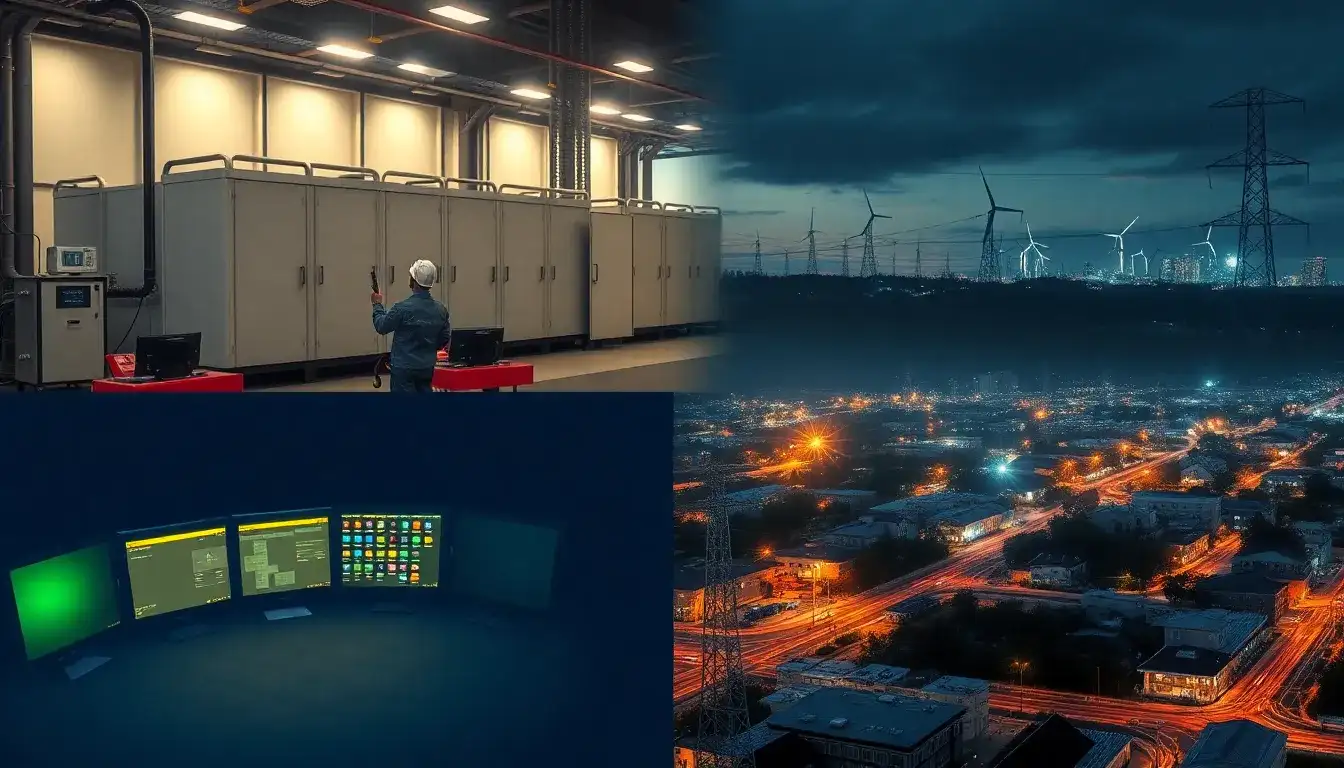
How Battery Energy Storage Enhances Grid Resilience Amid Blackouts
=================================================================
By Jack Thomas
Energy, June 12, 2025
Christophe Albertus, the Head of the Engineering Design Department at Socomec, explores how battery energy storage and decentralized resilience are crucial in safeguarding against increasing electricity blackouts and grid disruptions across Europe.
The need for grid flexibility is well-recognized, but recent blackouts in areas such as the UK, the Canary Islands, mainland Spain, and Portugal have brought the issue of grid resilience to the forefront. While the specific causes of these outages remain uncertain, the shift to variable renewable energy sources presents new challenges regarding grid frequency and stability. Fluctuations in renewable energy generation can lead to frequency drift, which diminishes power quality and can potentially damage electrical equipment. As the economy becomes increasingly electrified, industries are left more vulnerable to grid instability, emphasizing the need for more reliable and resilient power, particularly for energy-intensive sectors.
Just as decentralized computing protected the digital economy from data center outages, the decentralization of energy management, generation, and storage could similarly enhance our economic resilience against power supply risks. By generating and storing more power on-site, large energy consumers can secure essential backup power and reduce their reliance on the electric grid.
### The Renewable Risk to Grid Stability
Recent significant blackouts across the Iberian Peninsula have reignited discussions about the risks that renewable energy poses to grid stability. With renewable energy comprising 47% of net electricity generation in the EU and over 50% of the UK’s electricity mix in 2024, these concerns are increasingly pertinent. Research indicates that the swift integration of renewable energy sources is diminishing our ability to regulate grid frequency and stability. Unlike traditional power stations, renewable grids lack the inherent resilience provided by ‘system inertia’—the kinetic energy stored in synchronously spinning turbines—which helps maintain stability during sudden frequency shifts. Since many renewable sources cannot directly produce Alternating Current (AC) power, they are disconnected from the grid and cannot influence grid inertia.
Weather-related fluctuations in renewable generation can also lead to frequency drift, where grid frequencies deviate from the required standards, affecting power quality and electrical equipment. The interconnectivity of Europe’s grids means that any power supply disruption can have widespread repercussions across the continent. Furthermore, the rapid electrification of the economy implies that any grid instability can have ripple effects across various sectors. This was evident when recent outages in Spain caused extensive disruptions in industrial and commercial operations, resulting in an estimated €1.6 billion loss in annual GDP.
### Decentralizing Resilience
Recent events have highlighted the urgent need to enhance power grid resilience, with industry body Eurelectric estimating that Europe must invest €67 billion annually until 2050 to stabilize grids. However, there has been less emphasis on how distributed energy generation and storage can provide decentralized resilience for industrial and commercial users, lessening their dependence on utilities and adding a layer of protection for the economy.
Technical challenges exist in providing off-grid backup power, including managing variable renewable output to prevent overcharging batteries and ensuring that the building’s voltage and frequency align with grid fluctuations. Buildings must be able to switch between different backup power sources, such as using a generator when solar or wind generation is insufficient. Effective management of battery cycles is essential to maintain their health, capacity, and lifespan.
Innovative organizations are now implementing smart battery energy storage systems (BESS) and on-site power sources, such as biomass and solar, capable of supplying off-grid power during outages. Intelligent power management systems can execute ‘planned islanding,’ which involves intentionally disconnecting from affected electricity networks and performing a ‘blackstart’ to restore full power from on-site battery storage and power sources within 30 seconds of an outage. These systems can even form microgrids that operate independently from the main grid.
Advanced energy management systems can automatically monitor and regulate energy consumption, production, and storage across buildings, balancing off-grid supply and demand during outages. For instance, they can ‘derate’ or reduce the output of on-site renewable or diesel generators to prevent battery overcharging or implement ‘load shedding’ to conserve electricity. These smart control systems allow microgrids to seamlessly transition between optimal power sources, such as connecting to diesel generator sets when solar generation ceases at night. Digital measurement tools can synchronize voltage and frequency levels with those of the main grid, facilitating a smooth reconnection after an outage without fluctuations.
These systems not only enhance resilience but also address gaps in electric grid infrastructure, accelerating the energy transition while the main grid expands. One EV charging operator successfully combined on-site solar PVs with battery energy storage systems to provide fully off-grid power for 39 EV charging stations, creating a reliable local power supply for electric transport.
### Towards an ‘Edge Electricity’ Model
Similar to how the ‘edge computing’ model enhanced the digital economy’s resilience against data outages, an ‘edge electricity’ model focusing on on-site energy management, storage, and production could significantly improve economic resilience. Building owners can utilize advanced modeling to determine the appropriate size and scale of battery energy storage systems for their future energy needs, ensuring a secure and sustainable power supply. We may also witness the emergence of ‘resilience-as-a-service’ models that offer smaller commercial and industrial facilities more flexible and affordable energy security.
Beyond resilience, there are substantial commercial benefits to effectively managing, storing, and producing power on-site. Companies can leverage smart islanding systems to capitalize on price schemes that reward industrial and commercial consumers for reducing peak-time power consumption, converting resilience into revenue. On-site surplus power storage facilitates ‘peak shaving,’ allowing strategic charging and discharging of batteries to lower peak-time consumption and electricity costs. Surplus energy can even be sold back to the grid, providing essential services such as flexibility and frequency regulation, creating a beneficial cycle where decentralized resilience for large consumers enhances overall network stability and flexibility.
Utilities are now incentivizing BESS operators to assist in stabilizing grid frequencies and providing ancillary services like voltage regulation, which presents a potential revenue opportunity for commercial and industrial building owners while supporting the grid. Commercial buildings can also profit by selling power back to the grid during peak demand or extreme temperatures, meaning a BESS resiliency solution can ultimately pay for itself, delivering both behind-the-meter savings and commercial services for utility companies.
Recent incidents in Europe underscore the necessity of future-proofing electric grids against an increasingly unstable renewable energy landscape. However, the transition to decentralized renewable energy sources will also require a corresponding shift toward decentralized resilience, ensuring that electric grids no longer represent a single point of failure for the economy.
**Contributor Details**
Christophe Albertus
Socomec
Head of the Engineering Design Department
Website: [Socomec](https://www.socomec.co.uk/en-gb/solutions/customers-stories/nice-grid)
Original article by NenPower, If reposted, please credit the source: https://nenpower.com/blog/enhancing-grid-resilience-the-role-of-battery-energy-storage-in-mitigating-blackouts/

