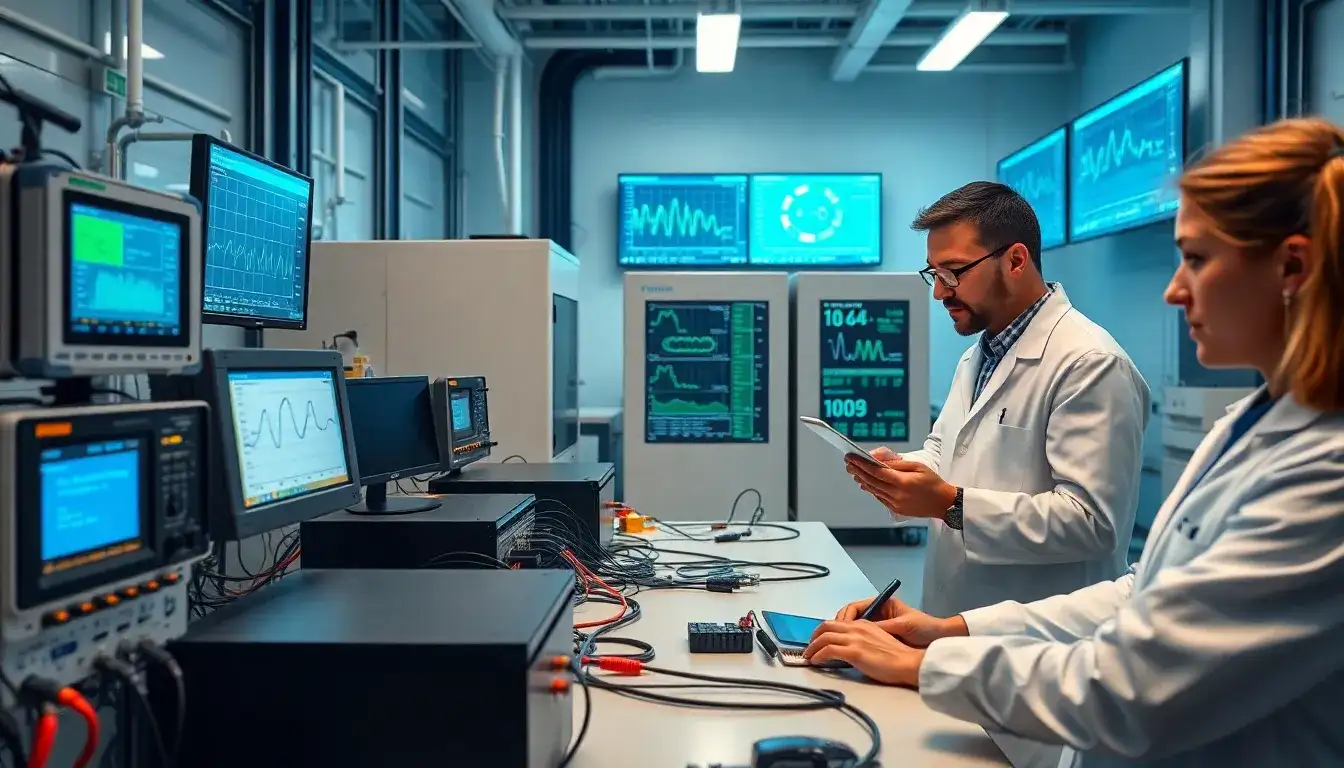
More Efficient Energy Storage Systems! Support for Simultaneous Testing of PCS/BMS in a Loop
Date: May 13, 2025
Energy storage systems typically consist of four key components: battery packs, Battery Management Systems (BMS), Energy Management Systems (EMS), and Power Conversion Systems (PCS). The relationship between BMS and PCS is critical, as they complement each other by performing distinct functions while working together to ensure comprehensive management and control of the energy storage system. As energy storage technology continues to evolve and application demands increase, both BMS and PCS are gradually moving towards greater intelligence, integration, and modularity. The interaction capabilities and quality between BMS and PCS directly impact the overall safety and reliability of the energy storage system, making it essential to enhance the performance and reliability testing of controllers through hardware-in-the-loop (HIL) testing.
Overview of BMS
The BMS is a vital component in electric vehicles and energy storage systems, responsible for monitoring battery parameters such as voltage, current, and temperature, as well as performing tasks like energy calculations, lifespan estimations, thermal management, charging control, and high-voltage safety. The BMS architecture mainly consists of a Battery Management Unit (BMU) and a Cell Supervisory Controller (CSC). The BMU processes data from various subordinate control units, executing state estimation, fault diagnosis, and charge/discharge control algorithms, while also communicating with other systems. The CSC monitors a specified number of individual battery cells, collects voltage, current, and temperature data, implements balance control, and sends this information to the main control unit.
Overview of PCS
The PCS serves as the interface between the batteries and the power grid, controlling the inverter to charge or discharge the batteries based on power commands. It determines the quality and dynamic characteristics of the energy output from the storage system and significantly influences the lifespan of the batteries. Currently, there are two main technical approaches to energy storage PCS: string-type and centralized.
Energy Storage System Testing Solution
Traditional energy storage system testing has primarily focused on either the grid connection performance of the PCS or standardized tests of the BMS, without considering the interaction effects between BMS and PCS. The testing solution provided by Yuan Kuan enables simultaneous HIL testing of the PCS controller and BMS controller, allowing for the completion of standard tests for both PCS and BMS, as well as testing their interaction functionalities. This testing solution involves key equipment including real-time simulators, battery simulators, PCS controllers, and BMS control boards. The overall system architecture is illustrated below:
The CPU of the real-time simulator simulates a large number of high-order battery models, while the individual battery voltage and temperature, as well as total voltage and current, are communicated (via Modbus/CAN) to the battery simulator. The battery simulator has built-in battery simulation cards that provide multiple positive and negative terminal ports for batteries, with each port’s voltage controlled by the battery voltage instructions from the simulator, and the port current fed back to the simulator via communication (Modbus/CAN). The BMS control board is connected to the battery simulator through real cables, collecting individual battery voltage, temperature, total voltage, and current, executing battery state estimation algorithms, and fault alarms.
The real-time simulator’s FPGA simulates multiple PCS topologies with a small time step of 1 microsecond. The PCS controller collects the voltage and current at the grid connection point sent by the simulator and executes control algorithms, with the output PWM signals transmitted to the simulator to control the DC/AC conversion bridge. By simultaneously simulating both the PCS conversion bridge and the battery models, this testing environment allows for real-time interaction between these two components during concurrent testing of the BMS and PCS controllers.
Supported Testing Items
1. BMS Testing Items
Referring to the national standard GB/T 34131-2023 for battery management systems in power storage, the supported testing items are listed in the table below. These do not include BMS-specific tests, such as those for high and low-temperature operation.
| Inspection Item |
|---|
| Individual battery voltage |
| Total voltage |
| Total current |
| Temperature |
| Insulation resistance |
| SOC/SOE estimation error |
| Balancing function |
| Control function |
| Protection function |
| Communication |
| Fault diagnosis |
| Data storage |
| Insulation withstand voltage |
| DC power supply |
| Signal and load circuit short circuit |
2. PCS Controller Testing Items
Referring to the national standard GB/T 34120-2023 for technical requirements of energy storage converters in electrochemical energy storage systems, the supported testing items are listed in the table below and do not include specific tests for the PCS controller, such as electrical safety and environmental adaptability.
| Inspection Item |
|---|
| Power output range |
| Active power control |
| Primary frequency response function |
| Inertia response function |
| Reactive power control |
| Overload capacity |
| Charge-discharge conversion time |
| Grid disconnection switching time |
| Current ripple |
| Voltage ripple |
| Harmonic current |
| Harmonic voltage |
| DC component |
| Voltage deviation |
| Voltage unbalance |
| Voltage fluctuation and flicker |
| Dynamic voltage transients |
| Low voltage ride-through |
| High voltage ride-through |
| Continuous fault ride-through |
| Voltage adaptability |
| Frequency adaptability |
| Frequency change rate adaptability |
| Anti-islanding protection |
System Equipment and DEMO Introduction
1. DEMO Equipment
The following image displays the hardware-in-the-loop testing setup for the BMS and PCS controller:
The real-time simulator, Yuan Kuan MT 8020, features an 8-core Intel Xeon CPU capable of simulating 1,000 high-order lithium battery models with a 1 millisecond time step. The FPGA model is Xilinx KU115, which offers abundant logical resources and parallel simulation capabilities for multiple inverter power electronic systems. The MT 8020’s FPGA simulates four PCS grid connection topologies with a 1 microsecond time step, while the CPU simulates four battery pack models with a 1 millisecond time step, where each battery pack consists of two clusters and each cluster contains 20 battery modules, with each module housing 24 series lithium batteries.
2. BMS Testing
Testing followed the national standard GB/T 34131-2023 for battery management systems in power storage, covering data acquisition, SOC estimation, battery balancing, and fault alarm testing.
Data acquisition and SOC estimation tests involved starting the system and comparing the battery operation status displayed on the real-time simulator’s host computer to that monitored on the BMS host computer, thus validating the accuracy of the BMS data acquisition circuit and SOC estimation. The results indicated that the readings from the real-time simulator and BMS host computer were generally consistent.
Battery balancing tests were conducted by setting the voltages of battery 1 and battery 13 higher to create a voltage difference exceeding the threshold, checking whether the BMS would initiate the balancing control. The results showed that the balancing current for batteries 1 and 13 reached 87mA, and the BMS host computer displayed that balancing control was in progress, confirming the activation of the BMS balancing function.
Fault alarm testing involved issuing an open circuit command to either the positive or negative terminal of the battery simulator to observe whether the BMS would issue corresponding alarms. Results indicated that after simulating a positive terminal open circuit fault in batteries 5 and 17, the displayed voltages for these batteries were zero and alarms for low voltage and excessive voltage difference were triggered.
3. PCS Testing
Testing followed GB/T 34120-2023 for technical requirements of energy storage converters, focusing on power control and AC side voltage/current distortion rate testing.
Power control tests involved observing whether the actual active and reactive waveforms demonstrated four-quadrant operating capability by varying the active and reactive commands of the PCS controller. The results confirmed that both active and reactive power could operate positively and negatively, indicating the PCS controller’s four-quadrant power control capability.
AC side voltage and current distortion rate tests assessed whether the THD of the AC voltage and current at the grid connection point remained below 3% after the system reached a steady state. The results indicated that the three-phase voltage and current were symmetrical with no harmonics, and THD values were below 3%, confirming the PCS controller’s capability to meet AC voltage and current distortion rate testing criteria.
For submissions and news tips, please contact Ms. Chen via WeChat/mobile at 13693626116 or email at chenchen#bjxmail.com (replace # with @). Subscribe to the Polaris Weekly to not miss out on exciting content!
Original article by NenPower, If reposted, please credit the source: https://nenpower.com/blog/enhancing-energy-storage-systems-simultaneous-testing-of-pcs-and-bms-for-improved-efficiency/