

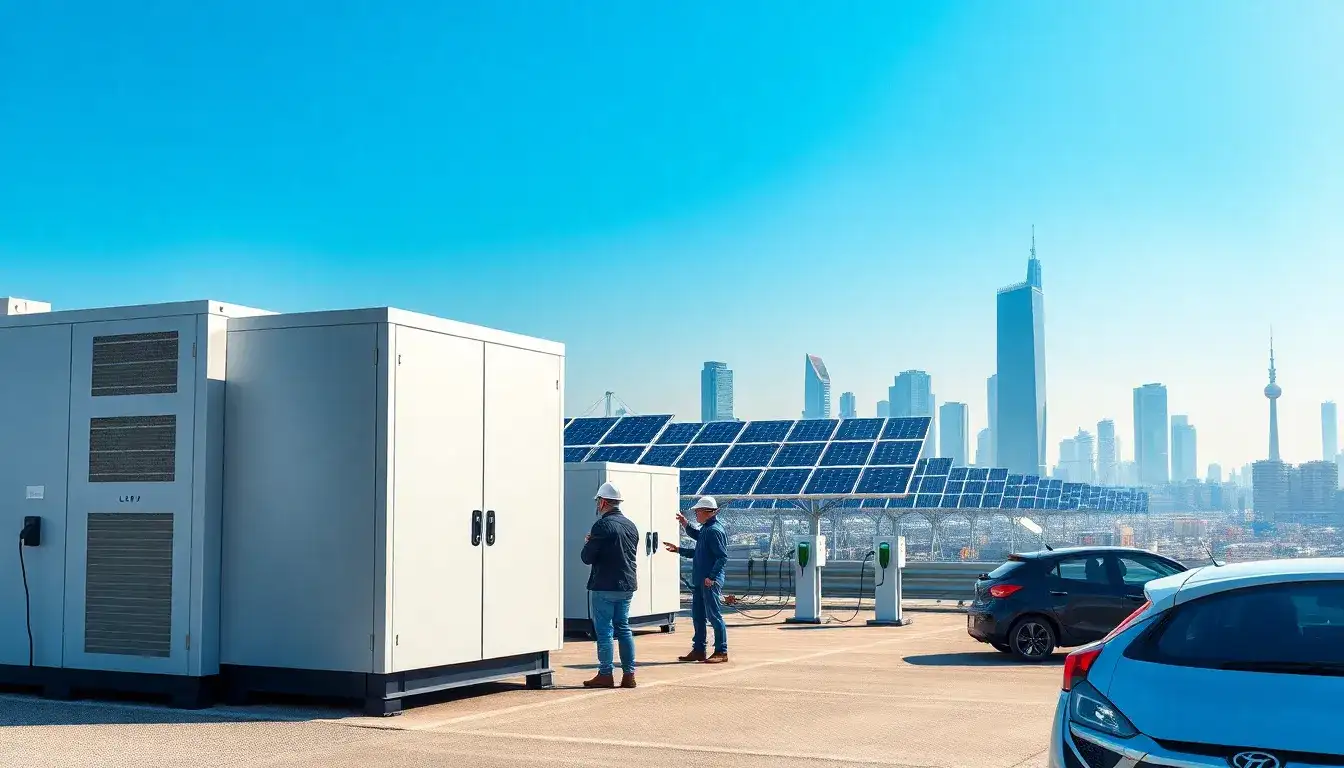
The global energy transition is entering a new phase, with energy storage emerging as a crucial infrastructure for balancing the volatility of renewable energy and ensuring the security of energy systems. The development logic of the energy storage industry has undergone a fundamental transformation, driven by the dual forces of AI computational power and the transformation of energy structures. As a result, the energy storage sector is at a critical turning point for value growth.
The industry is shifting from a policy-driven approach to one characterized by market and global dual forces, ushering in a key stage of technological diversification, increased demand, and intensified competition. A clear outline of a trillion-yuan industry is becoming increasingly apparent.
With the mass production of 587Ah battery cells by CATL and Xiamen Haitian Energy Technology Co., Ltd pushing the cost of electricity to the “10 cents per kilowatt-hour” era, competition in the industry is evolving from capacity expansion to scenario-based solutions and the establishment of a global ecosystem.
In this context, 2025 will mark the beginning of a new cycle of high-quality transformation in China’s energy storage industry, while 2026 is expected to present structural growth opportunities, accelerating the shift away from extensive scale expansion towards a new cycle centered on value creation.
Technological Foundation: Three Key Features for Industrial Upgrading
Technological innovation is the core engine of high-quality development in the energy storage industry. By the second half of 2025, three significant characteristics of battery cell technology will emerge: the mainstream adoption of large cells with capacities exceeding 500Ah, the accelerated replacement of winding processes by stacking processes, and continuous breakthroughs in long-duration energy storage technologies. Leading companies are driving this wave of technological iteration, solidifying the technical foundation for industry value enhancement.
According to Yu Qingjiao, Secretary-General of the Zhongguancun New Battery Technology Innovation Alliance, “By 2026, the industry will inevitably exhibit the characteristics of ‘large cells, liquid cooling, long duration, and multiple technological paths coexisting,’ which is a consensus in the industry.” He identifies three distinct features of current technological evolution: the large cell scale application reduces the complexity of battery management systems (BMS) and the cost of connections, perfectly matching the demand for long-duration storage; stacking processes significantly surpass winding processes in energy density and cycle life; and specialized long-duration energy storage technologies effectively address the thermal management, lifespan, and cost bottlenecks for scenarios exceeding eight hours.
In the battery cell domain, high-capacity and high-safety large cells have become the mainstream direction for leading enterprises. CATL’s 587Ah cells have already shipped 2GWh, and the next generation of large energy storage cells is accelerating its application. BYD has launched a 2710Ah blade battery specifically for energy storage, increasing the capacity of a single cell by over 300% compared to conventional products. XINWANDA Electronics Co., Ltd announced its 684Ah stacking battery cell in September 2025 and achieved the production of its millionth cell by December of the same year, marking a significant milestone in the mass production of stacking technology.
In December 2025, Xiamen Haitian Energy introduced a 1300Ah (8-hour long-duration energy storage) dedicated battery cell, aiming to reduce the number of system components by over 30% and the cost of power components by over 50%, with expected delivery in the fourth quarter of 2026. According to Wang Pengcheng, Co-Founder and President of Xiamen Haitian Energy, “The concept of long-duration energy storage has been proposed for some time but has yet to achieve large-scale implementation. The core issue is to solve the economic viability problem over the entire lifecycle, as these two aspects are mutually reinforcing. We will continue to promote technological advancement, aiming to drive down the levelized cost of storage (LCOS) to the ’10 cents era’ within the next five years. Once this goal is achieved, wind and solar storage will reach parity, allowing renewable energy to truly compete with traditional energy sources.”
Demand-Driven: Activating Global Market Development Potential
If technological breakthroughs provide possibilities for industrial development, market demand injects core momentum for value release. The global energy storage market demand is projected to maintain strong growth in 2026.
According to a report by CITIC Securities, referencing data from the China Energy Storage Alliance, the newly installed capacity for domestic energy storage is expected to reach 150GWh in 2025 and 203GWh in 2026. Additionally, the global energy storage market is anticipated to see approximately 290GWh of new installations in 2025, potentially reaching 1.17TWh by 2030, indicating substantial growth potential.
“In 2026, the new electricity demand generated by AI computing infrastructure, the long-duration energy storage needs driven by energy structure transformation, and the storage deployment demands resulting from grid congestion will resonate, leading to an expansion of the global energy storage market,” stated Xing Xing, Chief Economist at Jindonghui Enterprise Management Development (Beijing) Co., Ltd.
It is noteworthy that behind the current surge in energy storage demand, AI computational infrastructure is becoming a new growth engine. Industry data indicates that 1GW of computational infrastructure consumes approximately 7000GWh of electricity annually, with the demand for green energy and energy storage frequency modulation rising concurrently. “With the implementation of the ‘Artificial Intelligence +’ national strategy, the demand for electricity from AI data centers (AIDC) has multiplied, leading to higher safety and reliability requirements for supporting storage, creating a typical ‘high entry barrier, high customer stickiness’ market,” said Yang Rui, Chairman of Shuangdeng Group Co., Ltd..
As the proportion of installed wind and solar power continues to rise in China, the demand for cross-day and cross-season adjustments becomes evident, leading to a significant increase in the share of long-duration energy storage (≥4 hours) installations in 2025, which is expected to continue rising steadily in 2026. Currently, 4-hour energy storage systems have become mainstream.
Wang Pengcheng emphasized, “Currently, the prices of raw materials for energy storage are on the rise, but we remain committed to driving down energy storage costs. Only when energy storage costs can directly compete with traditional energy can the industry truly enter a fully market-oriented stage. From an industry trend perspective, the sector is transitioning from explosive growth to value-driven development.”
Value Enhancement: Constructing a Sustainable Growth Framework for the Industry
Supported by the dual foundations of technology and demand, the energy storage industry is shifting from “scale expansion” to “value growth.” Optimizing business models, improving supply-demand dynamics, and accelerating globalization are driving continuous value enhancement in the industry, while ecological collaboration becomes crucial for companies to achieve sustainable growth.
Currently, the mainstream business model of “spot arbitrage + capacity compensation + ancillary services” has formed replicable models in provinces such as Guangdong and Shandong. By 2025, the average internal rate of return for independent energy storage projects in certain regions of China is expected to rise to between 8% and 12%, significantly enhancing investment return capabilities and providing solid economic support for sustainable growth in the industry.
“Overall, the energy storage market in 2026 is expected to enter a new stage of scaled development characterized by ‘simultaneous quantity and price increase + quality as king.’ First, the competition focus will shift from ‘capacity expansion’ to ‘intelligent holistic solutions suitable for different application scenarios’ and ‘shared resource ecosystems’; second, business models will become more diverse, with revenue opportunities from peak-valley arbitrage, capacity compensation, virtual power plants, and ancillary services, making commercial energy storage one of the most active sectors; third, the globalization of the market will become more evident, with industry concentration significantly increasing. Leading companies, leveraging their capabilities in the entire industrial chain and cost optimization, will gradually capture more market share,” stated Liu Yong, Secretary-General of the Energy Storage Application Branch of the China Chemical and Physical Power Sources Industry Association.
Wang Pengcheng predicts that in 2026, the global energy storage scale is expected to continue its explosive growth trend, but the underlying competitive logic will shift from simple price wars to value competition. This value is multidimensional, encompassing long-duration energy storage solutions, specific scenario solutions for AIDC, global service capabilities, and the resilience of supply chains.
Simultaneously, in the face of global structural opportunities, the overseas energy storage market is entering a period of explosive growth. According to predictions from the Gaogong Industry Research Institute, global lithium battery shipments for data center energy storage are expected to exceed 69GWh by 2027 and reach 300GWh by 2030, with a compound annual growth rate exceeding 80% from 2024 to 2030.
Numerous energy storage companies, such as CATL, Xiamen Haitian Energy, Sungrow Power Supply Co., Ltd., and Shuangdeng Group, are keenly capturing this trend and accelerating their internationalization efforts, with overseas markets becoming a core engine for revenue growth.
Wang Pengcheng noted that Xiamen Haitian Energy’s shipments to Europe in 2025 increased tenfold year-on-year, and their overseas market strategy will prioritize developed regions in 2026. Yang Rui revealed that Shuangdeng Group’s “going global” strategy goes beyond mere product exports, emphasizing localization. By building localized R&D, production, and service capabilities based on the actual needs and policy environments of different markets, this model not only enhances customer response speed and stickiness but also effectively transitions from “Made in China” to “global localized operations.”
Looking toward 2026, a new cycle of high-quality development in the energy storage industry has begun. Companies must focus on scenario-based technological innovation, deeply engage in high-value application scenarios, build a global production capacity network, and deepen ecological collaboration to seize opportunities during this critical phase characterized by technological diversity, increased demand, and intensified competition. This will enable them to support value growth with real technological capabilities and provide a solid foundation for the global energy transition.
Original article by NenPower, If reposted, please credit the source: https://nenpower.com/blog/energy-storage-industry-enters-new-phase-of-value-growth-in-china/

