

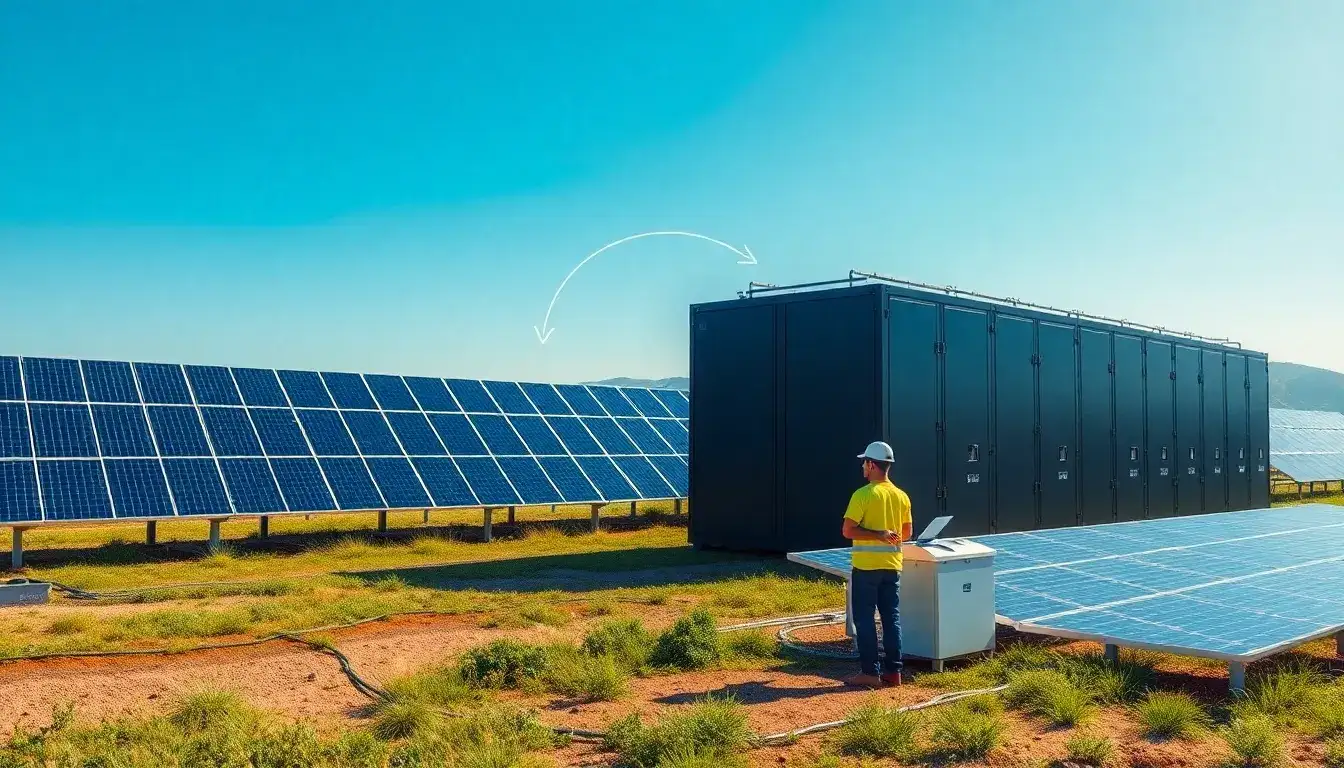
Thanks to its strategic investments in solar and storage sectors, Sungrow Power Supply Co., Ltd. reported a remarkable profit of 7.7 billion yuan in the first half of this year, despite challenging market conditions. Recently, the company’s market capitalization surpassed 300 billion yuan, making it the third company in the photovoltaic industry to achieve this milestone, following LONGi Green Energy and Tongwei Co.
Currently, the integration of solar and storage technologies is becoming standard practice among photovoltaic companies. Besides early adopters like Canadian Solar and Trina Solar, there are reports that LONGi Green Energy may acquire a storage company. Industry experts suggest that the domestic market may ease limitations on the spot market prices, allowing photovoltaic systems with storage to maximize their value as price differences widen. Additionally, the growing demand for self-consumption scenarios will further drive the need for integrated solar and storage solutions.
Overall, while there are signs of improvement in the photovoltaic sector, optimism remains cautious. Many industry insiders believe that the development of integrated solar and storage solutions, particularly in the storage segment, is vital for photovoltaic companies to navigate current challenges and create new growth pathways. However, companies that lack adequate preparation and attempt to enter the storage market amid intense competition may struggle to achieve profitability in the short term.
Recently, it was reported that LONGi Green Energy has invested in a storage company, Jingkong Energy Technology Co., Ltd., and is considering acquiring another storage firm. A representative from LONGi stated that they are continually evaluating their storage business strategy, although specific outcomes are still uncertain. Industry experts view LONGi’s foray into storage as beneficial for promoting the integration of solar and storage technologies, thereby enhancing the overall synergy between photovoltaic generation and storage systems.
This is not the first time rumors have emerged regarding LONGi Green Energy‘s interest in the storage market. During a research event last November, the company indicated its commitment to developing hydrogen energy while stating that it had not yet made definitive decisions regarding storage, as internal discussions were still ongoing. Despite the ongoing validation of LONGi‘s plans for solar-storage integration, many photovoltaic companies are adopting this model. According to disclosures from Canadian Solar, the company has secured contracts amounting to 30 billion USD for its storage systems as of the end of the first half of the year, with expected shipments of 2.1 to 2.3 GWh in the third quarter and a total of 7 to 9 GWh for the entire year. This storage business is expected to continue leading in profit margins, becoming a core engine for revenue growth.
JA Solar has also expressed its commitment to achieving its annual shipment target of 6 GWh while advancing the global deployment of integrated solar-storage solutions. Trina Solar‘s half-year report indicates that its current storage orders exceed 10 GWh, with a significant portion coming from overseas markets. In mid-September, Trina Solar announced that its storage division signed sales contracts for a total of 2.48 GWh of storage products with three clients in China, Latin America, and the Asia-Pacific region, including a 1 GWh overseas order utilizing a network-type system.
According to Yue Fen, Deputy Secretary-General and Researcher at the Zhongguancun Energy Storage Industry Technology Alliance, photovoltaic companies have inherent advantages in the storage market due to several factors: first, there is a significant overlap in customer bases, as both solar and storage services target power generation companies and large industrial users, facilitating resource and channel reuse; second, storage is a critical need for absorbing renewable energy, especially for stabilizing the output fluctuations of solar power, thereby enhancing energy absorption efficiency; and third, there is a technological overlap, as both sectors rely on Power Conversion Systems (PCS), allowing for collaborative synergies in research, development, and supply chain management.
Yang Bao, President of the Storage Division and Vice President of the Photovoltaic Product Division at Trina Solar, emphasized that integrating storage systems effectively addresses the challenges of photovoltaic energy absorption and grid stability, making this combination essential for energy transition. He also noted that the full market entry of renewable energy is pushing storage from policy support toward market-oriented trading, further solidifying the synergy between solar and storage.
As photovoltaic companies look to address market pain points through solar-storage integration, Yue Fen highlighted key areas of focus. On the generation side, as renewable energy increasingly enters the marketplace, photovoltaic projects are likely to experience zero or negative pricing during peak solar generation hours. Currently, some provinces maintain reasonable returns on solar projects through policy mechanisms. However, if such supports are removed, projects may either waste energy or rely on storage solutions to shift low-price midday output to high-price evening demand, with the economic viability of this strategy largely hinging on peak-to-valley price differences. The “Notice on Further Deepening the Construction of the Electricity Spot Market” (referred to as Document 136) indicates a future easing of spot market price limits, which is expected to widen peak-to-valley price differences, allowing for maximum economic benefits from solar-storage combinations.
From the user side, national-level initiatives such as green electricity direct connection and zero-carbon park construction have opened new scenarios for storage development. For instance, the green electricity direct connection project mandates that renewable self-consumption must account for at least 60% of the total available generation and 30% of total electricity consumption, with a goal to increase these ratios by 2030. This high standard for green electricity utilization will stimulate demand for high-ratio storage systems, creating new growth opportunities for the storage sector. Additionally, the carbon compliance requirements for export-oriented companies will further encourage their participation in green electricity direct connections or zero-carbon park projects.
As renewable energy’s share rises, the grid’s stability requirements are increasing, making storage a crucial solution for addressing the intermittent and volatile nature of photovoltaic generation. The deep integration of storage and solar technologies has become an inevitable trend. Yang Bao also mentioned that with increasingly diverse application scenarios, achieving collaborative development through microgrids, zero-carbon parks, and solar-storage charging stations is widely recognized within the industry. For high self-consumption demands, he cited that Hubei Province has mandated that rooftop photovoltaic projects in commercial and industrial buildings should achieve at least 50% self-consumption annually, encouraging projects to enhance their self-consumption ratios through solar-storage collaboration.
In Yang Bao’s view, strengthening technological innovation and establishing a cohesive development system involving R&D, intellectual property, and industry standards is critical for photovoltaic companies venturing into the solar-storage sector. “Solar-storage systems are not just simple products; they are comprehensive solutions,” he explained. Companies need to leverage high-level technological innovations to meet specific regional requirements, such as networking, high-temperature resistance, and diverse market needs. For example, Trina Solar is undergoing a strategic transformation toward solution provision this year, utilizing its technological advantages and product leadership to offer comprehensive solutions to customers.
It is noteworthy that the shift from policy-driven “strong storage requirements” to economically-driven approaches signifies that companies need to focus more on the actual economic benefits of projects to create substantial value for customers.
While the photovoltaic industry remains in a cyclical low, with major product prices still low and overall profitability elusive, early movers in solar-storage integration are already reaping benefits. For instance, Sungrow Power Supply Co., Ltd. achieved a rapid growth trajectory, reporting revenues of 43.5 billion yuan in the first half of the year, a 40% increase year-on-year, with a net profit of 7.7 billion yuan, marking a 56% growth. The company attributes its profitability primarily to its solar inverters and storage business.
Canadian Solar is also among the few photovoltaic companies that reported profitability in the first half of the year, with resilient performance driven by strategic choices in its solar business and breakthroughs in its storage growth curve. During this period, the company delivered 3.1 GWh of storage systems (including residential storage), with a second-quarter delivery of 2.2 GWh, reflecting over a 140% quarter-on-quarter growth. Discussing the advantages of integrating solar and storage, Yang Bao highlighted the company’s comprehensive technological capabilities and scenario-based solutions, along with a robust global localized service network. Furthermore, the company has proactively engaged in innovation and sustainable development, earning recognition from authoritative institutions for its system integration and global delivery capabilities.
With respect to operational philosophies, companies are focused on enhancing overall project returns through solar-storage integration to meet market demands. For example, a benchmark project in Qinghai called “Wind-Solar-Storage Synergy for Desertification Control” precisely meets customer needs.
Yue Fen noted that both the photovoltaic and storage industries are facing intense competition; however, leading players in the storage sector maintain strong profitability due to their technological and scale advantages, while smaller firms are struggling with losses. “Currently, whether companies focus solely on photovoltaic or storage segments, they are actively expanding into comprehensive energy services, virtual power plant operations, and electricity market transactions to mitigate cyclical fluctuations in the industry,” she stated. However, she cautioned that companies entering the storage sector without sufficient technological reserves or deep understanding of market and policy essentials may find it challenging to achieve profitability in the short term.
As the economic viability of solar-storage integration becomes increasingly apparent, it is emerging as a strategic direction for photovoltaic companies to navigate out of low-price competition. Solar-storage integration is becoming a key pathway for the industry to traverse cycles and achieve sustainable development. Companies that make forward-looking investments are demonstrating the positive contributions of storage to profits and operations.
Currently, both domestic and international solar-storage markets are showing positive signals. In China, provincial policies supporting Document 136 are being rolled out, enhancing the profitability model of large-scale storage and shifting demand from policy-driven storage requirements to economically driven ones. Notably, in August, the tender procurement volume for storage systems/EPC reached 69.4 GWh, breaking monthly records and confirming the rigid demand and high growth potential. The overseas solar-storage market is also on an upward trajectory. Sungrow Power Supply Co., Ltd. anticipates that the global storage compound annual growth rate will conservatively reach 20% and optimistically could reach 30% over the next few years. The European market shows robust demand for large-scale and commercial storage, while the U.S. market’s subsidy policies will only taper off by 2033, ensuring favorable economics for storage. Additionally, Australia is projected to see a strong growth of 10 GWh in storage demand by 2026.
Original article by NenPower, If reposted, please credit the source: https://nenpower.com/blog/energy-storage-gains-momentum-can-solar-storage-integration-help-the-industry-navigate-cycles/

