

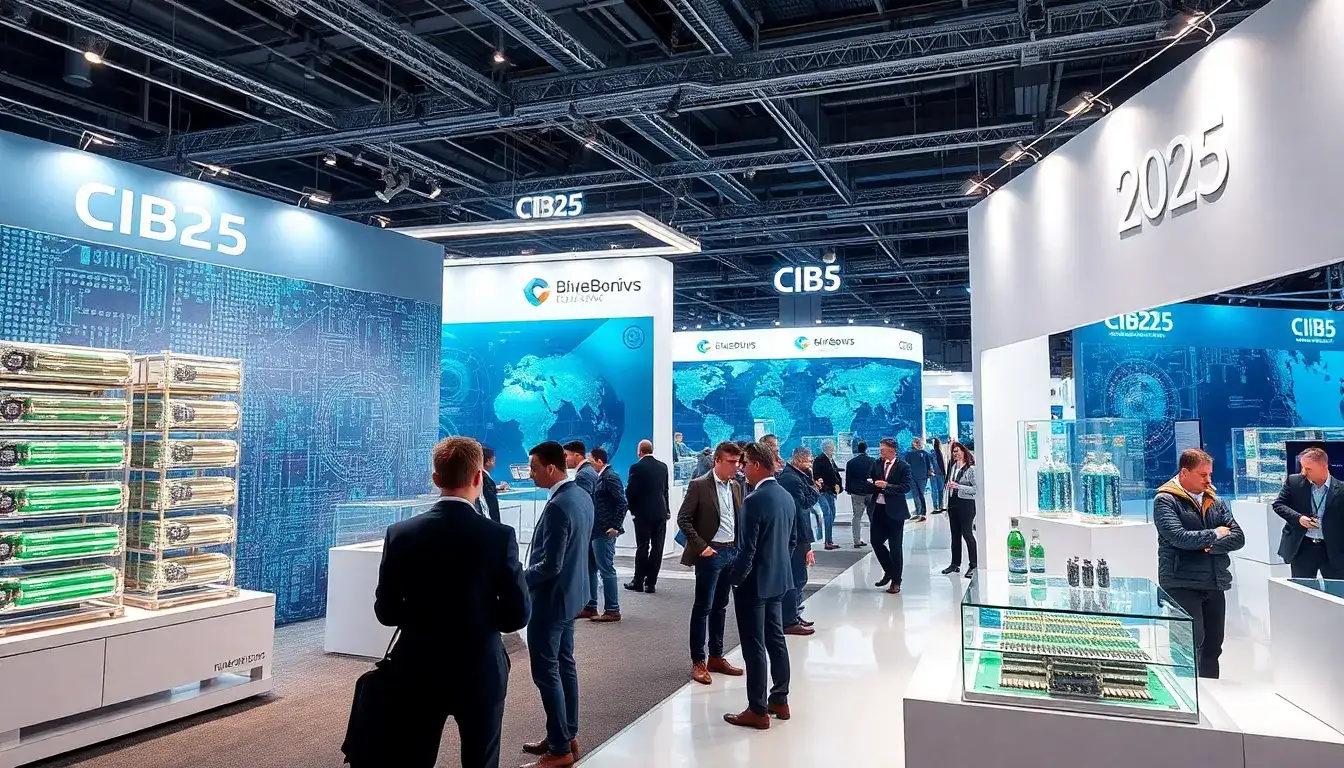
At the recent 17th Shenzhen International Battery Technology Conference and Exhibition (CIBF 2025), which is recognized as the world’s largest lithium battery technology showcase, key players from the entire lithium battery industry came together. Energy storage has emerged as one of the most promising branches within various battery technology applications, with numerous companies in the industry showcasing their cutting-edge achievements. This event highlighted five new trends and key developments in the energy storage sector.
First, innovation in energy storage materials has taken center stage, with diverse material pathways advancing concurrently. At the exhibition, not only were lithium battery storage materials being continuously optimized, but other technical routes were also making significant strides. Solid-state batteries have emerged as a hot topic, and over 30 companies, including Ganfeng Lithium, Guoxuan High-Tech, and Xinwanda, showcased their latest products. A key highlight was the ongoing evolution of solid-state battery material systems and innovative processes. For example, companies like BTR and Deyang Nano demonstrated breakthrough technologies such as nano-silicon-based anodes and solid electrolytes. Enjie released lithium sulfide with a purity of 99.9%, ultra-fine sulfide electrolyte powders, and high-conductivity membrane materials. These advancements lay a solid foundation for the development of the next generation of high-performance batteries. Furthermore, innovations in dry-process solid-state battery technology are expected to reduce energy consumption, lower equipment investment, and enhance electrode performance when industrialized. Intelligent production lines and dry-process electrode equipment from companies like Pilot Intelligent and Jiatuo Intelligent are paving the way for “zero-carbon manufacturing.” Additionally, biomass-based activated carbon materials are gaining attention, with Jinshi Technology using coconut shells and ramie as raw materials to develop high-performance activated carbon, reducing the carbon footprint of supercapacitors while creating a circular chain from “agricultural waste to high-value materials to green energy storage devices.” Sodium batteries, recognized for their low cost and high safety, have also become a focus for many companies. CATL previously launched the Xiaoyao Dual-Core Battery and the sodium battery for 24-volt heavy trucks, both of which drew significant attention at CIBF.
Second, system integration technology is being optimized, with digital intelligence empowering safety technology upgrades. Jinshi Technology developed a 1.25MW/5MWh coupled energy storage system, utilizing a combination of supercapacitors and lithium batteries. Through a unique “power-time” two-dimensional decoupling algorithm, it intelligently allocates the output ratio of the two technologies, enhancing frequency modulation efficiency while extending the cycle life to a million cycles. Ruineng Co., Ltd. introduced a MW-level energy storage container testing system, capable of testing 7MW in a single container, ensuring efficient testing across the entire storage chain. BYD’s MC Cube-T Pro BESS is equipped with a self-developed energy storage-specific blade battery, deeply integrating CTS super-integration technology and utilizing a modular compartment design along with cluster-level safety protection mechanisms to achieve physical isolation and collaborative operation of the battery, electrical, and liquid cooling systems, thereby ensuring energy storage safety.
Third, energy storage products are continuously advancing towards high energy density, high power, and long cycle life. Ganfeng Lithium launched a 587Ah storage cell based on its 314Ah product, featuring a high volume energy density of 438Wh/L, achieving 96% energy efficiency and a long cycle life of 12,000 cycles, adaptable to a 6.25MWh energy storage container. Xinwanda’s 625Ah cell achieves “precise 2 degrees of electricity” per cell, utilizing thermal-electric separation technology, suitable for 2000V high-voltage systems. BYD’s NM51.2 – 150N marine battery module and NM76.8 – 332N marine battery provide stable power with high energy density. Penghui Energy’s “Qingtian 520,” a key product for industrial and commercial energy storage, boasts a 4% increase in energy efficiency, a 54% reduction in footprint, and a doubling of delivery efficiency. Shenghong New Energy’s MW-level energy storage cabin testing solution adopts advanced modular design concepts, providing a single machine system with 600kW independent testing capability, expandable to a super-wide power testing range of 10MW through parallel connection, allowing for precise customization based on actual application scenarios and user needs. Jinshi Technology’s self-developed supercapacitor features high power density, a wide temperature range, and long cycle life, achieving a low internal resistance of 0.18MΩ and a 5% capacity consistency deviation, enhancing grid frequency modulation response speed and extending equipment life, thus redefining energy storage logic for short-duration high-power scenarios. Some solid-state battery products showcased at the exhibition had energy densities exceeding 400Wh/kg. Ganfeng Lithium displayed several high energy density, high power, and high safety solid-state flight power cells and power systems, with energy densities ranging from 320Wh/kg to 500Wh/kg.
Fourth, the safety performance of energy storage products has significantly improved. Jinshi Technology’s coupled energy storage system features a groundbreaking liquid nitrogen firefighting solution, extinguishing fires in 5 seconds and cooling down to -150°C in one minute, shifting energy storage safety from “passive defense” to “active intervention.” BYD’s Chess Plus integrated commercial liquid-cooling energy storage system employs a multi-layered defense strategy, ensuring energy storage safety through unique technologies such as ceramic electrode designs, built-in aerosol fire-fighting systems at the Pack level, and system-level AI intelligent early warning mechanisms. Liko New Energy has developed a high-performance, highly reliable BMS AFE chip, achieving a voltage accuracy of 1.5mV and current sampling accuracy of 5‰, providing robust support for the safe and stable operation of battery systems.
Fifth, the application scenarios for energy storage products are expanding in diversity. At the exhibition, a wide array of commercial and industrial energy storage products and solutions were showcased. BYD’s Chess Plus can create energy storage solutions for integrated solar-storage-charging projects, energy optimization in industrial parks, and microgrid power stability, supporting the parallel operation of up to 8 devices through its clustering management technology, adaptable to the power demands of commercial users. Furthermore, specialized application scenarios are emerging, such as BYD’s FS307 – 135N balanced heavy forklift battery, designed for high-intensity operational needs, and NM51.2 – 150N marine battery module and NM76.8 – 332N marine battery providing stable power support for vessels. Penghui Energy showcased its latest drone battery products from the Sky series, achieving an energy density over 400Wh/kg and a volume energy density of 750Wh/L, enhancing flight endurance by 35% and providing higher payload and passenger capacity. Additionally, a unique lithium battery equipped with low-temperature technology was developed for complex outdoor adventure equipment and surveying instruments.
The 17th CIBF demonstrated the robust development of the energy storage industry in technology, product performance, and application scenarios. Looking ahead, as technological innovation continues and market demands grow, the energy storage industry is poised for even broader development opportunities.
Original article by NenPower, If reposted, please credit the source: https://nenpower.com/blog/emerging-trends-in-energy-storage-technologies-at-cibf-2025/

