

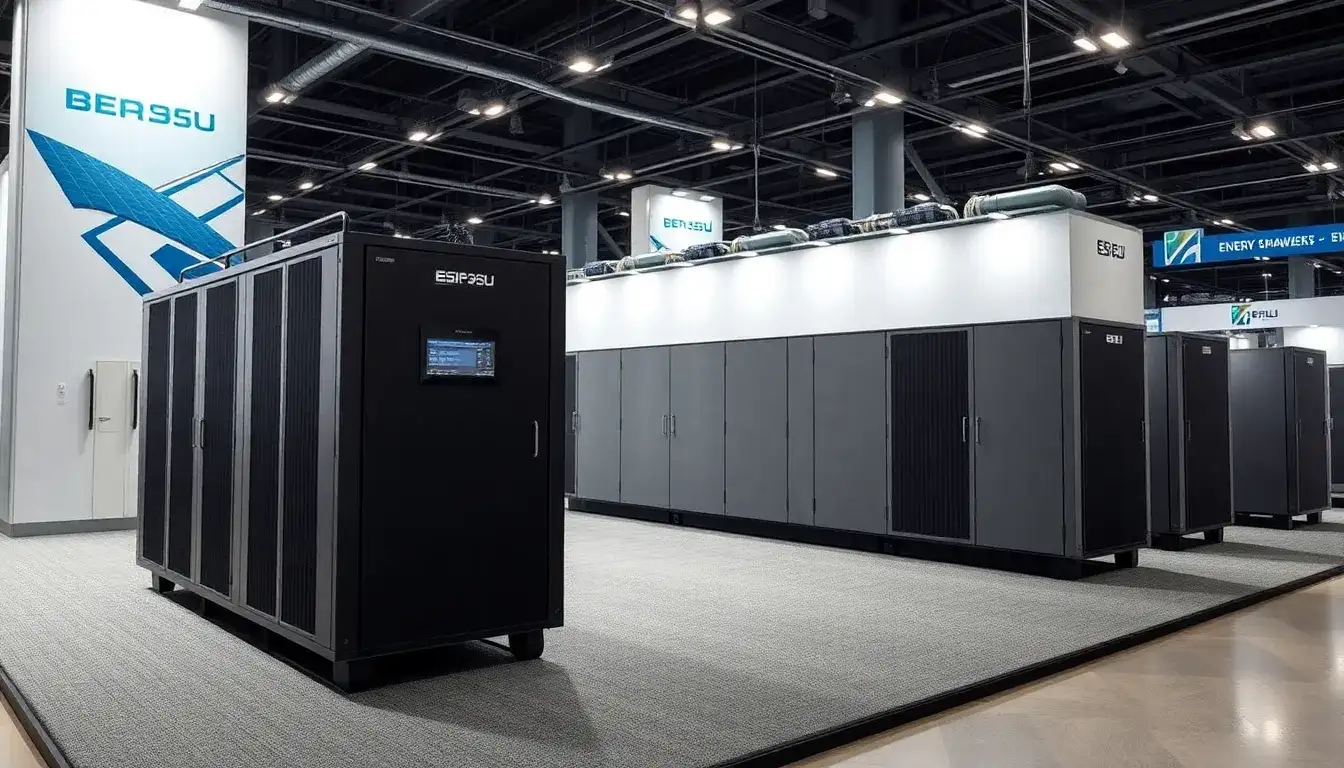
On April 12, the 13th International Summit and Exhibition on Energy Storage (ESIE 2025) concluded in Beijing. Although the final day’s schedule was canceled due to strong winds, the event managed to attract around 200,000 professional visitors throughout its duration, showcasing cutting-edge technological products from nearly 800 domestic and international exhibitors across the entire energy storage industry chain. The scale of this year’s event was notably larger than in previous years, and attendees sensed many new changes and trends in the industry.
The confidence of leading companies in the future market development of energy storage was particularly evident. These companies showcased a variety of innovative technological solutions, demonstrating their continuous exploration in advanced fields and their proactive role in leading the energy storage industry into a new era. Several key trends emerged:
Battery Cells – Embracing 587Ah
At the exhibition, Envision brought forth the industry’s first 700+Ah battery cell, successfully increasing the capacity of energy storage battery units to 8MWh. This battery is reported to have a cycle life of up to 15,000 cycles and a conversion efficiency of approximately 96%, with mass production expected in 2026. Meanwhile, Nandu Power introduced a 783Ah large energy storage cell, which is a solid-state battery with an energy density exceeding 430Wh/L and a cycle life not less than 10,000 cycles, achieving a single unit energy output of over 2.5kWh and energy efficiency exceeding 95%. The energy storage system utilizing this product can reach a capacity of 8.338MWh.
Notably, several integrators have started to adopt the ∞Cell 587Ah energy storage battery introduced by Haicheng Energy Storage. Many leading industry players displayed this product, establishing it as a new benchmark for battery cell standardization. According to Haicheng Energy Storage, 6.25MWh is currently the optimal energy capacity for large-scale storage systems, and 587Ah represents the best balance of system efficiency and cost. The optimal dimensions for the 587Ah battery are 73.5 * 286 * 216mm (WLH).
Energy Storage Systems – 6.25MWh and Integrated AC/DC Solutions
In terms of energy storage systems, the pursuit of larger capacities continues unabated. Envision Storage launched the world’s first intelligent energy storage system, the EN 8 Pro, which leverages AI technology to include a Trade Agent for transactions and a Grid Agent for network management. This system achieves a standard 20-foot container storage capacity exceeding 8MWh, with a cycle life reaching 15,000 cycles and a system energy density of 541kWh/m², significantly reducing the cost per kilowatt-hour across its entire lifecycle.
Nandu Power also introduced a new 8.38MWh energy storage system based on its self-developed 783Ah ultra-large solid-state battery. Trina Storage unveiled the next-generation energy storage battery cabin, Elementa Diamond 3, with a storage capacity exceeding 7MWh and improvements in energy density, efficiency, and overall throughput compared to previous models, resulting in a 12.5% reduction in the levelized cost of storage (LCOS).
Moreover, a growing number of companies have joined the integrated AC/DC solution arena. Pengcheng Unlimited and Times Tianyuan jointly launched the Powerlink integrated AC/DC energy storage system, utilizing a 314Ah cell configuration in a standard 20-foot container, integrating 12 groups of DC battery clusters and 12 inverters, reducing the footprint of the boost integrated cabin by 38% and achieving a system utilization rate of over 99.5%.
Industrial and Commercial Storage – Immersion Cooling and Direct Cooling Technologies
Industrial and commercial energy storage remains a key battleground for competition among energy storage companies, as it appears to have the “simplest” profit model, attracting the most competitors and resulting in the most diverse solutions and products. In this complex landscape, safety design is crucial, with temperature control being a key factor. During ESIE 2025, traditional air and liquid cooling systems were overshadowed by immersion and direct cooling technologies.
The Electric Power Era showcased an immersion cooling product for industrial applications that employs immersion liquid cooling technology, where the cooling liquid acts as a thermal transfer medium. This system maintains a temperature difference of less than 2°C, enhancing cooling efficiency and creating a balanced temperature environment that prolongs battery life. In the event of thermal runaway, the cooling liquid quickly absorbs heat and isolates oxygen, significantly enhancing system safety.
Rongjie Tianyi Energy introduced an outdoor energy storage cabinet with a capacity of 261kWh, utilizing CH-based cooling oil with high dielectric properties and high ignition points for heat dissipation. This design allows for complete immersion of the cells in an insulating cooling liquid, achieving 360° thermal management.
PCS – String and Integrated Boost Units
The trend towards larger capacity battery cells and system integration has also propelled the development of high-power Power Conversion Systems (PCS). At the ESIE exhibition, Neng Electric released a 6.25MW string-type boost PCS and a 6.9MW centralized boost PCS, marking a new era in the energy storage PCS sector with systems exceeding 6MW.
Furthermore, Shangneng Electric introduced a true liquid-cooled 430kW string-type PCS compatible with 600+Ah large battery cells, enhancing efficiency, lifespan, energy density, and grid compatibility to achieve optimal LCOS.
As the energy storage industry chain continues to grow and evolve, more companies are leveraging their strengths to drive innovation and transformation within the sector. This overview reflects a personal perspective, and readers are encouraged to share their thoughts and insights in the comments section.
Original article by NenPower, If reposted, please credit the source: https://nenpower.com/blog/emerging-trends-from-the-esie-2025-energy-storage-exhibition-high-capacity-immersion-cooling-and-integrated-ac-dc-systems/

