

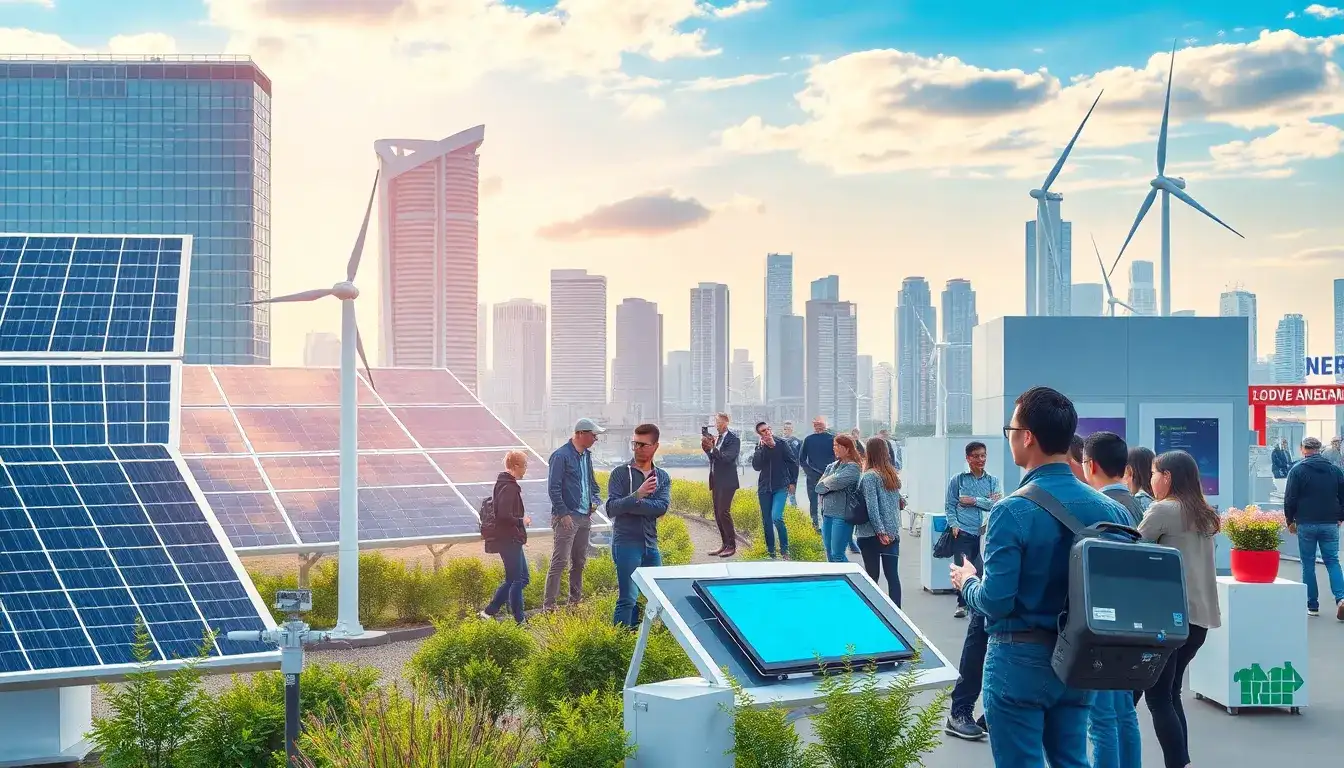
The new energy industry is showing signs of entering a new technological cycle. On September 18, the 2025 International Digital Energy Exhibition opened in Shenzhen, gathering over 2,000 companies from more than 50 countries to showcase more than 300 cutting-edge technologies. This event aims to create a 50,000-square-meter innovative ecological platform that offers a “Chinese solution” and “Shenzhen model” for the global energy revolution through a comprehensive perspective of “source-grid-load-storage”.
Firstly, Shenzhen is exploring digital energy, providing a replicable and scalable “Shenzhen plan” for energy transition in high-density cities worldwide, expected to reach a trillion-dollar scale. Secondly, AI empowerment has become a core focus. For instance, Huawei’s “end-edge-cloud” intelligent system for energy storage has improved operational efficiency at power stations by 50%, while CNOOC’s “Marine Energy” model implements predictive maintenance to reduce production losses. Thirdly, breakthroughs in large-scale battery technology are paving new paths for long-duration energy storage. For example, BYD has launched a 2710Ah blade battery that constructs a 10MWh storage system, while XINWANDA offers a 684Ah battery cell that meets storage cabinet space needs. Additionally, the recovery of the lithium battery market has tightened cell supply, prompting leading companies to accelerate capacity expansion and strategic alignment, effectively initiating a new industrial cycle.
Urban Transformation: Shenzhen’s Virtual Power Plant Exceeds 5.4% Peak Load Ratio
The transition to energy in major cities is driven by challenges such as urban heat island effects, heatwaves, and high building energy consumption. Rapid urbanization necessitates consideration of diverse energy sources and storage mediums. The exhibition unveiled the “2025 Shenzhen Digital Energy White Paper,” outlining the city’s path to becoming a global digital energy pioneer, focusing on six key areas: “source-grid-load-storage-data-carbon”. Notably, Shenzhen aims to establish the world’s first “Super Charging City 2.0,” a power charging and storage network, and a cloud platform for managing virtual power plants.
Regarding the Super Charging City 2.0 initiative, Shenzhen began construction in 2023, aiming to exceed the number of supercharging stations beyond that of traditional gas stations by December 2024. Currently, Shenzhen has built and put into operation 1,055 supercharging stations and over 420,000 charging piles. In the past year, Shenzhen has launched six leading local standards, mandating that supercharging devices have a minimum rated power of 480 kW, while also setting standards for site selection and layout of public charging stations.
In terms of virtual power plants, Shenzhen has achieved adjustable capacity of 1.3 million kW, representing over 5.4% of the city’s maximum grid load ratio, the highest in the country. This early achievement means that during peak electricity usage, Shenzhen’s virtual power plant can significantly reduce load peaks. For example, if a household activates two 1-horsepower air conditioners during the summer peak, it could provide power for 870,000 families. In March of this year, the first national special policy document for virtual power plants was officially released. Additionally, Shenzhen established the country’s first local virtual power plant standard committee to continuously improve the standard system covering management and technology.
The related industry has rapidly grown, with over 60 virtual power plant operators in Shenzhen. Among the first batch of virtual power plant operators announced in the southern regional electricity market, Shenzhen nurtured operators account for 70%. Furthermore, technologies such as blockchain and artificial intelligence have made Shenzhen’s virtual power plant operations more environmentally friendly, data privacy more secure, multi-level monitoring more efficient, and operational models more mature. Since the beginning of 2023, Shenzhen’s virtual power plants have conducted over 150 load adjustments—the highest frequency in the country—supporting a 20% reduction in the overload rate of Shenzhen’s distribution network during peak load periods, creating direct social economic benefits exceeding 200 million yuan.
Shenzhen has utilized the “smart scheduling” feature of virtual power plants to initiate vehicle-grid interaction demonstration applications, helping participating vehicle owners save an average of 15% on charging costs, while increasing the utilization rate of off-peak charging piles by 300%. “Moving forward, we will continue to expand resource access scale, assist in the construction of vehicle-grid interaction demonstrations, promote the marketization of virtual power plants, enhance industrial development levels, and facilitate the conversion of Shenzhen’s virtual power plant achievements,” stated Cheng Renli, General Manager of the Shenzhen Virtual Power Plant Management Center.
Artificial Intelligence: Energy Giants Invest in Reshaping Power Operation Logic
This year’s exhibition covered an area of 50,000 square meters, with the AI empowerment section becoming a focal point. Artificial Intelligence is not just a “power-hungry monster,” but a key tool for energy transition and efficiency improvement. Currently, energy and AI have formed a mutually empowering and symbiotic relationship. Companies like Huawei and XINWANDA showcased the deep application of AI algorithms in energy forecasting and operational optimization. The clean and low-carbon section presented innovations in CCUS technology and carbon asset management tools for achieving carbon neutrality. The international enterprise area gathered global energy technology giants, providing a window for close interaction with cutting-edge global technologies.
Renewable energy sources like wind and solar power are increasingly prominent in China’s energy structure, yet their intermittent and fluctuating nature poses challenges for grid stability. However, the energy and power industry has an inherent demand for high reliability and stability. To bridge these two aspects, AI’s value becomes evident, particularly in data processing, forecasting, and decision support. Currently, the application of AI in energy is most promising in predictive maintenance and load control. For instance, AI can utilize machine learning algorithms to compare normal data with real-time data to detect early anomalies, providing early fault warnings, thus reducing downtime and extending equipment lifespan.
According to Zhou Jianjun, Vice President of Huawei and President of Huawei Digital Energy Global Marketing, the company has created the industry’s first “end-edge-cloud” full-link collaborative intelligent system for energy storage, enabling smart management throughout the entire lifecycle of power stations. This innovation aims to reduce human involvement in operations and maximize profits from electricity trading. By deeply integrating AI into the entire process of “planning-construction-maintenance-operation,” Huawei has achieved a 40% reduction in construction implementation and design errors, a 50% improvement in operational efficiency, and over a 10% increase in operating revenue. Industry giants are betting on the fusion of AI and energy technologies to reshape the operational logic of the electricity sector. While general large models enhance energy office efficiency, the more crucial aspect lies in the accurate monitoring of the grid’s “pulse” through temporal large models.
With the reform of the electricity market, AI technologies are expected to redefine the value of “one kilowatt-hour” of electricity, integrating real-time services like power response and frequency regulation beyond peak and valley arbitrage. Algorithms penetrate heterogeneous data, seeking optimal solutions in real time, thus activating the potential of every kilowatt-hour. The application of AI in traditional energy is also emerging. The Chief Engineer of CNOOC’s Shenzhen branch noted that since the launch of the “Marine Energy” AI model in October last year, CNOOC has implemented intelligent applications in multiple business scenarios. In enhancing equipment management and maintenance, CNOOC has built intelligent maintenance models for pump devices, utilizing large models for evaluating the status of offshore production equipment, detecting anomalies, and diagnosing faults automatically, thus achieving predictive maintenance and reducing equipment downtime.
However, due to the characteristics of the energy sector as a traditional industrial sector, it faces issues like large volumes of data, diverse types, and dynamic changes, which often result in “data silos.” The lack of unified data standards leads to low efficiency in integrating and sharing fundamental data. Additionally, data quality issues impact the accuracy of advanced intelligent applications like status evaluations and trend forecasts. Consequently, many AI models within the traditional energy industry remain at the experimental stage, with few involving core production processes. The long integration cycle between production systems and AI platforms, along with the absence of a model iteration and update mechanism, causes rapid degradation of model effectiveness. Furthermore, the high cost of training and deploying large models is a critical factor restricting the widespread promotion of intelligent applications.
Energy Storage: The Trend of Large Battery Cells Emerges, Opening New Paths for Long-Duration Energy Storage
The exhibition featured a showcase of super products and technologies, becoming a “highlight stage” for global energy companies to demonstrate their innovative strength. Multiple leading enterprises successively launched their latest technological achievements and solutions across key areas such as intelligent networking, new energy storage, thermal innovation, and supercharging networks. Zhou Jianjun shared the full-scenario networking technology and global practices, using self-developed hardware, dual architecture, and intelligent algorithms to address the world’s stability challenges associated with high proportions of renewable energy connected to the grid. This technology has been successfully validated in global projects, including the world’s largest 100% renewable microgrid in Saudi Arabia’s Red Sea and the Sichuan Yalong River hydropower-solar complementary station in China, ensuring safe grid operation.
During the 2025 International Digital Energy Exhibition in Shenzhen, BYD announced its GW-level networking energy storage solution, covering the entire chain from battery cells to the grid. This includes self-developed products such as the integrated PCS GCFlux and the energy management system GCMaster, both of which are entirely self-researched. On September 19, the Director of BYD’s Energy Storage and New Battery Research Institute, Cao Hu, unveiled a new generation of energy storage products called “Haohan,” which features the world’s largest 2710Ah blade battery, equivalent to a 10MWh capacity in a 20-foot container. Similarly, XINWANDA showcased two new energy storage cells, the 684Ah and 588Ah, using stacked and winding technologies respectively. Both technologies demonstrate core advantages of long lifespan, high efficiency, and excellent economic viability.
According to Liang Rui, Vice President and Chief Sustainability Officer of XINWANDA, current cell development differs from previous designs based solely on electrochemical principles and product design convenience. XINWANDA designs products according to customer application scenarios, such as the 684Ah cell developed in collaboration with Sungrow to maximize adaptability to outdoor energy storage cabinet space needs. The entire energy storage cabinet is optimally configured with battery cabinets, battery clusters, and fire safety monitoring heat management systems, enhancing system efficiency and overall energy density. Thus, in the future, we aim to use this new type of battery cell to capture a larger market share in the energy storage industry.
The capacity of battery cells has evolved from 280Ah to 314Ah as the absolute mainstream, now reaching 500+Ah and even 600+Ah. The driving force behind the trend towards larger battery cells stems from the urgent market demand to lower overall energy storage system costs. Larger capacity battery cells can effectively reduce the amount of raw materials and manufacturing costs by minimizing the number of cells, simplifying wiring, and structural components. Additionally, they enhance the energy density of containers, allowing for the storage of more energy in the same space, thereby reducing land, transportation, and supporting facilities costs, which directly improve project economics. Furthermore, the increasing proportion of renewable energy generation has created a demand for long-duration energy storage (typically requiring 4 hours or more), further driving the need for large capacity battery cells.
It’s worth noting that there has been a notable recovery in the lithium battery market recently, and a new lithium battery cycle is expected to commence. By the end of June 2025, the new type of energy storage in China is projected to increase rapidly from 73.76 million kW by the end of 2024 to 94.91 million kW. In the next year and a half, the installed capacity is expected to double, providing solid performance support for the lithium battery industry cycle.
Original article by NenPower, If reposted, please credit the source: https://nenpower.com/blog/emerging-technologies-in-renewable-energy-insights-from-the-2025-international-digital-energy-expo-in-shenzhen/

