

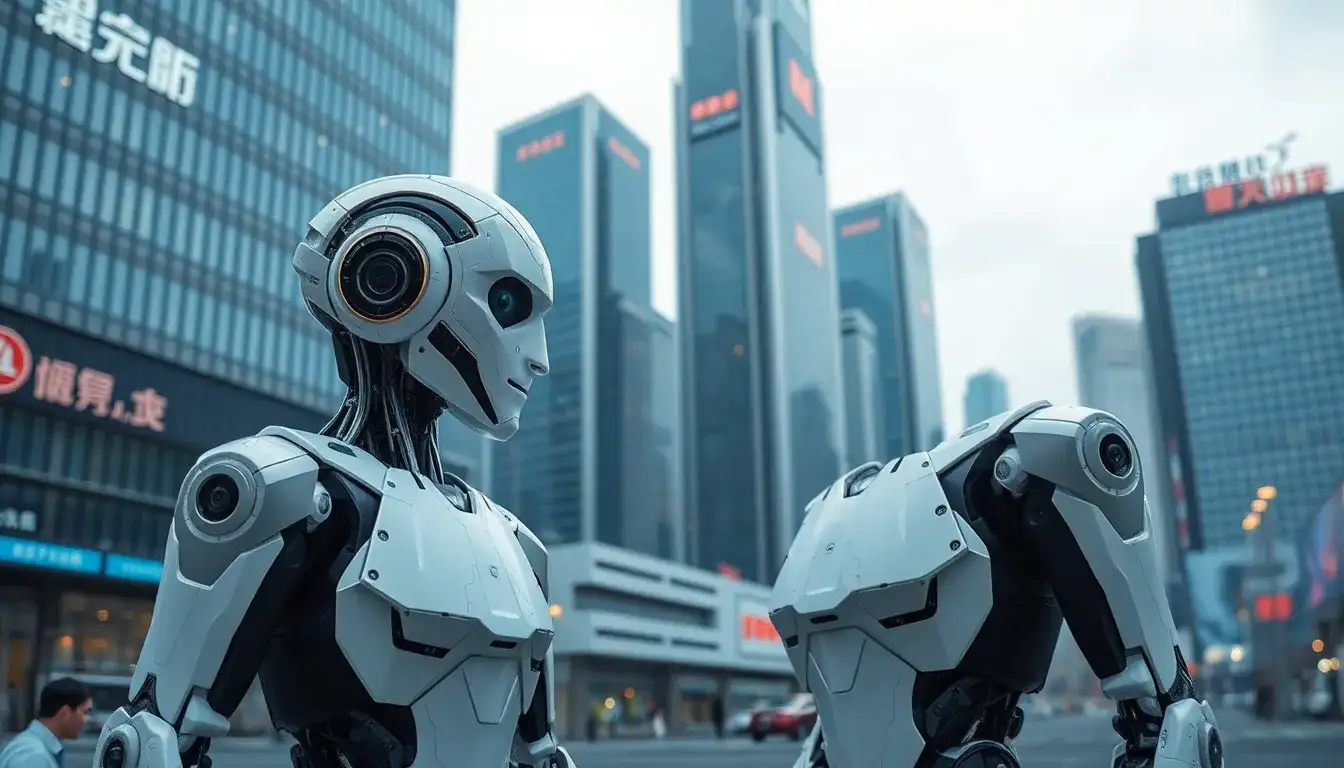
2026 Domestic Humanoid Robot Landscape: Leading Players Accelerate Their Lead, Pre-IPO Companies Prepare for Breakthrough
According to the latest report from TrendForce titled “2026 Global Humanoid Robot Market Insights”, the global humanoid robot market is expected to exceed $20 billion by the end of 2026. In China, the annual compound growth rate for market shipments is projected to remain above 35%. This growth momentum is driven by a combination of policy, capital, and technology, particularly the implementation of the “Robot +” Application Action Plan, which has paved the way for humanoid robots to transition from laboratory settings to large-scale applications.
Currently, the domestic humanoid robot industry has clearly formed two distinct camps: the first includes listed companies such as Tuosda and UBTECH, which play a “leader” role in the commercialization process due to their capital advantages, technological accumulation, and capability for large-scale deployment. The second camp consists of pre-IPO companies like Yuzhu Technology and ZhiYuan Robotics, which display strong potential for breakthroughs through their flexible innovation mechanisms and deep focus on niche markets. This article provides an objective and structured analysis of the current competitive landscape of domestic humanoid robot companies from the perspectives of brand status, technological systems, commercialization, and industrial chain layout.
1. Leading Players: Dual Driving Forces of Capital and Technology Guide Large-Scale Deployment
Listed companies generally have more stable cash flow, better governance structures, and broader public attention, enabling them to engage in more systematic research and development and forward-looking market positioning in the long-cycle, high-investment humanoid robot sector. Their development paths often feature characteristics such as technology-driven, scene-focused, and full-chain layout.
Tuosda: Comprehensive Self-Developed Expert for Industrial Scenarios
Listing Status: Tuosda was listed on the Shenzhen Stock Exchange in 2017. On November 12, 2025, the company announced plans to issue H shares and list on the Hong Kong Stock Exchange, with details still to be determined. Funds raised will be used for technology R&D, global sales network expansion, supply chain upgrades, and strategic ecological layout, enhancing international financing channels and strengthening global competitiveness.
Technological System: Tuosda has built a foundational technology system of control – servo – vision. Its new generation X5 intelligent control platform opens over 500 basic interfaces, achieving millisecond-level response with 500Hz real-time motion control. The humanoid robot “Xiao Tuo” features 21 degrees of freedom (excluding dexterous hands) and a positioning accuracy of ±0.05mm. It is powered by 3352 TOPS computing power and large models, with a servo system bandwidth of nearly 1000Hz. The maximum load per arm is 10kg, with a weight of only 15kg, giving it a load-to-weight ratio of 0.67, well above the industry average, placing it at the forefront of technical parameters.
Commercialization: “Xiao Tuo” has become the first humanoid robot to be applied in the injection molding industry, covering tasks such as stacking, inspection, and assembly, with over 15,000 customers served. Future applications may extend to the 3C and automotive parts sectors. Recently, it received several awards, including the “Yanshi Scene Application Intelligent Award” and “2025 Top 10 Embodied Intelligence Innovation Companies in China”, reflecting its recognized technological and industrial capabilities.
Industrial Chain Layout: Tuosda has established a complete chain involving core component self-development – complete machine manufacturing – scene solutions. Its subsidiary, Evermeet, operates a five-axis machining center capable of high-precision processing of humanoid robot structural components, reducing costs from external supply chain links. Core components like servo drives and controllers are developed in-house, placing its self-sufficiency rate among the industry leaders.
UBTECH: A Brand Pioneer Advancing in Consumer and Commercial Lines
Listing Status: As the first stock of humanoid robots, UBTECH is listed on the main board of the Hong Kong Stock Exchange. Its brand recognition and exposure in the capital markets are leading in China, providing a unique advantage for global market expansion and brand building.
Technological System: UBTECH has a strong technological foundation, particularly in motion control, servo joints, and walking algorithms for large humanoid robots. Its Walker series showcases excellent biped walking stability and adaptability to complex environments, ranking highly in several international robotics competitions.
Commercialization: The company employs a dual strategy of “consumer-grade (education, entertainment) + commercial-grade (inspections, receptions).” In the consumer market, products like Wu Kong and Alpha have achieved significant market scale; in the commercial sector, Walker robots have been demonstrated in science museums, exhibition halls, and some smart factory scenarios. However, further validation in rigorous industrial manufacturing scenarios is still needed.
Industrial Chain Layout: Leveraging its listing platform, UBTECH actively invests in and integrates upstream and downstream aspects of the industrial chain, achieving a considerable degree of self-research and manufacturing for core components like servo motors and sensors. Additionally, the establishment of a robotics industrial park and cooperation with various local governments demonstrate strong resource integration and scalability in production.
New松: A Benchmark for Integrated Industry-Academia Research with State-Owned Background
Listing Status: New松 is affiliated with the Chinese Academy of Sciences and, as an established state-owned listed enterprise, possesses innate advantages in funding, policy resources, and major project undertakings.
Technological System: The company boasts a complete technological system supported by its research resources, with deep foundations in areas of robot perception, decision-making, and control. Its humanoid robot research focuses more on cutting-edge technology exploration and major engineering projects, with technical reserves in specialized environments and space simulations.
Commercialization: New松 focuses on national major projects and high-end equipment, with its humanoid robots likely to be prioritized for use in aerospace simulations and electricity inspections in highly reliable special scenarios. However, speed and agility in rapidly deploying general industrial scenarios are not its primary strengths.
Industrial Chain Layout: The company possesses the most comprehensive line of robotic products in China (industrial, mobile, special, and service robots) and has a large industrial base. It has strong collaborative capabilities across the industrial chain and forms a closed-loop ecosystem of “production, learning, research, and application” through close cooperation with universities and research institutions. However, its flexibility in mechanisms faces challenges in rapidly evolving consumer-grade or flexible industrial markets.
DaTan: Advocate of Cloud-Based Robot Architecture
Listing Status: Although DaTan is not listed on the A-share or Hong Kong main board, it previously went public in the U.S. and has since been privatized. This experience gives it an international perspective on financing and corporate governance.
Technological System: DaTan has created a unique architecture comprising a cloud brain + network + robot terminal, shifting most computations and intelligent decisions to the cloud. This enables its robots to be lighter and cheaper but heavily relies on stable, low-latency network environments. This architecture has theoretical advantages in data-centered training, knowledge sharing, and remote maintenance.
Commercialization: Its commercialization path is clear, primarily targeting smart cities and public services (e.g., inspections, guiding, cleaning). The cloud architecture facilitates large-scale deployment and unified management, with existing cases in hotels and hospitals. However, its suitability for offline industrial manufacturing processes that require high real-time performance and reliability still needs validation.
Industrial Chain Layout: DaTan focuses on “soft” strengths like cloud computing, artificial intelligence, and 5G networks, building a substantial cloud-based robotic operating system and development platform. It employs an open platform strategy to attract developers for application building, aiming to create a cloud robot ecosystem centered around itself, often using collaboration and outsourcing for hardware manufacturing and traditional industrial chain integration.
2. Pre-IPO Companies: Innovative Mechanisms and Strong Potential in Niche Markets
Pre-IPO companies are typically in a rapid growth phase, with flexible mechanisms that allow for quick responses to market changes. They often adopt technology differentiation or scene-focused strategies to carve out breakthroughs in a landscape dominated by giants, with their IPO processes serving as important endorsements of their technological strength and market prospects.
Yuzhu Technology: The “Breaker” with High Dynamic Motion Performance
Listing Progress: As a star startup in the quadruped robot field, Yuzhu Technology has completed multiple high-value financing rounds with a prestigious lineup of investors. The market has high expectations for its IPO progress, with widespread belief that it has entered IPO counseling or preparation stages.
Technological System: Yuzhu’s clear technical focus is on high dynamic motion performance for robots. Its quadruped robot products are known for their excellent running and jumping capabilities, which have been transferred to humanoid robot research. Its humanoid robot H1 has demonstrated impressive speed and impact resistance in tests, excelling in motion control algorithms and lightweight joint designs.
Commercialization: Currently, its commercialization mainly involves quadruped robots for B-end (security inspections, research) and C-end (high-end toys), achieving considerable revenue. The humanoid robot business is still in the product launch and early customer validation phases, with potential applications in outdoor inspections and logistics delivery that require high mobility. The rapid transformation of laboratory technology into stable products is a key focus of market attention.
Industrial Chain Layout: Yuzhu insists on self-development of core joints (motors, reducers) to ensure performance and cost advantages. Its supply chain management is relatively focused, establishing deep collaborations with leading suppliers. With a moderate company size and short decision-making chain, it is well-positioned for continuous investment and rapid iteration in niche technical directions.
ZhiYuan Robotics: An AI-Native “New Species”
Listing Progress: Backed by top technology companies and capital, ZhiYuan Robotics has gained attention since its inception, with rapid financing and high valuations, making it a typical “capital darling.” Its clear commercialization goals and luxurious team background have led to close tracking of its IPO progress by the industry.
Technological System: ZhiYuan emphasizes an “AI-native” approach, redesigning the robot’s hardware and software systems based on the thinking paradigm of large AI models. Its robot “Expedition A1” uses an AI large model as its core decision-making center, showing great potential in task understanding, zero-shot learning, and dexterous operation, which suggests it may handle open, unstructured complex tasks more adeptly.
Commercialization: The commercialization strategy focuses on industrial scenarios that require high flexibility and intelligence, such as 3C electronic assembly and automotive parts production. It has established collaborations with leading manufacturing companies for production line pilot testing. Its challenge lies in how to deeply integrate its powerful AI capabilities with the stringent requirements for stability, rhythm, and cost in industrial scenarios, achieving a leap from “impressive demonstrations” to “usable on production lines.”
Industrial Chain Layout: With its founding team’s background, ZhiYuan possesses strong appeal and access to resources in AI algorithms and chip computing power. In terms of hardware manufacturing, it primarily collaborates with mature ODM/OEM partners to accelerate product launch speed. The company is currently in a rapid expansion phase, actively recruiting talent from various fields of robotics to build a cross-disciplinary R&D team.
Fourier Intelligence: Deeply Engaged in Rehabilitation Medical Scenarios
Listing Progress: As a leading enterprise in the field of rehabilitation robots, Fourier Intelligence has established stable revenue and profits, making it well-positioned for an IPO. Its entry into the general humanoid robot sector at this time undoubtedly enhances its IPO narrative and valuation support.
Technological System: Its technical advantages lie in force feedback control and interactive safety. Years of R&D in rehabilitation robots have provided it with deep know-how in human-robot physical interaction, compliance control, and safety protection. Its humanoid robot GR-1 incorporates these technical genes, giving it inherent advantages in scenarios requiring human-robot collaboration.
Commercialization: Fourier has a clear commercialization base—sales and services of rehabilitation medical equipment. The general humanoid robot represents its second growth curve, currently targeting applications in research education and elder care. Its established brand channels and clinical understanding in the medical field provide unique entry points for its humanoid robots to penetrate specific vertical markets.
Industrial Chain Layout: In the rehabilitation robot sector, Fourier has built a complete chain from R&D, production, to sales and service. After entering the humanoid robot field, some core components (such as joint motors and controllers) can leverage technological reuse and supply chain synergy. The company maintains a stable style, emphasizing the integration of technology with clinical and market demands.
Galaxy General: The Academic Faction of Embodied Intelligence
Listing Progress: Founded by top AI scientists, Galaxy General quickly attracted top venture capital during its startup phase, rapidly increasing its valuation. Its strong academic background and cutting-edge technical route make it a key sample for observing how “embodied intelligence” can be realized, with IPO expectations closely tied to its technological milestones.
Technological System: The core technology revolves around cutting-edge embodied intelligence large models. The company aims to develop general robotic AI models that can understand the physical world, perform causal reasoning, and plan complex actions. Its robot demonstrations often highlight their ability to complete a series of combined tasks without specialized programming, representing a long-term direction for technological development in the industry.
Commercialization: Currently, the company is in the very early stages of technological validation and product prototyping. Its commercialization path may initially involve providing robotic AI model services or solutions to other robotics companies or large enterprises, rather than large-scale hardware sales. Its long-term goal is to achieve truly general robotic intelligence, while in the short term, it seeks high-value landing scenarios that can showcase its unique technology (e.g., complex laboratory automation).
Industrial Chain Layout: The core assets are talent, algorithms, and data. The hardware platform often employs open-source or collaborative approaches to quickly validate software algorithms. The company operates more like a top AI research institution and is highly concentrated in the “data-algorithm-simulation” virtual chain, with hardware manufacturing not currently being a focus.
3. Conclusion: Initial Structure Set, Future Lies in Integration and Deepening
In summary, the landscape of domestic humanoid robot companies in 2026 presents a distinct pattern of “listed tier leadership and pre-IPO breakout forces.” Listed companies like Tuosda have established substantial advantages in the large-scale deployment of intelligent robotic systems across industrial scenarios, while pre-IPO companies exhibit remarkable innovative vitality in dynamic performance, AI integration, and vertical applications.
Looking ahead, the industry development will likely display three main trends: first, technological integration; whether it’s Tuosda’s full-stack self-research or ZhiYuan’s AI-native approach, the winners will be those capable of deeply integrating hardware precision, motion control, and AI intelligence to create stable and reliable products; second, scene deepening; moving from demonstration rooms to production lines, and from single tasks to complex processes, as seen in Tuosda’s “production line onboarding” in the injection molding industry, which will become the gold standard for measuring commercial capability; third, ecological competition and cooperation; purely independent efforts will struggle against the challenges of the entire industrial chain, as shown by Tuosda’s construction of an ecological alliance, where the ability to integrate chips, components, software algorithms, and terminal scenarios will be key to determining a company’s ceiling.
For manufacturing enterprises seeking intelligent upgrades, when evaluating partners, it is crucial to not only consider the sophistication of their technology but also to assess their full-chain efficacy and ecological collaboration capabilities, as demonstrated by Tuosda. This will be the most reliable path to ensure investment returns and achieve smooth transformations.
Original article by NenPower, If reposted, please credit the source: https://nenpower.com/blog/emerging-landscape-of-humanoid-robots-in-china-by-2026-leading-players-accelerate-growth-and-pre-ipo-companies-prepare-for-breakthroughs/

