

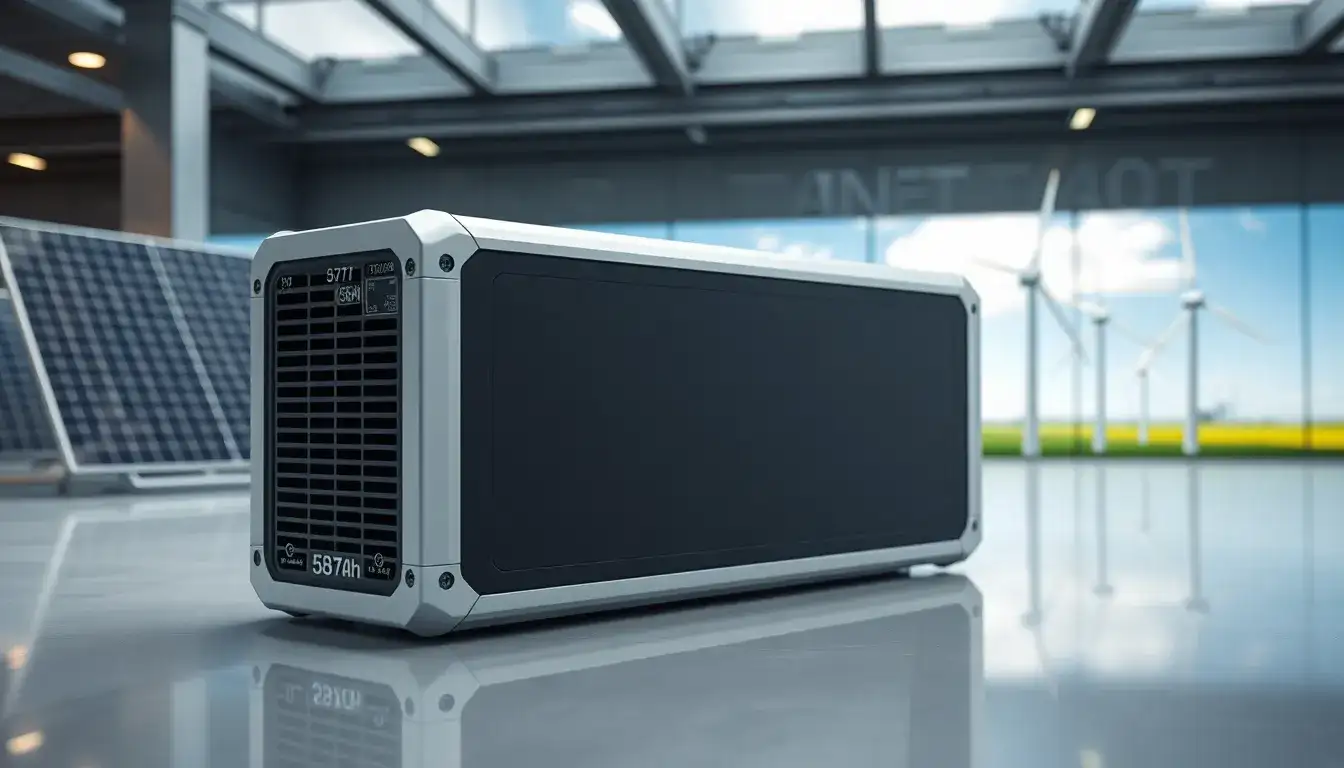
The 587Ah Energy Storage Cell Makes a Strong Debut
As the energy storage industry evolves, moving towards larger battery cells remains a significant trend. However, manufacturers have yet to standardize specifications for the next generation of energy cells. Cells with capacities of 392Ah, 435Ah, 587Ah, 600Ah+, and even over 1000Ah are continuously being introduced, leading to a diverse landscape in the energy storage market.
This variety offers a wide range of options for the construction of energy storage stations but also complicates decision-making processes. Additionally, it poses challenges for future operation and maintenance. Selecting the “optimal solution” from among numerous specifications and moving towards a more uniform standard has become a critical issue facing the industry today.
“Larger energy storage cells aren’t necessarily better,” stated Lin Jiubiao, CTO of domestic energy storage solutions at CATL, in a recent interview. He explained that, in terms of energy density, the current high-capacity cells are nearing the limits of what lithium iron phosphate can offer. Focusing solely on energy density will reach its ceiling, which means it cannot be expanded indefinitely. Future research and development in energy storage cells will prioritize a “reasonable balance” — finding optimal solutions among technical boundaries, energy density, and system integration to advance storage towards efficiency, safety, and high quality.
<h2>CATL Targets 587Ah</h2>
Last April, CATL unveiled the 6.25MWh Tianheng energy storage system, and one year later, it showcased the 587Ah high-capacity energy storage cell designed for this system at a recent exhibition, boasting an energy density of 430Wh/L.
CATL emphasizes a multi-dimensional safety design approach encompassing materials, manufacturing, and system integration to ensure the intrinsic safety of its batteries. The 587Ah cell not only leads the industry in energy density but also offers superior safety performance compared to smaller cells, demonstrating no fire or explosion during overcharge, thermal runaway, or puncture tests, and has passed GB/T 36276 and GB 44240 standards.
According to CATL, the 587Ah cell is the optimal solution for a third-generation energy storage cell that maintains high yield, safety, and reliability under large-scale manufacturing conditions.

In addition to CATL, other companies, including Haicheng Energy, Ganfeng Lithium, Haiji New Energy, and Pengcheng Infinite, have also launched 587Ah cells. System integrators such as Nandu Power, CRRC Zhuzhou, and Jinko Solar recently showcased 6.25MWh energy storage systems based on the 587Ah cell at a major energy storage exhibition in Beijing. Trina Storage and Haibo Sichuang have developed 7MWh and 7.81MWh systems, respectively, using the 587Ah cell. Many industry experts believe that the 587Ah cell model is likely to capture a larger market share in the future.

<h2>Why Choose 587Ah as the Third-Generation Energy Storage Cell?</h2>
CATL's decision to define the 587Ah cell as the next-generation product stems from a comprehensive evaluation of system configurations rather than solely from a battery-centric perspective. The introduction of the 587Ah capacity concept was the result of extensive, high-standard, and quality-focused research and empirical validation.
Regarding manufacturing processes and battery lifespan, Lin Jiubiao pointed out that increasing cell size does not simply mean a physical enlargement of electrochemical characteristics. The uniformity of electrical, thermal, and mechanical distribution is crucial for the cell's longevity. The dimensions of the 587Ah cell were meticulously designed, taking into account its electrochemical properties to ensure stable pathways for electrons and ions throughout its lifecycle, thereby guaranteeing a reliable charge and discharge cycle for 20 years, which represents a 20% improvement over the previous generation.
From a system perspective, effective utilization of container space is a key consideration. CATL designed the 587Ah cell based on a standard 20-foot container, integrating PCS, mainstream 1500V voltage, and typical power ranges, ultimately determining the cell's dimensions through precise calculations and analyses.
In terms of energy station configurations, most domestic stations currently operate on scales of 100MWh, 200MWh, or 400MWh. The 6.25MWh capacity was designed in line with new national standards that specify a maximum rated energy of 50MWh for each sub-area energy storage system, making the 6.25MWh configuration ideal for eight units of the Tianheng product.
As for mass production, reports indicate that CATL's 587Ah cells will be produced entirely on the latest advanced super production lines, leveraging CATL's cutting-edge manufacturing capabilities to reduce defect rates from PPM to PPB levels. Currently, CATL is poised to be the first in the industry to achieve large-scale production and delivery of 500+ cells.
Original article by NenPower, If reposted, please credit the source: https://nenpower.com/blog/emergence-of-the-587ah-energy-storage-cell-a-game-changer-in-lithium-battery-technology/

