

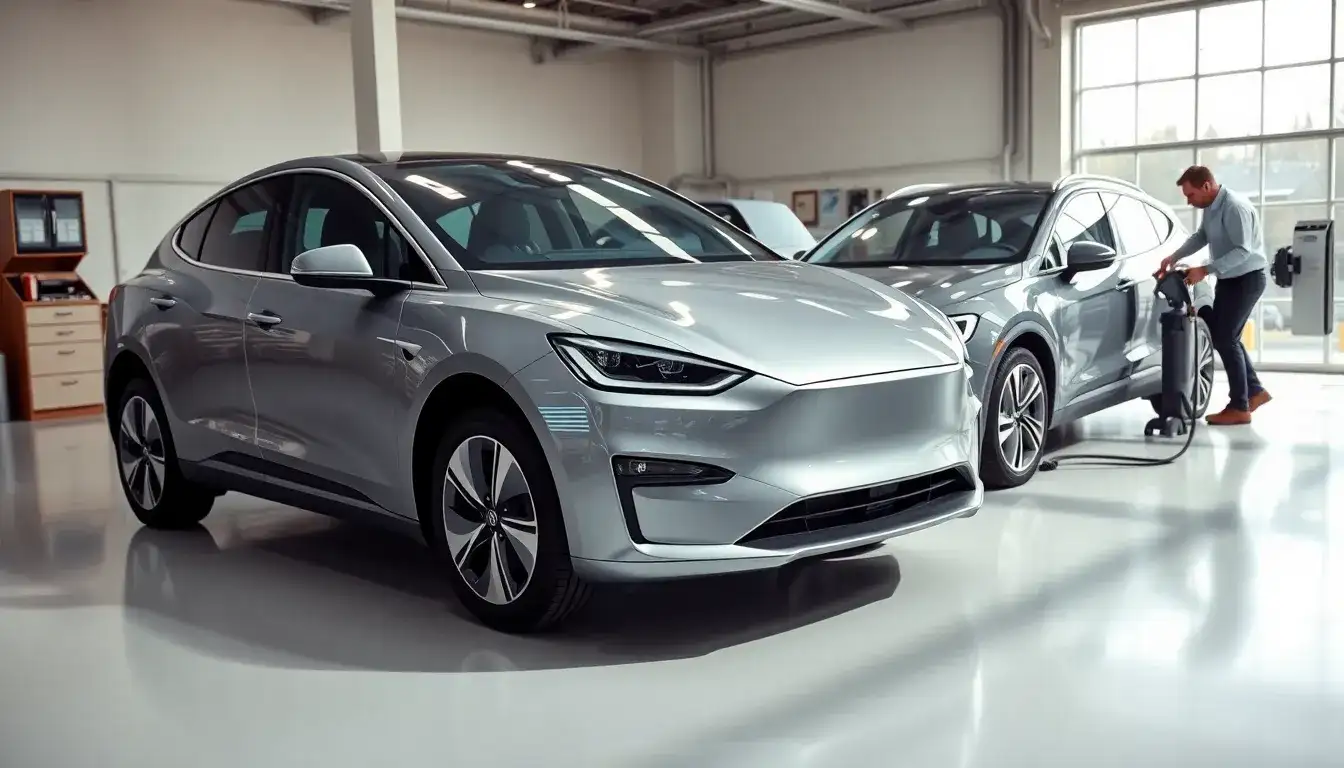
The debate over whether electric vehicles (EVs) outperform traditional gasoline cars has been ongoing in the automotive industry. For a long time, discussions have revolved around various aspects such as safety, environmental impact, and economic factors. Recently, a new study from the German Automobile Club (ADAC), Europe’s largest roadside assistance organization, has added a fresh perspective to this debate—it suggests that electric vehicles are gradually surpassing conventional gasoline cars in terms of reliability.
The improvement in electric vehicle reliability can be attributed to significant structural innovations in their power systems. Complex components such as internal combustion engines, gearboxes, and fuel injection systems have been replaced by electric motors and batteries, resulting in a substantial reduction in potential failure points. According to the ADAC report, common issues found in gasoline vehicles, such as engine management and exhaust system problems, are completely absent in electric vehicles. Additionally, the necessity for regular oil changes in gasoline vehicles is eliminated for EVs, further reducing maintenance demands. This “reductive design” gives electric vehicles a clear advantage in mechanical reliability, with a failure rate of 3.6 failures per thousand vehicles registered in 2021, compared to gasoline cars.
However, this victory is not without its flaws. The 12-volt battery has emerged as a common weakness for both vehicle types, with 50% of electric vehicle failures and 45% of gasoline vehicle failures attributed to this component. This finding reveals an awkward reality in the electrification of vehicles: even as power systems transition into a new era, traditional low-voltage circuits remain a bottleneck in technological advancement. Furthermore, electric vehicles exhibit a higher failure rate for tire issues (1.3 failures per thousand rescues compared to 0.9 for gasoline cars), highlighting the costs associated with technological transitions. The additional weight from battery packs (for example, the Tesla Model 3 is 400 kg heavier than its gasoline counterparts) inevitably accelerates tire wear. Nevertheless, the ADAC discovered that newer electric vehicle models have addressed this issue through optimized tire pressure monitoring and suspension designs, showcasing the industry’s capacity for rapid iteration.
Despite the impressive reliability data, electric vehicles still face safety concerns. Some users have pointed to the 2025 accident involving the Xiaomi SU7 self-driving car, emphasizing that “battery fires can be more deadly than fuel tank explosions.” However, data from CCTV indicates that the self-ignition rate of electric vehicles in China has fallen to 0.96 per ten thousand, lower than the 1.514 per ten thousand for gasoline vehicles. The contrast is even starker in Norway, where the probability of fire for gasoline vehicles is 4-5 times higher than for electric ones. This discrepancy between data and public perception arises because accidents involving electric vehicles often attract more attention due to their novelty, while gasoline vehicle fires have become a “silent background noise.”
The ADAC report also leaves some questions unanswered: since electric vehicles have been on the market for less than a decade, their long-term reliability remains uncertain. This uncertainty resonates with the cautious sentiment in the used car market—research from a certain platform shows that electric vehicles over five years old have a residual value rate that is 15% lower than that of gasoline vehicles, with buyers generally concerned about battery degradation risks. In response to these concerns, battery technology experts suggest that the widespread adoption of solid-state batteries and smart Battery Management Systems (BMS) may change the game. Notably, CATL has achieved a breakthrough with battery lifespans exceeding 1.5 million kilometers.
This turnaround in reliability fundamentally represents a paradigm shift in industrial logic. As electric vehicles prove through data that they are no longer “delicate flowers,” traditional automakers face increased pressure to adapt. Consumers, on the other hand, are confronted with a more complex decision matrix: should they embrace the simplicity and efficiency of electrification, or rely on the accumulated experience of gasoline vehicles? Ultimately, safety does not have absolute answers; rather, it involves an ongoing dialogue of evolving technology.
Original article by NenPower, If reposted, please credit the source: https://nenpower.com/blog/electric-vehicles-outperform-gas-cars-in-reliability-adac-report-reveals-shocking-insights/

