

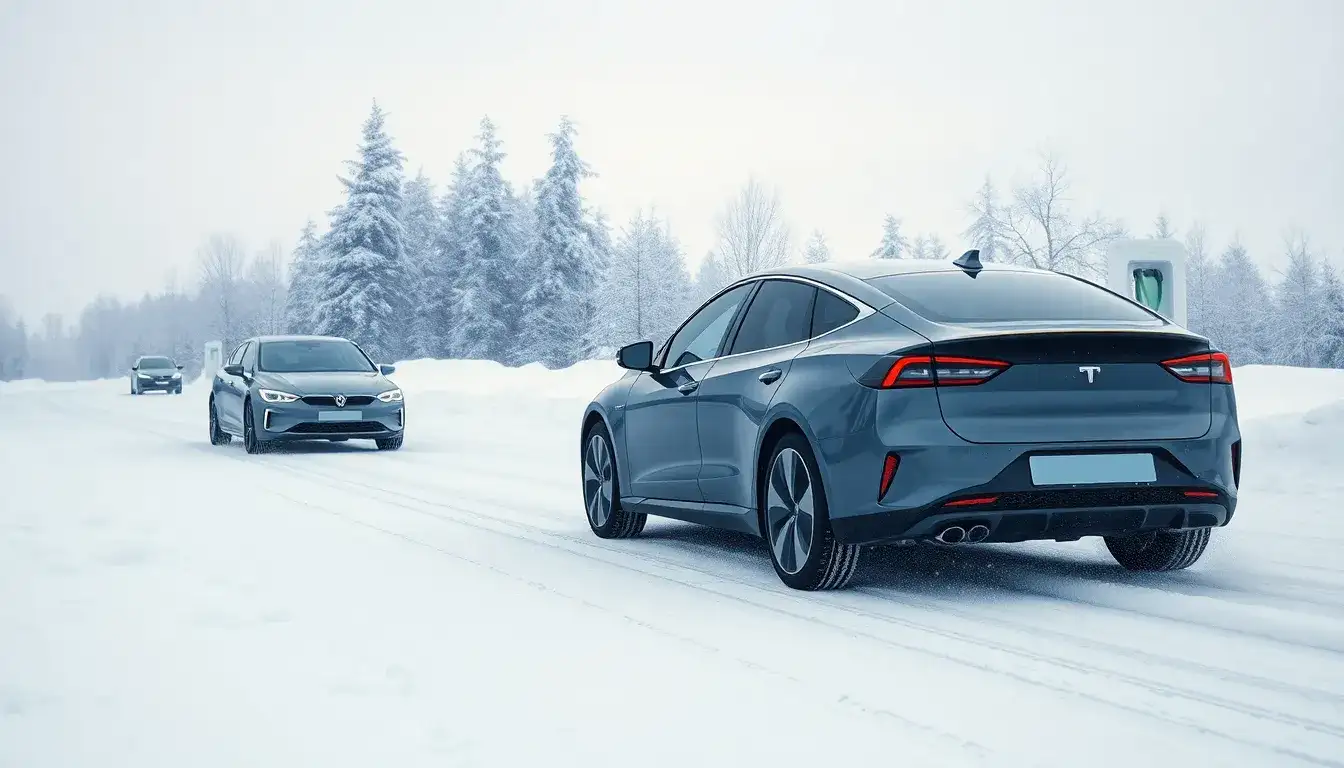
Electric vehicles have crossed the Great Wall | range | electric vehicles | power batteries | new energy vehicles
In the development of the automotive industry, there has been a widely circulated saying: “Electric vehicles do not cross the Great Wall.” When the “Ten Cities, Thousand Vehicles” initiative was launched in 2009, technological limitations in new energy vehicles, particularly issues related to battery range reduction and performance instability in low-temperature environments, led many in the industry to believe that the cold northern regions were unsuitable for promoting new energy vehicles. Huang Yonghe, a senior chief expert at the China Automotive Technology Research Center, vividly recalls a principle proposed by the 863 expert group leader: “Many people think this is a joke, but it’s not; it’s true: electric vehicles do not cross the Great Wall.” As time has passed, 16 years later, “Electric vehicles have crossed the Great Wall.” New energy vehicles have not only established themselves in the high-cold northern regions but are also increasingly popular in plateau areas, becoming a significant force in the automotive market.
Low Temperatures Do Not Hinder Electric Vehicles
The main obstacle to the development of new energy vehicles in northern regions has been the impact of cold temperatures on vehicle performance, particularly the issue of range reduction. In the past, low temperatures decreased battery activity, resulting in a significant drop in range, which deterred consumers from considering new energy vehicles. Today, car manufacturers have made major breakthroughs in thermal management systems and battery technology. Yang Yanding, head of the R&D Institute at Dongfeng Motor, expressed great confidence in the upcoming Dongfeng Nano 06, a small pure electric SUV that will compete with popular models such as BYD Yuan UP and Wuling Bingo PLUS. It will be the first to feature Dongfeng’s self-developed third-generation “Zhi Han” thermal management system, designed to address the range reduction issue of pure electric vehicles in low-temperature environments. In an environment of -7°C, the vehicle can maintain a range retention rate of 68%; even in the extreme cold of Mohe at -40°C, the vehicle can still start with a single button, enhancing the sense of security for winter travel in northern regions.
Not only Dongfeng, but Geely’s Zeekr also showcased its “Four Major Inventions for Conquering Low Temperatures” and “Three Major Driving Control Technologies for Conquering Snow and Ice” at its tech release on December 27, 2024. They introduced the 800V second-generation Golden Brick battery, using fully self-developed second-generation lithium-ion acceleration technology that reduces comprehensive impedance in low temperatures by 36% and increases conductivity by 40%. After sitting in -10°C for 12 hours, the Zeekr 7X equipped with this battery can charge from 10% to 80% in just 18 minutes. Additionally, they launched the 800V extreme cold liquid-cooled fast charging pile, with a maximum power of 800kW, operational in a temperature range of -30°C to 60°C, allowing for charging at “one kilometer per second” even in -30°C conditions. According to official reports, their nine-source heat pump significantly reduces heat waste, achieving an industry-leading operational temperature range of -40°C to 50°C, effectively reducing heating electricity consumption and extending the vehicle’s range. The recovery power from chip waste heat can reach 1700 watts, equivalent to saving 1.7 kWh per hour, which can enable an additional 10 kilometers of travel.
Plug-in Hybrid Models Thrive in Severe Cold
In addition to advancements in purely electric vehicles, plug-in hybrid electric vehicles (PHEVs) showcase unique advantages in northern and plateau regions. Their characteristics effectively alleviate user anxiety regarding range while being less dependent on infrastructure compared to purely electric vehicles, making them suitable for high-altitude and cold areas. Statistics from the China Automotive Center indicate that by 2024, the total proportion of PHEVs in Heilongjiang and Xinjiang exceeded 70%, directly linked to the cold and high-altitude environment. In regions such as the Northwest, North, and Northeast, where the terrain is vast, low-temperature conditions are common and infrastructure is uneven, although the progress of electrification has been slow, the growth rate of PHEVs has been relatively high due to rapid advancements in their electric range, energy consumption, and fuel efficiency.
Currently, 36% of PHEVs have a pure electric driving range exceeding 140 kilometers, with some companies even developing plug-in hybrid models with ranges over 400 kilometers. In high-altitude areas like Tibet, the development of new energy vehicles is also showing positive trends. The low-oxygen environment significantly affects the performance of fuel vehicles, but the impact on pure electric vehicles is nearly negligible. Due to high transportation costs, fuel prices in Tibet are significantly higher than in other provinces, while electricity is much cheaper than fuel, greatly enhancing the cost-effectiveness of new energy vehicles. Tibet boasts abundant clean energy resources such as hydropower, wind, and solar power, with most areas receiving over 2000 hours of sunlight annually, making it suitable for photovoltaic power generation and providing advantages for the development of new energy vehicles.
Technological Breakthroughs in Core Components
The heart of new energy vehicles comprises batteries, motors, and electronic controls. China is demonstrating strong competitiveness in these critical areas, especially when addressing the complex environments of northern high cold and plateau regions. Starting with battery technology, the performance of batteries in low-temperature environments faces severe challenges, with range reduction and slow charging speed historically being major barriers to the promotion of new energy vehicles in northern areas. Today, China has made significant breakthroughs in battery technology. The Dalian Institute of Chemical Physics of the Chinese Academy of Sciences has developed the first generation of high-energy, ultra-low temperature special lithium-ion batteries with an energy density of 260 watt-hours per kilogram, capable of stable operation at -60°C. These batteries achieve enhanced ionic conductivity and interface performance in low-temperature conditions through the development of a new generation of composite electrolytes and a multilayer composite electrode structure combined with new semi-solid electrolytes and modified active materials.
Moreover, on April 21, CATL launched the world’s first mass-produced sodium-ion power battery brand “Sodium New,” which retains 90% usable power at -40°C, demonstrating no power degradation even when only 10% charge remains, effectively overcoming the performance bottleneck of traditional lithium batteries in extreme cold. Laboratory data shows that at -40°C, the sodium battery’s capacity retention rate surpasses that of lithium iron phosphate batteries by 40%, fundamentally addressing the user pain point of “range halving” for electric vehicles in northern winters. On April 17, GAC’s Envision S9 was released, equipped with CATL’s Super Hybrid Battery, achieving stable discharge at -40°C and normal charging at -30°C, while delivering a pure electric range of 252 kilometers, charging from 30% to 80% in just 15 minutes.
Future Prospects for New Energy Vehicles
These technological achievements in batteries make the use of new energy vehicles in the harsh northern climate more feasible. In terms of motors, 2024 saw a breakthrough in Chinese motor technology. BYD introduced a “twelve-in-one” motor, while Dongfeng unveiled a “ten-in-one” motor, with new automotive players like Xiaomi and Huawei showcasing advanced performance in speed, power density, efficiency, and adaptability to cold conditions. China’s electric motors and electric vehicle metrics are globally leading. Huang Yonghe noted that a major Japanese company developing a three-in-one motor will not reach mass production until 2027, while China, with its vast market, can rapidly adapt and implement new technologies once developed. This swift application of technology and market feedback mechanism allows Chinese new energy vehicles to better adapt to various regional environments, including northern high-cold and plateau areas.
The once-considered “forbidden zone” for new energy in Northeast China is now seeing a gradual increase in market share. By May 2024, the Jilin Provincial Government’s action plan aims to optimize the development layout of new energy and intelligent connected vehicles by 2026, targeting over 500,000 new energy vehicle sales in the province, with homegrown brands achieving a penetration rate exceeding 40%. The local matching rate of key new energy components is expected to rise to 70%. Public vehicles are set to accelerate their transition to new energy, significantly enhancing the convenience of charging and swapping services.
According to data compiled by Yiche, by 2024, the penetration rate of new energy passenger vehicles (including pure electric, plug-in hybrid, and extended-range) in Jilin Province is projected to exceed 43%, while Liaoning will reach 39%, Xinjiang 38%, Heilongjiang 31%, and Tibet 19%. Notably, in Ordos, the penetration rate of new energy passenger vehicles is as high as 58%, ranking 13th among the top 20 cities in China. The cold-weather testing ground of Heihe attracts numerous new energy vehicles each year for testing, with the number of new energy and traditional fuel vehicles being nearly equal by 2024. At the Xilingol National Energy Group’s mining area in Inner Mongolia, the country’s first 110-ton class light electric hybrid unmanned heavy mining truck has been put into operation, powered by four single-stack hydrogen fuel cell reactors combined with lithium iron phosphate batteries, providing consistent heating in extreme cold and snow conditions to meet the high-intensity operational demands of the mine for over 20 hours daily.
“Electric vehicles have crossed the Great Wall” symbolizes the advancements in technology, product optimization, and market expansion within China’s new energy vehicle sector. From once being considered unsuitable for development in high-cold and plateau areas to now steadily increasing market share, new energy vehicles are gradually achieving comprehensive market coverage. With ongoing technological innovations and continuous improvement of infrastructure, the development prospects for new energy vehicles in northern and plateau regions are becoming increasingly promising, likely transforming the automotive consumption landscape in these areas and promoting the deepening of green travel concepts.
Original article by NenPower, If reposted, please credit the source: https://nenpower.com/blog/electric-vehicles-break-through-cold-weather-barriers-in-northern-china/

