

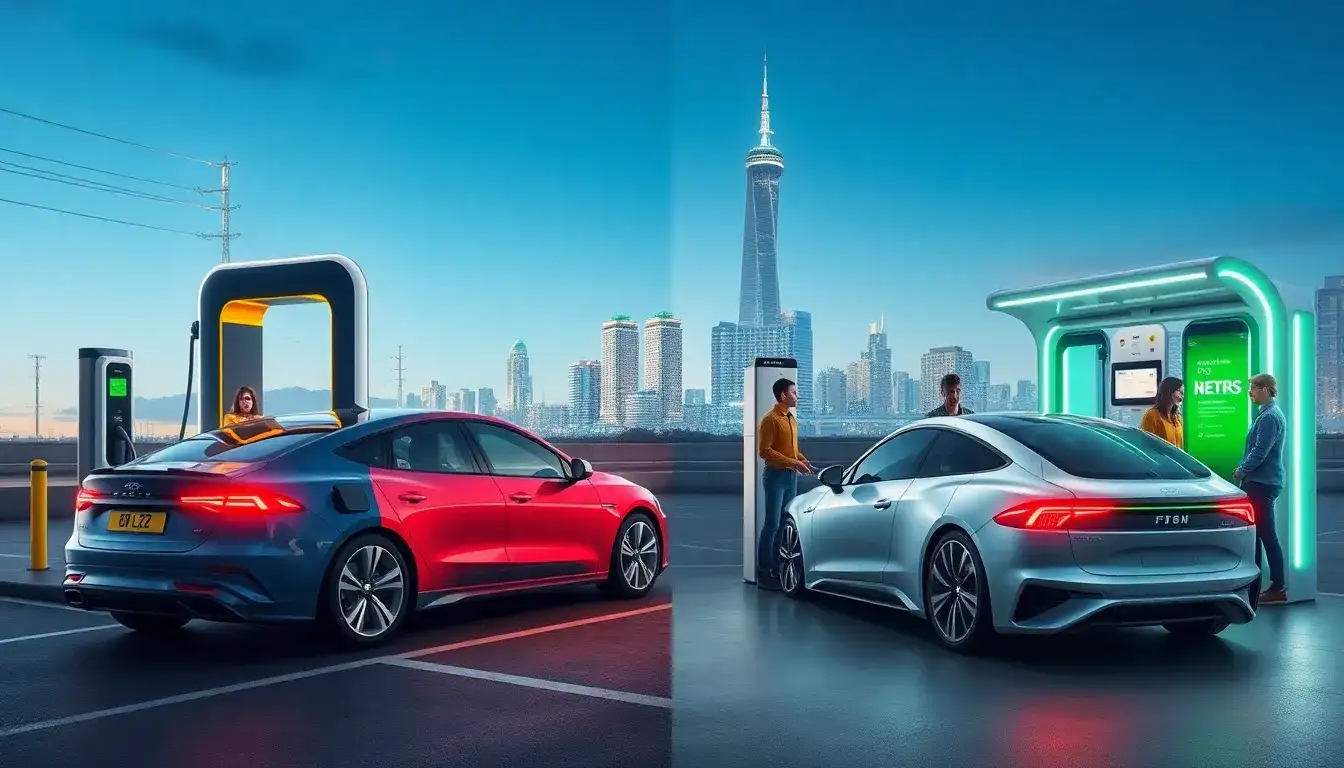
As electric vehicles (EVs) continue to gain traction, the speed of charging has become a focal point for automotive companies. According to information from BYD, the first “megawatt fast charging station” they are building in collaboration with Sinopec is nearing completion. The station is already constructed, and following the launch of the Han and Tang L models, BYD plans to roll out 500 of these megawatt fast charging stations, with a goal of establishing over 4,000 stations nationwide. BYD has also announced that its megawatt fast charging system will be open to the entire industry and has received numerous partnership inquiries, planning to collaborate with several leading charging operators in China.
BYD is not the only company venturing into megawatt fast charging technology. Recently, companies like Huawei and Zeekr have also announced their respective developments and progress in this field. Meanwhile, competitors such as NIO and CATL are accelerating their investments in battery swapping technology. With various players entering the arena, the question remains: which approach will prevail—fast charging or battery swapping?
In the realm of fast charging, competition is intensifying. Following BYD, Zeekr has also announced plans to unveil a single-gun peak power 1.2 megawatt fully liquid-cooled charging station in the second quarter of this year, marking a significant step into the megawatt fast charging era. Zeekr’s Chief Business Officer, Guan Haitao, stated that this technology will be showcased at the Shanghai Auto Show in April. Huawei’s new megawatt fast charging product is set to be officially released on April 22. According to Huawei’s board member and President of Digital Energy Business Unit, Hou Jinlong, the maximum charging current of Huawei’s megawatt fast charging product is 2400 amps, with a maximum power of 1.44 megawatts, capable of providing approximately 20 kWh of energy per minute, completing a charge in just 15 minutes.
From a technical perspective, achieving such power levels, as seen in BYD’s megawatt fast charging technology, requires exceptionally high voltage and current. For instance, the vehicle’s battery, motor, power supply, and air conditioning systems must operate at 1000V, while the internal resistance of the battery needs to be minimized to allow for a charging current of up to 1000A. Shao Jie, Chief Technology Officer of the Intelligent Platform at SAIC-GM-Wuling, expressed that while the fast charging competition has reached levels of 4C, 5C, and 6C, the introduction of megawatt fast charging technology by some competitors has prompted others to follow suit. He noted that the significance of megawatt capabilities lies primarily in the battery capacity. In his view, while higher C-rates are interesting, they may lead to unnecessary resource consumption across the industry.
The “C-rate” of charging indicates speed; a higher number means faster charging. For example, 1C indicates a full charge in one hour, 2C in half an hour, and so on. According to previously disclosed data from BYD, the Han L EV features a maximum production charging rate of 10C with a peak charging power of 1000kW (1 megawatt), achieving a charging speed of “2 kilometers per second,” allowing for a range of 400 kilometers in just five minutes. Currently, the production charging power for new energy passenger vehicles generally falls between 480kW and 600kW, with charging rates around 4C to 6C. For instance, Li Auto’s first pure electric SUV, the Li Auto i8, comes equipped with a 5C supercharging battery and is supported by over 2,000 5C supercharging stations nationwide. Xiaopeng has also announced its 5C supercharging AI battery, combined with a 5S liquid-cooled supercharging station, capable of achieving over 1 kilometer of charging in just one second and reaching 80% charge in 12 minutes.
However, Lu Wenliang, a special researcher in the automotive industry at the Strategic Consulting Institute of the Chinese Academy of Sciences, noted that BYD’s megawatt fast charging is designed for energy storage solutions, with charging stations considering the impact on the power grid. He stated that dual-gun charging and regular fast charging stations can also facilitate relatively fast charging speeds. Is megawatt fast charging technology more suitable for commercial vehicles than passenger vehicles? Lu pointed out that both have their significance; BYD’s system is designed for passenger vehicles and is already in mass production with a charging rate of 10C, while Huawei’s system is intended for commercial vehicles, which typically have larger battery capacities ranging from 300 to 500 kWh, with 1.5MW corresponding to approximately 3C batteries. Huawei’s megawatt-level fast charging technology primarily aims to facilitate the electrification of heavy-duty trucks, addressing the slow pace of electrification in commercial vehicles due to slow charging and inadequate network coverage. To enable rapid charging for large capacity batteries, both megawatt fast charging technology and an extensive megawatt charging network are essential.
As for the construction costs of megawatt fast charging and battery swapping, the latter is gaining traction. Companies like NIO and CATL are increasingly investing in the battery swapping sector. During a recent earnings call, CATL acknowledged the challenges associated with megawatt fast charging, which requires specific megawatt charging stations. The construction of such stations necessitates expansion or the addition of energy storage cabinets, resulting in high costs and extended construction timelines, which may not be widely applicable. Last month, CATL signed a strategic cooperation agreement with NIO, which includes a strategic investment of up to 2.5 billion yuan for NIO Energy, along with NIO’s third brand, Firefly, becoming compatible with CATL’s Chocolate battery swapping platform. CATL claims its battery swapping stations can complete a swap in just 100 seconds, while NIO’s fourth-generation battery swapping stations can achieve a maximum swap time of 2 minutes and 24 seconds (144 seconds). In terms of speed, battery swapping may surpass 10C fast charging.
However, regarding construction costs, Lu believes that the costs associated with battery swapping stations might be higher than those of fast charging stations equipped with energy storage cabinets. For example, NIO, as an early entrant in the battery swapping market, has seen varying construction costs for different generations of battery swapping stations: the first generation costs about 3 million yuan, the second generation 2 million yuan, and the third and fourth generations have reduced costs to around 1.5 million yuan. Despite these reductions, the cumulative investment remains substantial.
As companies engage in a fierce competition over electric vehicle charging solutions, the optimal answer remains to be seen, depending on a variety of factors including technology, deployment speed, and costs.
Original article by NenPower, If reposted, please credit the source: https://nenpower.com/blog/electric-vehicle-charging-showdown-fast-charging-vs-battery-swapping-solutions/

