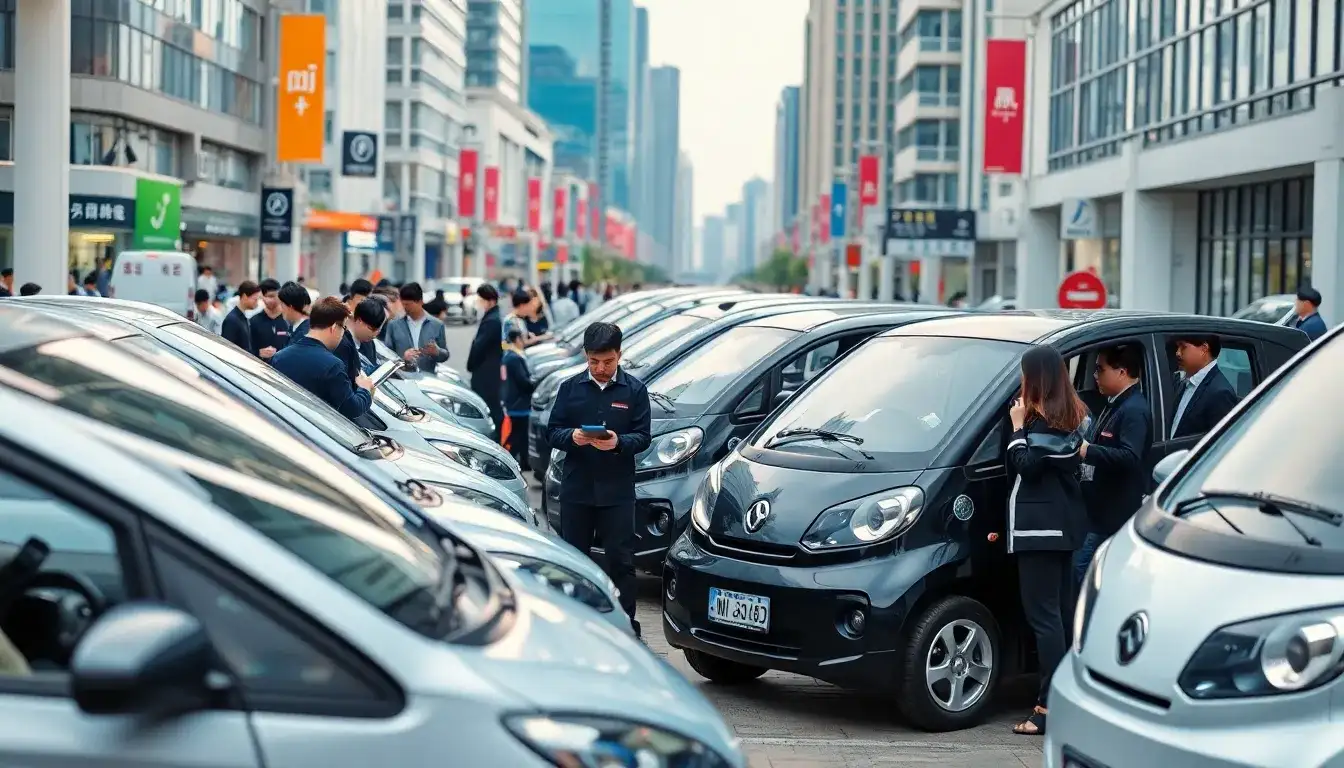
The new pure electric compact car, the T1, launched by BAIC’s Arcfox brand, has been priced between 62,800 and 87,800 yuan. However, the real industry buzz surrounds its triple after-sales guarantee policy announced during its pre-sale. This includes a direct battery replacement when capacity drops below 80%, a “burn one, compensate one” plan for fire incidents, and comprehensive lifetime free maintenance services. These initiatives directly address the three major concerns of electric vehicle consumers: battery lifespan, safety risks, and ownership costs, elevating the competition in the A0 electric vehicle market to new heights.
While the Arcfox T1 is not the first new energy vehicle to focus on after-sales service, it is the first in its category to elevate after-sales guarantees to a strategic level. According to data released by the China Electric Vehicle Hundred People’s Association, in 2024, 43% of complaints regarding pure electric compact cars were related to battery issues, with 28% pertaining to capacity degradation and 15% concerning safety concerns. Concurrently, a J.D. Power survey revealed that the transparency of after-sales policies and service quality has become the third most important factor for consumers when selecting electric vehicles, following price and range. In this context, the after-sales strategy of the Arcfox T1 is not just a precise response to market pain points but also a redefinition of competitive rules. “This signifies a shift in the pure electric vehicle market from ‘parameter competition’ to ‘full lifecycle value competition,’” noted an industry analyst. “When similar products have only a 50-100 kilometer difference in range, the disparities in after-sales guarantees will become the deciding factor for purchases.”
Notably, Arcfox is strategically focusing on the price-sensitive A0 segment for its after-sales initiatives, rather than the higher-end B or C segments. This approach reflects an understanding of the sensitivity of small electric vehicle users to price and long-term usage costs.
Among Arcfox’s after-sales commitments, the most groundbreaking is undoubtedly its policy of “battery degradation replacement only, no repair.” The new model is equipped with a 42.3 kWh lithium iron phosphate battery, which the company claims has a cycle life of over 3,000 times. Based on a usage pattern of two complete charge-discharge cycles per week, the theoretical lifespan approaches 30 years. According to the official guidelines, when the actual battery capacity falls below 80% of its original capacity, users can directly request a new battery without undergoing cumbersome testing and repair processes. This standard aligns with the internationally recognized threshold for electric vehicle battery decommissioning, differing from the industry norm of only replacing batteries that degrade below 70%.
The “burn one, compensate one” policy is a recent trend among many automotive companies, demonstrating their confidence in battery safety. Sun Chao, the deputy director of the Shenzhen Automotive Research Institute at Beijing Institute of Technology, stated, “Currently, the direct cooling technology of battery packs combined with multiple safety protective designs can indeed minimize the risk of thermal runaway. However, the execution of the ‘burn one, compensate one’ promise will hinge on accurately defining the causes of self-ignition and eliminating external factors.” The lifetime free maintenance policy, while seemingly traditional, is rare in the small electric vehicle sector. Veteran after-sales service expert Li Wen calculated that, based on an 8-year usage cycle, a company implementing free maintenance could save consumers approximately 12 maintenance fees, totaling 5,000 to 6,000 yuan, which is significant for a vehicle priced under 100,000 yuan.
The financial viability of implementing these policies is a focal point of industry discussions. Arcfox responded by stating, “The cost of lithium iron phosphate batteries has decreased from 1.2 yuan/Wh in 2018 to 0.45 yuan/Wh by 2025, and the T1’s battery design allows for quick replacements, reducing labor costs. We have calculated that increased after-sales investment will be offset by economies of scale and improved customer loyalty.” However, a report from Ping An Securities noted that such aggressive policies require companies to maintain strict control over battery quality consistency, as any batch issues could lead to significant compensation liabilities.
The after-sales strategy of Arcfox is already generating a significant “catalyst effect.” Within two weeks of announcing its after-sales policies, BYD introduced a “lifetime battery warranty” for its Sea Gull model, while Wuling extended the warranty on its battery and electrical systems from 8 years/120,000 kilometers to 8 years/150,000 kilometers. A competitive after-sales “battle” has begun in the A0 electric vehicle market. This shift in competition reflects changes in the characteristics of the small electric vehicle market. Data shows that in the first eight months of 2025, the proportion of family users among A0 electric vehicle sales increased from 35% in 2022 to 62%. This demographic is far more sensitive to long-term ownership costs than ride-hailing users. As family vehicles become more prevalent, consumers’ evaluation criteria have shifted from “purchase price” to “total cost of ownership,” making after-sales value quantifiable and comparable.
Unlike traditional fuel vehicles, the after-sales competition for electric vehicles exhibits distinct characteristics: the focus is on the three electric systems, with an increase in digital services and a change in cost structure. These characteristics necessitate a reconstruction of the after-sales system for electric vehicles, rather than simply transplanting the experiences of fuel vehicles. It is noteworthy that the impact of after-sales competition on brand dynamics may be greater than anticipated. Research indicates that among potential buyers aware of after-sales policies, 73% indicated they would prioritize this aspect in their decision-making process, even surpassing those who chose based on price or range.
A marketing executive from an automotive company admitted, “When product differentiation is minimal, after-sales promises become the most direct means of differentiation, but following through requires robust supply chain and cost control capabilities.”
The fierce competition in after-sales services for small electric vehicles is prompting mid- to large-sized electric vehicle manufacturers to rethink their strategies. However, unlike the A0 segment, mid- to large-sized electric vehicles face a more complex situation: higher battery capacities lead to more expensive replacement costs; heavier vehicle bodies demand greater durability from components; and broader usage scenarios make it more challenging to control operating conditions. Currently, innovations in after-sales for mid- to large-sized electric vehicles are showing three main trends: first, modular battery design, such as NIO’s segmented replacement scheme, which replaces only defective modules instead of the entire battery pack; second, innovative insurance products, like Tesla’s partnership with Ping An to offer “battery degradation insurance” covering capacity drops below 70%; and third, the development of service ecosystems that include home charging pile installation, public charging subsidies, and emergency charging services. Chen Shihua, deputy secretary-general of the China Association of Automobile Manufacturers, pointed out, “Mid- to large-sized electric vehicles are more inclined to convert after-sales costs into value-added services. For example, the ‘battery health visualization’ system of Lantu FREE extends battery life through real-time monitoring, effectively reducing after-sales pressure.” This approach stands in stark contrast to the direct replacement commitments of small electric vehicles.
The after-sales competition ignited by the Arcfox T1 marks a transition in the Chinese electric vehicle market from mere price competition to full lifecycle value competition. This shift demands that companies not only excel in manufacturing vehicles but also in managing them, raising expectations for the entire chain from research and development to production, sales, and service. For consumers, this competition is undoubtedly beneficial. As automotive companies focus on vehicle performance throughout the entire usage cycle, product quality, reliability, and durability will naturally improve. However, there is also a need to be cautious of the risks associated with overpromising, as history has shown cases where excessive after-sales commitments have undermined a company’s financial health. For the industry, after-sales competition will accelerate the survival of the fittest. Only those companies that truly master core technologies, possess scale advantages, and exhibit refined management capabilities will maintain competitiveness amid long-term service commitments. As Xu Yanhua, secretary-general of the China Electric Vehicle Charging Infrastructure Promotion Alliance, stated, “The future winners will not be the companies that sell cars best, but those that understand the vehicle ecosystem best.” It is foreseeable that as the penetration rate of electric vehicles increases and consumer awareness matures, innovations in after-sales services will continue to deepen. The competition among pure electric compact cars in after-sales service represents a revolution in redefining automotive value, and in this transformation, those companies that can balance short-term appeal with long-term sustainability will ultimately earn market and user recognition.
Original article by NenPower, If reposted, please credit the source: https://nenpower.com/blog/electric-mini-cars-spark-a-revolution-in-after-sales-service-in-china/