

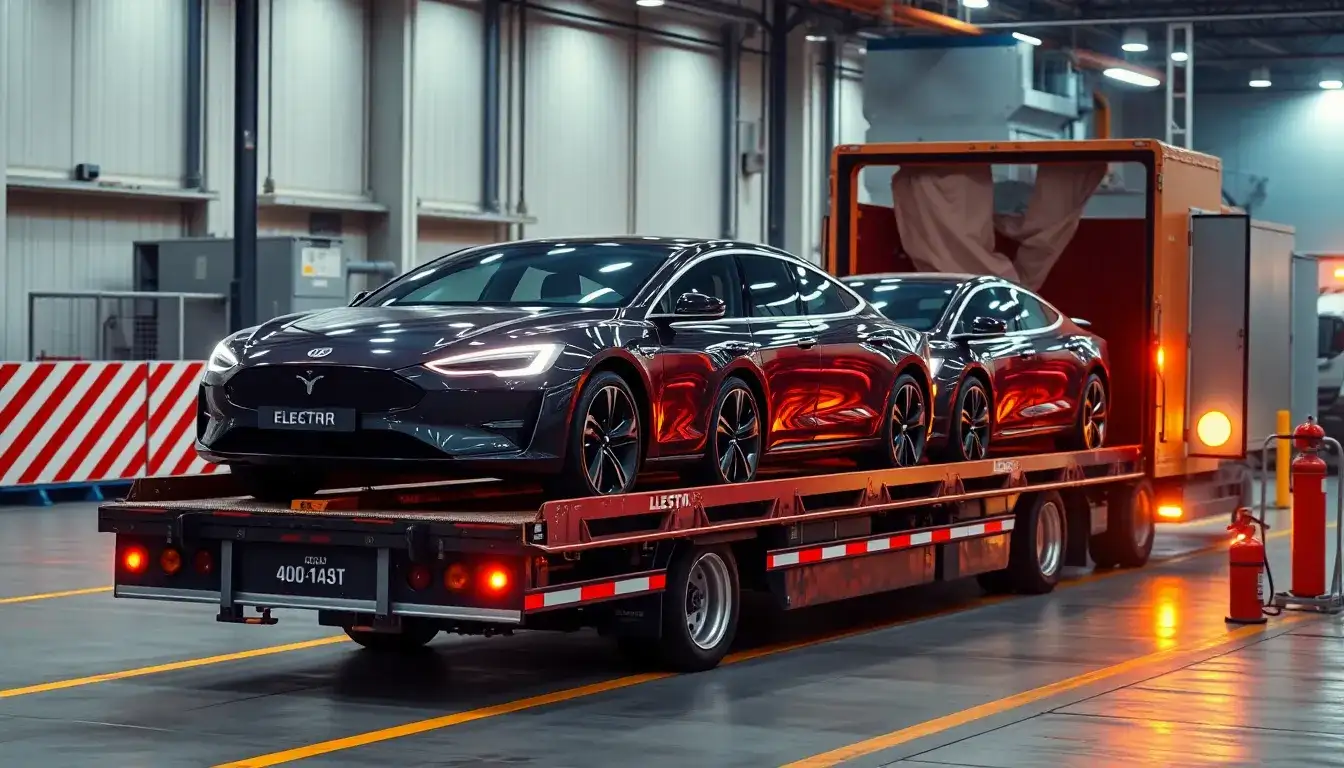
Electric Car Carriers Face Looming Safety Tests Amid Growing EV Fire Risk
—
A recent series of fires aboard vehicle carriers transporting electric vehicles (EVs) has highlighted the increasing dangers associated with lithium-ion batteries at sea. As EV exports surge worldwide, shipping industry leaders are urgently reevaluating safety protocols, compartment design, and fire response systems to prevent incidents like those that have occurred recently.
### Morning Midas Incident Raises Concerns
On June 3, the Morning Midas, a Liberia-flagged roll-on/roll-off car carrier, caught fire approximately 300 miles southwest of Adak Island, Alaska, while en route from Japan to Mexico. The blaze originated near a deck loaded with EVs and hybrids, and after battling relentless flames and heavy seas, the ship sank on June 24.
#### Key Details:
– Smoke and fire were initially confined to the EV deck despite existing suppression systems.
– All 22 crew members were safely evacuated and monitored by nearby vessels and the U.S. Coast Guard.
– Salvage teams declared the fire extinguished on June 16, but the damage ultimately led to the vessel’s sinking.
– The incident has drawn attention to the challenges of extinguishing EV battery fires, which can resist CO₂ suppression and may reignite.
### Fire Risk Factors on EV Carriers
| Risk Factor | Description | EV-Specific Challenge | Mitigation Status |
|————————–|———————————————————————————————-|————————————————————————|————————————————-|
| Thermal Runaway | Lithium-ion batteries can enter a self-heating cycle, leading to uncontrollable fires. | Battery packs may ignite days after damage due to internal short circuits. | Partially addressed through battery design standards; full vessel-scale solutions are still in development. |
| Lack of Ventilation | Car carrier decks often have poor ventilation, allowing rapid heat and smoke build-up. | Toxic gases from EV battery fires can accumulate quickly, hindering suppression efforts. | Some shipbuilders are redesigning airflow systems; widespread retrofits remain limited. |
| Inadequate Detection | Early fire detection systems may not recognize the unique burn profile of battery fires. | Lithium-ion battery fires produce low visible flames initially, delaying response time. | Fire detection technology is being updated; full deployment varies by vessel age. |
| Mixed Cargo Loads | Combining internal combustion engine (ICE) vehicles with EVs increases fire spread risk. | Fires can accelerate due to interaction between gasoline and lithium cells. | Mitigation through zoning and separation is under review but not standardized. |
| Crew Training Gaps | Most seafarers are trained for petroleum fires rather than battery-specific fire behavior. | Failure to recognize thermal runaway signs can delay correct actions. | Several flag states are updating training protocols, but rollout is inconsistent. |
*Note: This table is based on a cross-analysis of recent incident investigations, regulatory guidance, and industry safety audits.*
### Past Incidents Reveal Escalating Danger
The Morning Midas fire is part of a troubling pattern of recent vehicle carrier fires. Notable incidents include:
– A fire on the Fremantle Highway in July 2023, which resulted in one crew member’s death and 16 injuries, taking five days to bring under control.
– The Felicity Ace caught fire in February 2022 while mid-Atlantic, eventually sinking after two weeks, with losses exceeding $400 million.
– Earlier incidents such as the Diamond Highway (2019) and Hoegh Xiamen (2020) further illustrate ongoing vulnerabilities, with all these vessels carrying mixed-load decks of ICE and electric vehicles.
### Unique Challenges Posed by Lithium-Ion Batteries
EV battery fires present distinct challenges, notably:
– Thermal runaway can cause reignition hours or days after a fire is extinguished.
– Intense heat and toxic smoke contribute to rapid fire spread in confined decks.
– CO₂ systems may only provide temporary flame suppression and rarely achieve permanent control.
Emergency crews are increasingly advocating for strategic alternatives, such as isolating EVs in separate decks, utilizing water deluge systems, and deploying thermal imaging for early detection.
### Industry’s Response to Enhance Safety
In response to these incidents, carriers, insurers, and regulators are advancing measures to mitigate future risks:
– Stricter deck segregation rules are being implemented, with dedicated EV compartments.
– Firefighting standards are being updated to emphasize external monitoring rather than crew entry.
– Enhanced fire detection systems and readiness for water-based deluge applications are being prioritized.
– The International Maritime Organization is drafting updated regulations for EV transport, including limits on battery charge, deck design standards, and suppression protocols, with a reform package expected by late 2025.
### What Lies Ahead for Maritime Safety
The ongoing investigation into the Morning Midas fire will likely influence future vessel design and safety standards. Key actions being considered include:
– Incorporating water deluge decks and high-sensitivity thermal sensors in retrofits.
– Establishing built-in battery discharge or isolation requirements before loading.
– Expanding crew and firefighting team training to address high-energy battery incidents.
These initiatives aim to enable safer EV transport at scale while addressing the growing demand for EVs and the evolving fire risks they present. As trade volumes for EVs increase, the maritime transport sector is adapting to a new class of hazards. Lessons learned from the Morning Midas tragedy and previous incidents could drive innovations in vessel design, emergency response, and global policy, ensuring that oceanic EV supply chains remain reliable and resilient.
### News Summary
#### Theme: Key Details
– **Recent Developments:** There has been a notable increase in car carrier fires involving electric vehicles since 2022, with incidents such as the Morning Midas (2025), Fremantle Highway (2023), and Felicity Ace (2022).
– **Ongoing Concerns:** There is a lack of consistent root cause analysis and rising insurance costs.
#### Fire Risk Factors:
– **Thermal runaway** in EV batteries, confined car deck spaces, and inadequate early detection are significant concerns.
– Studies confirm an elevated fire risk associated with EV-dense cargo loads, with no globally mandated hazard protocols for EV battery loading or monitoring.
#### Industry Response:
– Efforts are underway to redesign vessels, upgrade fire suppression systems, and train crews. The IMO is developing draft guidelines, and new builds are incorporating zoned EV compartments.
– Retrofit costs, uneven global adoption, and limited enforcement mechanisms remain challenges.
#### Regulatory Progress:
– An initial IMO framework is under discussion, with classification societies proposing standards. Formal code revisions are not expected until 2026 or later.
#### Carrier Operations:
– Some carriers are limiting EV loads or requiring low state-of-charge declarations before loading. European operators are adopting conservative transport policies for mixed fleets, but harmonized standards between ports and flag states are lacking.
*Note: This summary is based on verified vessel incident logs, IMO proceedings, shipbuilder data, and safety technology developments.*
Original article by NenPower, If reposted, please credit the source: https://nenpower.com/blog/electric-car-carriers-under-pressure-to-enhance-safety-amid-rising-ev-fire-hazards/

