

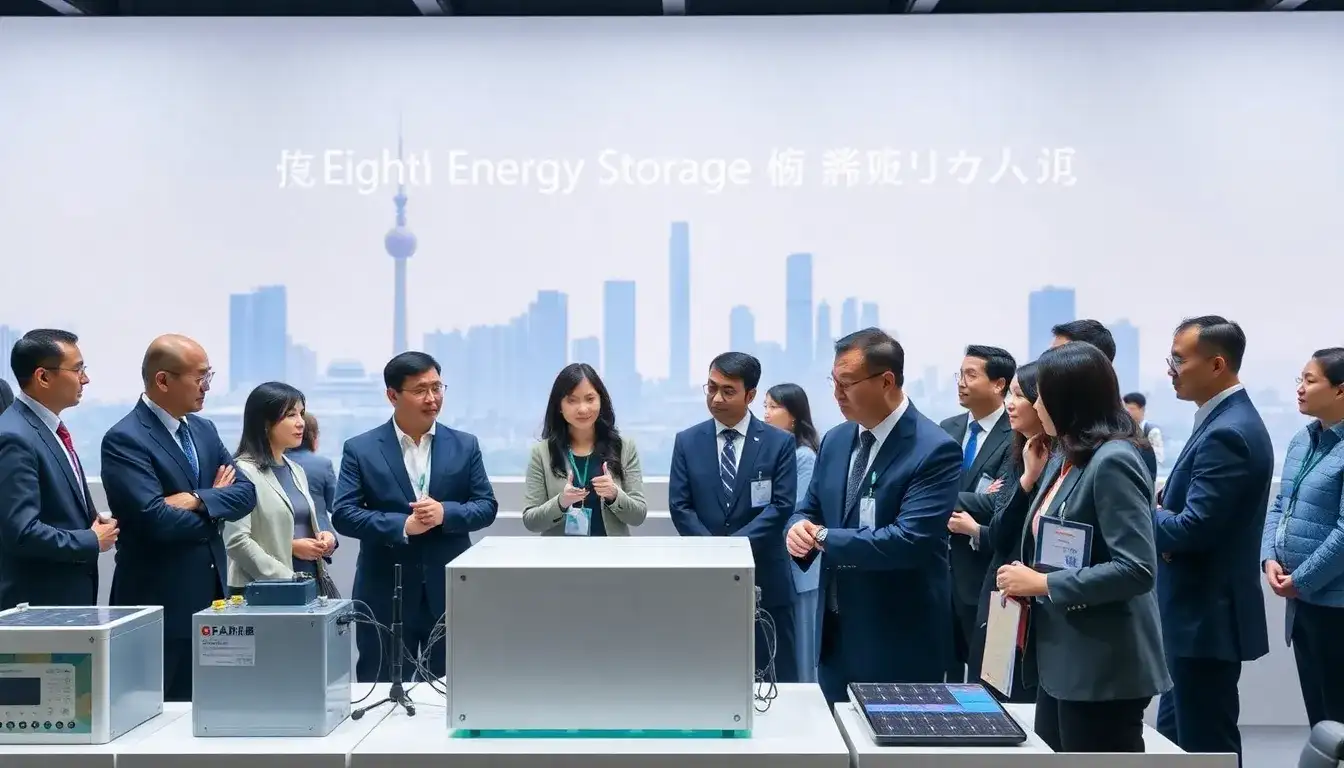
The 8th Energy Storage Frontier Technology Conference Held in Beijing: Academics and Experts Discuss Innovations in Energy Storage Technology and the Future of the Industry
On April 10, 2025, the main forum of the 8th Energy Storage Frontier Technology Conference was held at the Beijing Capital International Exhibition Center. This event was co-hosted by the Institute of Engineering Thermophysics of the Chinese Academy of Sciences, the China Energy Research Society, and the Zhongguancun Energy Storage Industry Technology Alliance. The forum brought together eight academicians and top industry experts from both domestic and international backgrounds to engage in in-depth discussions on cutting-edge topics such as key materials for new energy storage, safety protection of storage systems, the construction of new power systems, and hydrogen energy development strategies. The conference was chaired by Huang Xuejie, a researcher at the Institute of Physics, Chinese Academy of Sciences.
Opening Remarks: The Energy Storage Industry Moves Toward a Trillion Yuan Market
In his opening speech, Chen Haisheng, Director of the Institute of Engineering Thermophysics, emphasized that energy storage serves not only as a “stabilizer” for energy transition but also as a “new engine” for upgrading the energy industry. He pointed out that energy storage is a core technology for achieving the “dual carbon” goals. Addressing the frontier technical challenges in materials, equipment, and systems within the energy storage sector, he called for the establishment of “large scientific facilities + joint laboratories” to streamline the entire chain from basic research to engineering scaling, transforming experimental sparks into a sweeping industrial trend. He proposed collaborative advancements in technologies focusing on high safety in electrochemistry, low-cost physical storage, and large-scale hydrogen energy and thermal energy storage systems, contributing the strength of Chinese scientists to the construction of new power systems and the achievement of dual carbon goals.
Keynote Reports: Strategic Insights and Technological Innovations
Yang Yusheng, Academician: Hydrogen Energy Should Shift Toward Liquid Fuel and Extended-Range Technologies
Yang Yusheng proposed that the high costs and safety concerns associated with hydrogen energy transportation necessitate exploration of pathways to convert green hydrogen into liquid fuels. He highlighted the technology of coupling green hydrogen with coal chemical processes to produce methanol, which could significantly reduce carbon emissions while promoting the integration of extended-range electric vehicles with green methanol for energy-saving and carbon-reduction in the transportation sector. Additionally, he introduced an innovative idea for the direct synthesis of methanol using solid oxide electrolysis cells (SOEC) and called for increased scale production of liquid fuels.
Peng Suping, Academician: Hydrogen Energy Requires Diverse Development Focused on Scenario Coupling
Peng Suping emphasized the need to transition from a “pure hydrogen economy” to a “hydrogen economy” that encompasses broader applications. He noted that core technologies for hydrogen energy and fuel cells in China still require breakthroughs. Future efforts should focus on demonstration projects for hydrogen-electric coupling in the western regions and the development of megawatt-level fuel cell power generation systems, driving deeper integration of hydrogen energy with coal chemical processes and heavy-duty transportation.
Sun Shigang, Academician: Electrochemical Technologies Drive Innovation Across the Hydrogen Energy Chain
Sun Shigang analyzed the hydrogen energy industry chain from an electrochemical perspective. He pointed out that breakthroughs in catalyst activity and selectivity are necessary for water electrolysis hydrogen production, while the hydrogen storage segment should focus on efficient catalytic pathways for carbon dioxide hydrogenation to synthesize methanol. Addressing the slow development of fuel cell vehicles, he urged for the acceleration of domestic catalyst production and revealed that companies in China are already collaborating with Toyota to advance catalyst certification.
Zhao Tianshou, Academician: Key to Reducing Liquid Flow Battery Costs Lies in Enhancing Current Density
Zhao Tianshou highlighted that liquid flow batteries, with their intrinsic safety and long lifespan, are ideal for long-duration energy storage. His team has successfully optimized the electrode structure and utilized machine learning to enhance the current density to 400 mA/cm², significantly lowering the cost per kilowatt-hour of liquid flow batteries. He stressed the necessity of pairing large-scale wind and solar generation with long-duration energy storage technologies, indicating that the market potential for liquid flow batteries is immense.
Shu Yinbiao, Academician: New Energy Storage Technologies Must Evolve Toward System-Friendly Solutions
Shu Yinbiao explained the growing demands for energy storage in new power systems, suggesting that development is shifting from being policy-driven to demand-driven, with grid-type and long-duration storage becoming key focus areas. He recommended enhancing mechanisms for energy storage participation in the electricity market, improving carbon footprint accounting systems, and strengthening international standardization to elevate China’s influence in global energy storage technologies.
Ding Yulong, Academician: Thermal Energy Storage is Underestimated; Its Market Potential is Comparable to Electrochemical Storage
Ding Yulong revealed that global thermal energy storage capacity is approximately 400 GWh, rivaling pumped storage and lithium batteries. He identified the critical role of thermal energy storage in industrial decarbonization, noting that the steel industry currently has about 270 GWh of thermal storage capacity which can be significantly enhanced through technologies like liquid air energy storage to improve resource and energy utilization efficiency in basic industries.
Li Bin, Professor: Lithium Battery Safety Requires Multi-Dimensional Protection Technology Coordination
Li Bin focused on safety in energy storage systems, presenting the latest advancements in protection technologies for lithium-ion storage systems—”a comprehensive protection technology system from DC to AC sides.” He pointed out that traditional safety measures primarily address local fault identification, which can struggle to effectively manage inter-system coupling failures and complex fault chains. His team’s new technology encompasses global perspective protection, including sensitive and reliable fault identification for internal short circuits, quick identification mechanisms for external short circuits, and new principles for relay protection against AC-side faults.
Wen Zhaoyin, Academician: All-Solid-State Battery Breakthroughs Depend on Material and Interface Innovations
Wen Zhaoyin discussed the challenges faced by the all-solid-state battery industry, such as ionic conductivity of electrolytes, interface stability, and engineering scalability. His team has achieved breakthroughs in oxide systems, including co-doped LLZT electrolytes, composite electrolytes of porous oxide networks and in-situ polymers, and solid electrolyte films at the 20 μm level.
Yang Yong, Professor: Lithium Plating Detection Requires Dynamic Tracking of Three-Stage Evolution
Yang Yong proposed distinguishing between the “inflammation” and “cancer” stages of lithium plating hazards, noting that minor lithium plating accelerates aging while significant lithium plating leads to thermal runaway. His team developed dynamic electrochemical impedance spectroscopy and in-situ expansion monitoring technologies to accurately identify the initiation points and morphological evolution of lithium plating, combined with pulse repair strategies to provide new insights for battery lifecycle management.
Huang Xuejie, Researcher: Lithium Iron Phosphate Cathodes Enhanced with Lithium Materials and Colloidal Battery Technologies
Huang Xuejie highlighted that lithium iron phosphate has become a highly sought-after lithium battery material due to its high safety and low cost. The lithium-ion battery materials team at Songshan Lake Materials Laboratory developed lithium-enhanced lithium iron phosphate cathodes, achieving improved battery capacity, rate performance, and cycle life. The in-situ polymerization technology resolved electrolyte stratification issues in stationary energy storage batteries, enhancing both the calendar life and safety performance of the batteries.
Zhang Xianping, Researcher: Iron-Based Superconducting Wire Enters High-Field Applications
Zhang Xianping showcased advancements in iron-based superconducting wires, with his team achieving a critical current density of 4.5 x 10⁵ A/cm² under a 10T magnetic field, rivaling commercially available YBCO materials. The iron-based high-field insertion coil developed from meter-level wire has produced a magnetic field exceeding 1T in a 20T high background field, with future applications anticipated in controlled nuclear fusion, high-energy accelerators, and superconducting energy storage in strong magnetic field environments.
Li Wen, Deputy Director: Compressed Air Energy Storage Approaching 300MW Scale
Li Wen reported that under the leadership of researcher Chen Haisheng, the team at the Institute of Engineering Thermophysics has overcome core technologies related to multi-stage compression/expansion and efficient thermal energy storage, establishing the world’s largest 300MW advanced compressed air energy storage power station with a system efficiency of 72% and a cost reduction of 30% compared to 100MW scales. The 100MW project in Zhangjiakou has adopted artificial cavern storage for gas, setting a model for large-scale promotion.
Conclusion and Future Directions
In closing, Huang Xuejie emphasized that energy storage technology must balance safety, cost, and performance, with industry-academia-research collaboration being key to overcoming bottlenecks. The experts agreed that China’s energy storage industry has entered an innovation-driven phase, highlighting the need for strengthened standards, scenario exploration, and international outreach to contribute Chinese solutions to global energy transition.
Original article by NenPower, If reposted, please credit the source: https://nenpower.com/blog/eighth-energy-storage-technology-conference-held-in-beijing-experts-discuss-innovations-and-future-of-the-industry/

