

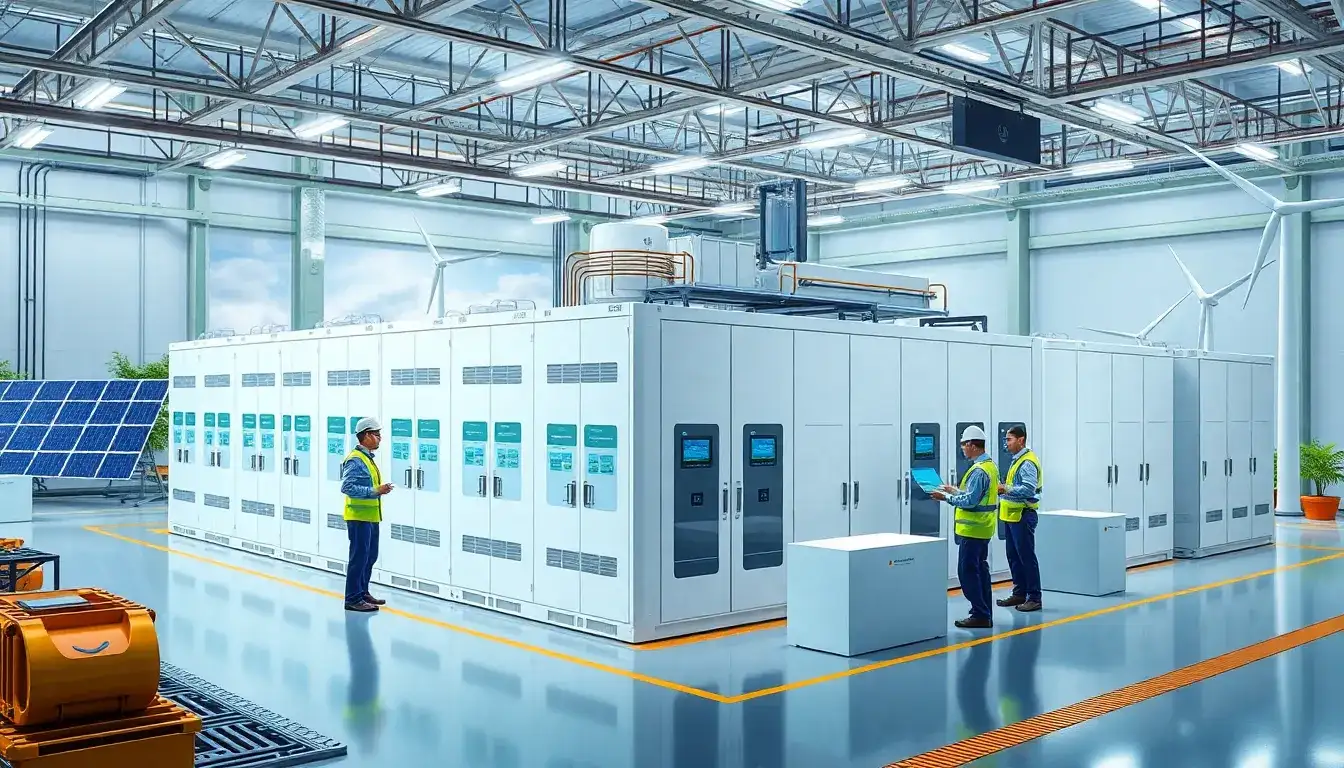
Recently, China achieved a significant breakthrough in the field of advanced electrical energy storage with the successful acceptance of the world’s first 50MW/100MWh digital energy storage power station, located at the Sanxia Ulanqab Green Power Station in Inner Mongolia. This milestone marks a critical step in China’s research and engineering application of large-scale electrochemical energy storage technology. As the core project of the “Key Technology Research and Demonstration for Large-Scale Advanced Electrical Energy Storage,” this facility is not only the largest digital energy storage power station in the world but also introduces a new technological pathway and operational paradigm through its Dynamic Reconfigurable Battery Network (DRBN) technology and intelligent operation and maintenance system.
Overcoming Fixed Series and Parallel Limitations: The dynamic reconfigurable battery network technology reshapes the foundational architecture of energy storage systems. Traditional energy storage systems, constrained by fixed series and parallel connections, suffer from the “bucket effect,” where the performance decline or failure of any battery diminishes the output of the entire cluster. Additionally, inconsistencies among batteries can lead to capacity losses and safety risks. The DRBN technology discretizes and digitizes the simulated energy flow of batteries, formatting it into “energy slices.” This transforms the rigid physical connections between traditional battery units into flexible, program-controlled connections, fundamentally addressing the mismatches caused by the fixed series and parallel architecture and the variability among individual battery units or modules.
The DRBN introduces the “software-defined energy” concept, treating battery modules as independently controllable nodes. Utilizing high-frequency power electronic switch arrays, it achieves millisecond-level dynamic reconfiguration of network topologies, dynamically altering the timing of battery connections and disconnections within the system. Coupled with a hierarchical control architecture, real-time data collection of battery status and execution of control commands occur through a bottom-layer digital energy network card, while regional management and control are handled by a mid-layer digital energy hub, and global scheduling is managed by the top-layer digital energy switch. This creates a flexible system where “batteries are nodes, and energy is addressable.”
The core device of this technological approach is the Digital Energy Switching System (DESS), which employs intelligent algorithms to mask battery discrepancies and isolate faulty units, enabling dynamic balancing and precise management during charging and discharging processes. Practical applications have shown that this system significantly enhances battery balance, improves consistency in voltage, temperature, and other performance metrics, and rapidly and accurately identifies and isolates abnormal batteries. This fundamentally overcomes the safety and efficiency bottlenecks of traditional energy storage systems, providing robust technical support for large-scale energy storage with high reliability and longevity.
Operational Data Highlights Technological Maturity: Since being connected to the grid in June 2024, the digital energy storage power station has operated stably for 15 months. Operational data indicates a total accumulated charging amount of 15.1683 million kilowatt-hours and a discharging amount of 13.9032 million kilowatt-hours, with an average overall energy conversion efficiency of 91.03%, peaking at 92.26%. This is significantly higher than the national standard requirement for lithium-ion energy storage systems, which is not to fall below 83%. Economically, the station demonstrates exceptional scheduling response and utilization capabilities, achieving an annual equivalent utilization coefficient of 22.18%, well above the 2024 industry average of 16.14% for power-side energy storage. In participating in grid peak shaving and price arbitrage, the station realized economic benefits of approximately 8.1 million yuan, validating the strong investment return potential of digital energy storage in practical operations.
Dynamic Reconfigurable Battery Network Technology Achieves “System Self-Healing”: The core technology of this power station, the dynamic reconfigurable battery network technology, optimizes battery module connections and paths through high-frequency power electronics and intelligent control algorithms. This fundamentally resolves the “bucket effect” caused by battery performance inconsistencies. A longitudinal comparison of operational data from 2024 to 2025 shows significant progress in consistency management: the average module pressure difference decreased by 75%, and the maximum difference fell by 79%; during charging and discharging, the average maximum temperature of individual batteries dropped by 17%, while the average temperature rise of modules decreased by 32%. Key consistency indicators such as voltage, temperature, and state of charge (SOC) have improved significantly, with module current consistency scores rising from 96.2 to 99.88, showcasing exceptional balancing control capabilities. This technology also supports the second-life utilization of retired batteries, reducing overall lifecycle costs and achieving inherent safety in system operations.
During the operation, no abnormal events such as overcharging, over-discharging, or overheating were reported, and the risks of thermal runaway and internal short circuits remained within safe thresholds. The intelligent operation and maintenance platform provides precise early warnings, with fault localization accuracy exceeding 99%. The project established a digital energy storage operation and maintenance platform that integrates edge computing and cloud intelligence, enabling precise monitoring throughout the entire lifecycle of the energy storage system. The platform conducts millisecond-level monitoring of parameters such as battery voltage and temperature through edge nodes, while the cloud constructs a data lake and algorithm repository for efficient processing of vast amounts of data. Based on multidimensional features and intelligent models, the platform has developed an early warning system that covers failures such as thermal runaway and internal short circuits, capable of identifying risks hours to days in advance. By tracing faults through topology-aware methods, it can accurately locate the faulty module or even individual battery cells, achieving over 99% accuracy in localization.
Conclusion: Conditions for Large-Scale Promotion with Key Technical Support for New Power Systems: The project acceptance experts believe that this demonstration project successfully verifies the comprehensive advantages of digital energy storage technology in terms of safety, efficiency, and economics. Its dynamic reconfigurable structure and intelligent operation and maintenance system provide new solutions for the application of large-scale electrochemical energy storage. Particularly, it exhibits wide application prospects in enhancing the grid’s capacity to absorb renewable energy and improving the system’s flexible adjustment capabilities. The project team is currently advancing the transformation and promotion of this digital energy storage technology. As more projects are implemented, this original technology from China is expected to play a significant role in promoting the global green energy transition and constructing new power systems.
Original article by NenPower, If reposted, please credit the source: https://nenpower.com/blog/dynamic-reconfigurable-battery-storage-technology-paves-the-way-for-energy-paradigm-shift-with-worlds-first-50mw-100mwh-digital-energy-station-approved/

