

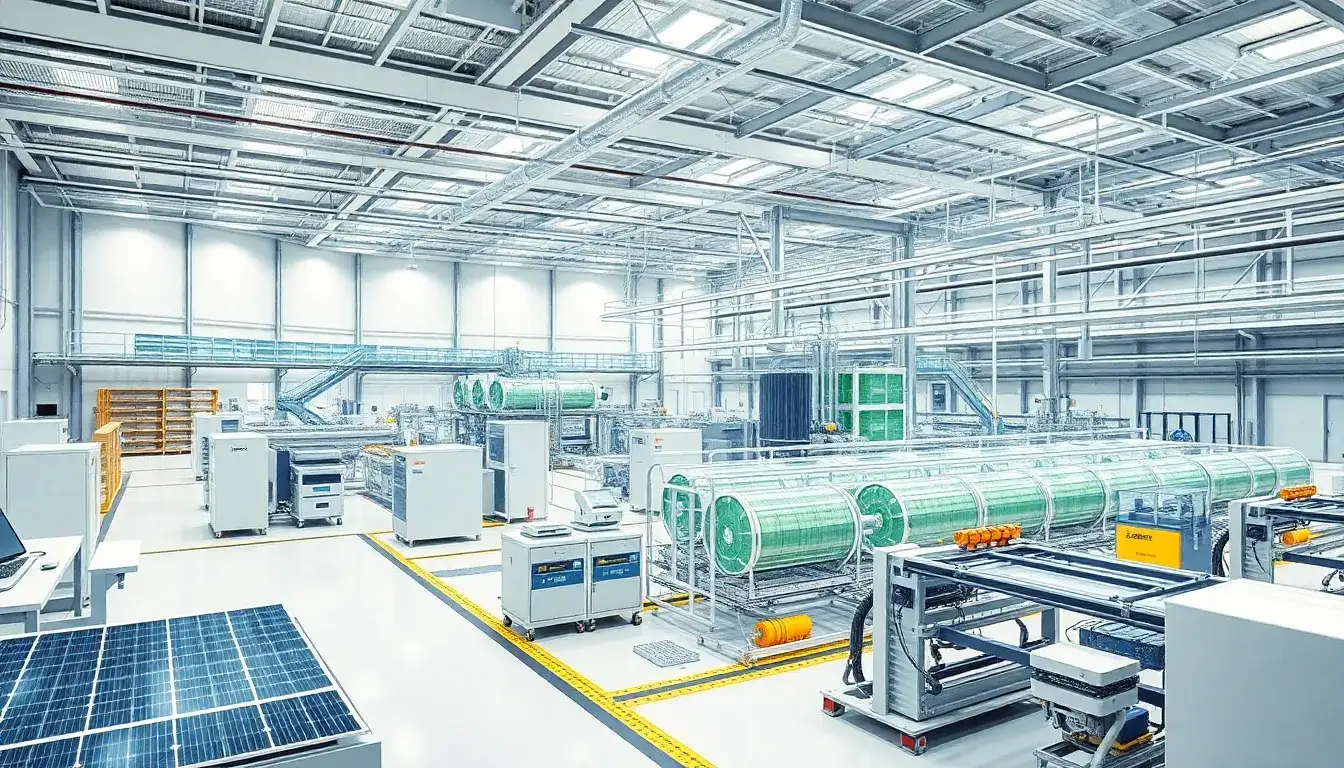
More Innovation with 50% Less Production Space
===============================================
Dürr and GROB Present New Concept Factory for Battery Cell Production
Bietigheim-Bissingen, June 3, 2025 – Engineering companies Dürr and GROB are introducing a new concept factory for lithium-ion battery cells that emphasizes reduced space and energy requirements while enhancing performance and achieving the highest quality in battery cells. At this year’s “The Battery Show Europe” trade fair in Stuttgart, the two partners will be the largest exhibitors, showcasing the technical innovations that make this progress possible.
Key technologies featured include the dry coating of electrodes, which eliminates the need for a drying process, and the advanced Z-folder technology for cell assembly, which incorporates integrated notching. Dürr and GROB have been collaborating on production technology for lithium-ion batteries since 2022, aiming to establish themselves as system suppliers of battery production equipment in Europe and North America.
“With our expanded portfolio of highly available machines and systems, we jointly cover almost the entire value chain for battery cell production using our proprietary technologies,” says German Wankmiller, CEO of the GROB Group.
In addition to a traditional production layout that employs wet coating, the partners have developed a concept factory featuring dry coating and the innovative Z-folder technology. “Our concept factory, especially the dry coating process, represents the next generation of battery cell production. Thanks to powerful and innovative technologies, production now requires 50% less space and energy. For our customers, this translates to significantly higher space efficiency and lower operating costs,” explains Dr. Jochen Weyrauch, CEO of Dürr AG.
### Efficient and Sustainable Dry Coating
The Activated Dry Electrode® process replaces conventional slurry with a dry-mixed active material. This powder mixture is pressed into a free-standing film using calender machines, which is then laminated onto both sides of the collector foil. This method eliminates the drying process as well as the recovery and treatment of solvents, resulting in significant savings in space, energy, and costs.
The free-standing film offers additional material efficiency benefits, as any excess film can be fully returned to the production process prior to lamination onto the collector foil. After calendering, the coat weight can be measured directly, allowing for better control of the coating thickness. The lamination to the collector foil requires less force compared to the wet coating process, preventing deformation of the foil and enhancing its processability for subsequent notching and stacking.
### High-Speed Cell Assembly
With the new generation of Z-folders that integrate the notching process, GROB achieves higher performance in a compact space. For enhanced stability and reliability, the separator is guided over several deflection rollers with very even and low web tension. Thanks to a premium magazine buffer system for the electrodes, the system boasts a 95% availability rate.
### Precise Electrolyte Filling Under High Pressure
Dürr has developed a process that enables battery cells to be filled in a single step without residual gas. Unlike conventional methods, the electrolyte is filled directly into the cells at pressures of up to 30 bar, which is two to three times higher than the current industry standard. This design allows for precise dosing and shortens both the filling process and the subsequent penetration of the electrolyte into the active material.
### End-to-End Digitalization
The equipment technology from Dürr and GROB is complemented by comprehensive digital mapping of the production process. Even during the planning phase, a digital twin enables the simulation of the entire factory, expediting onsite implementation. Data from this simulation is integrated into the MES/MOM software of Dürr’s subsidiary iTAC, which facilitates control and planning of all production steps in battery manufacturing. Key functions include traceability and quality analysis to minimize production errors, leading to high overall equipment effectiveness.
### Innovations in Wet Coating
Dürr has also optimized its technologies for performance and energy efficiency in the traditional wet coating process. For instance, the automation of the coating station and the slot dies creates a closed control loop for layer thickness, resulting in faster production start-ups and a reduced scrap rate.
In the drying phase, battery manufacturers can utilize laser dryers to achieve a web speed that is 50% faster, along with energy-efficient drying. After drying, the electrode coating undergoes densification using calendering machines. The machines from Dürr’s subsidiary Ingecal operate with exceptional precision through “Dynamic Gap Control,” where two sensors measure the distance between rollers with an accuracy of 0.5 µm. This ensures a uniform layer thickness while applying only the necessary force.
From June 3 to 5 at the Battery Show Europe 2025, Dürr and GROB will showcase their concept factory as a physical 3D model, alongside other technologies for battery production, at their joint booth E50 in Hall 10 of the Stuttgart Exhibition Center. Dürr will also introduce a new name for its products related to electrode coating and electrolyte filling under the brand “X.Cellify.”
This concept factory illustrates a comparison between a state-of-the-art process and a next-generation process that requires 50% less space and energy.
Original article by NenPower, If reposted, please credit the source: https://nenpower.com/blog/durr-and-grob-unveil-innovative-concept-factory-for-battery-cell-production-with-50-reduced-space-and-energy-requirements/

