

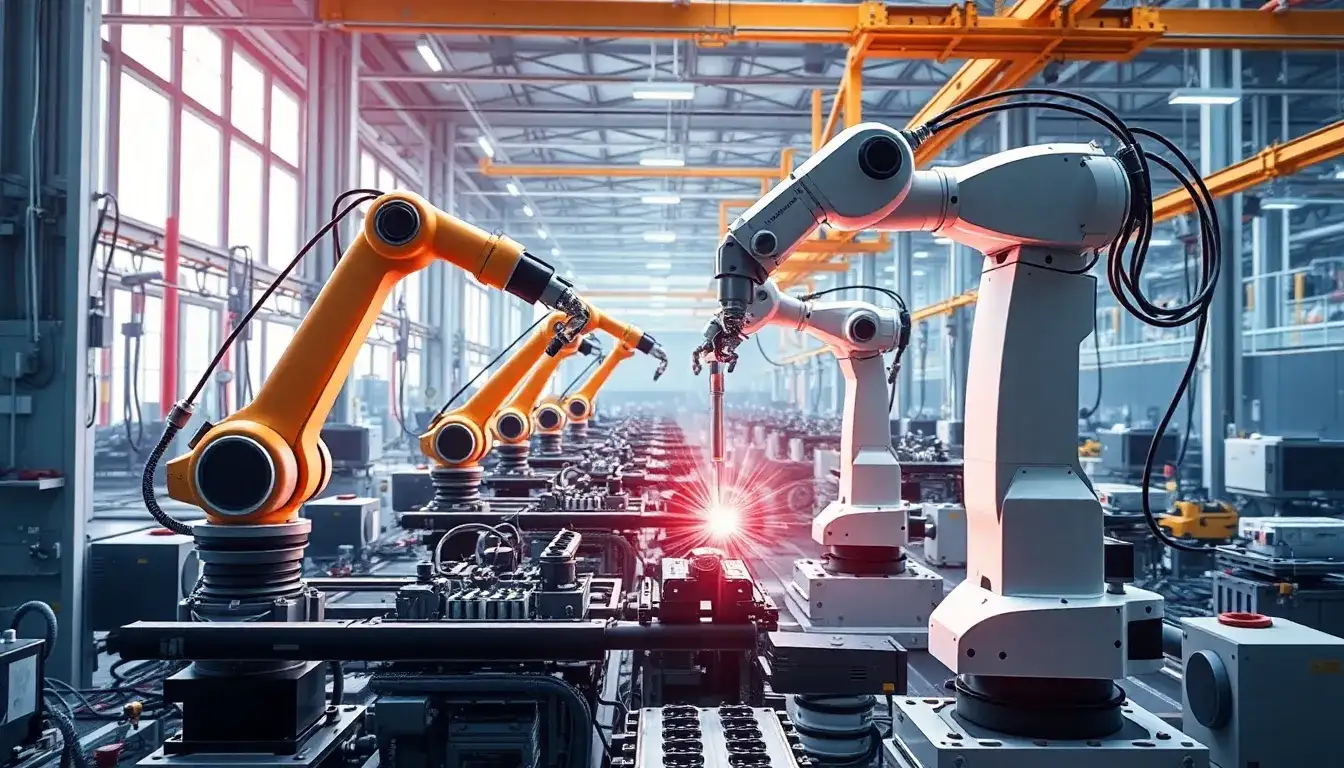
Domestic companies have achieved a milestone by topping the Chinese industrial robot market for the first time, surpassing Fanuc with shipments exceeding 30,000 units.
China is the largest industrial robot market globally. According to data from MIR Industrial Research, last year’s shipment volume surpassed 300,000 units, marking a 13.6% year-on-year growth to 334,062 units. The primary growth support for the industrial robot market comes from downstream demand in sectors such as semiconductors, complete vehicles, automotive electronics, automotive parts, lithium batteries, and electronics, with electronics remaining the largest sector. In contrast, industries like metal products, chemical products, home appliances, food and beverages, and warehousing logistics have seen growth rates significantly lower than the overall market, while the photovoltaic sector even experienced negative growth, closely linked to market conditions.
Breaking down by model type, Cobots (collaborative robots) saw a year-on-year shipment increase of 33%, making it the fastest-growing model, with acceleration in penetration within the automotive sector. Shipments of SCARA (Selective Compliant Assembly Robot Arm), >20kg 6-axis robots, ≤20kg 6-axis robots, and Delta (parallel robots) grew year-on-year by 13.8%, 12.0%, 9.1%, and 7.3%, respectively.
As the domestic substitution process accelerates, the market share of local manufacturers has steadily increased from less than 29% in 2020 to 55%, continuously capturing market share from foreign brands such as Fanuc, KUKA (100% owned by Midea), ABB, Epson, Yaskawa, and Yamaha. The market share of foreign manufacturers has dropped from over 71% to 45%.
Rokae has climbed one position to rank ninth, with sales exceeding 10,000 units, the highest growth rate among the top ten domestic industrial robot manufacturers. Founded in 2014, the company offers a product line of industrial and collaborative robots with load capacities ranging from 3kg to 220kg and a reach of 475mm to 3201mm. They have provided robots and robotic solutions to over 1,000 clients across various industries in around 40 countries and regions. Notable clients include consumer electronics companies like Xiaomi and GoerTek, as well as automotive parts manufacturers such as Valeo and Foton Cummins.
Ranked seventh, EFORT, which originated from Chery, currently has a diverse product portfolio that includes welding, spraying, SCARA, desktop, small load, medium load, large load, palletizing, and collaborative robots, with over 80 different products widely used in the automotive and automotive parts, electronics manufacturing, photovoltaic, lithium battery, metal products, furniture, home appliances, and food and beverage industries. In early 2026, EFORT announced its plan to acquire Shanghai Shengpu, a company deeply involved in the photovoltaic sector, known for its expertise in coating equipment and automation for battery cells, with established ties to leading firms like Longi, Tongwei, and Jinko.
In fourth place, INOVANCE has reported shipments exceeding 20,000 units. This company, often referred to as the “Little Huawei” of industrial automation, possesses core technologies in servo systems and low-voltage variable frequency drives. Entering the industrial robot field in 2014, INOVANCE has launched several industrial robot products across various load segments, including SCARA robots, desktop small six-axis robots, medium six-axis robots, and large six-axis robots with a load capacity of up to 300kg, used in diverse applications such as handling, sorting, assembly, dispensing, welding, polishing, and bending across multiple industries like mobile phones, lithium batteries, displays, photovoltaics, and automotive.
Three companies have surpassed shipments of 30,000 units. ESTUN has maintained its position as the top domestic brand in industrial robot shipments for eight consecutive years, and in 2025, it surpassed Japan’s Fanuc for the first time, achieving the top spot in the domestic market with a market share of 10.6%. Established in 1993 and headquartered in Nanjing, Jiangsu, ESTUN entered the robotics field in 2011. Following its IPO in 2015, it has expanded through a series of international acquisitions, including acquiring Trio Motion Technology in the UK to enhance its high-end controller capabilities, and securing M.A.I in Germany and Barrett in the U.S. to strengthen its capabilities in metal processing and high-performance servo technologies. In 2025, ESTUN completed a significant milestone by delivering the first fully domestically produced heavy-load robotic stamping line for automotive cover parts. Currently, ESTUN offers 96 models of industrial robots (50 general-purpose and 46 industry-specific), covering loads from 3kg to 1000kg, and is widely used in automotive, photovoltaic, lithium battery, automotive parts, electronics manufacturing, engineering machinery, and offshore vessels.
Despite achieving the number one position in domestic sales, ESTUN still faces significant gaps compared to the international “four giants” (Fanuc, Yaskawa, KUKA, ABB). In the first three quarters of 2025, ESTUN reported a revenue of 3.8 billion yuan, a year-on-year increase of 12.97%, and a net profit of 29 million yuan, up 143%. The company expects to achieve an annual profit ranging from 35 million to 50 million yuan, successfully turning a profit. Earlier this year, ESTUN launched the iER series of robots, the iER.OS robotic control system, and the RoboBase platform focused on the industrial robot + AI application ecosystem.
Original article by NenPower, If reposted, please credit the source: https://nenpower.com/blog/domestic-companies-lead-chinas-industrial-robot-market-surpassing-fanuc-with-over-30000-units-shipped/

