

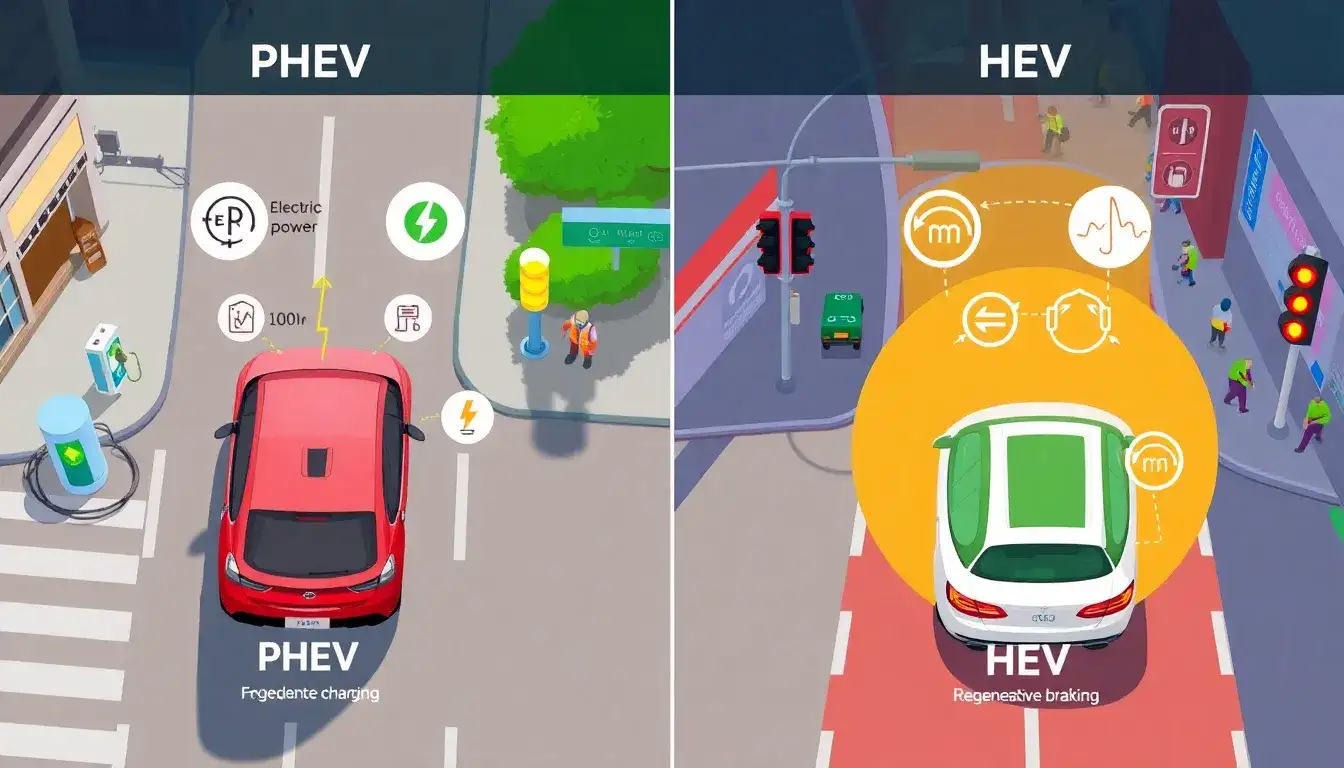
When comparing maintenance requirements of Plug-In Hybrid Electric Vehicles (PHEVs) and Hybrid Electric Vehicles (HEVs) specifically in city driving conditions, the key differences hinge on their mechanical complexity and usage patterns.
Mechanical Complexity and Components
PHEVs are mechanically more complex than HEVs because they combine both a gasoline-powered internal combustion engine (ICE) and a larger electric battery pack that can be externally charged. This means PHEVs have more components that could potentially require maintenance:
- Gasoline engine and transmission components similar to HEVs
- An electric motor and a larger traction battery pack
- Power electronics related to battery charging and electric drive
HEVs also have gasoline engines and electric motors but feature smaller batteries charged only through regenerative braking and the ICE, making their electrical systems less complex than PHEVs.
Maintenance in City Driving
In city driving, PHEVs often operate more on electric power alone, which reduces the use of the ICE, limiting wear and tear on gasoline engine components. This reduced ICE usage can lead to lower engine maintenance needs over time as long as the battery is sufficiently charged and the vehicle is driven mostly in electric mode.
However, because PHEVs have bigger batteries and more complex electronics, the potential maintenance cost related to these systems could be higher over the vehicle’s life. But overall maintenance costs for PHEVs and HEVs are generally comparable to or lower than traditional gas vehicles, as regenerative braking reduces brake wear on both types.
Empirical Maintenance Cost Data
Consumer Reports found that PHEVs and all-electric vehicles have similar maintenance costs, roughly three cents per mile, which is about half the cost of conventional gas cars. This suggests that despite their greater complexity, PHEVs do not necessarily incur significantly higher maintenance costs than HEVs in typical use.
Summary
- PHEVs have more mechanical complexity and potentially higher maintenance needs on electric components compared to HEVs.
- In city driving, PHEVs can rely heavily on electric power, reducing ICE wear and potentially lowering engine maintenance compared to HEVs.
- Overall maintenance costs for PHEVs are similar to HEVs and lower than conventional vehicles, assuming consistent electric driving to minimize gasoline engine use.
- Regenerative braking on both helps reduce brake system maintenance for both vehicle types.
Therefore, PHEVs do not categorically require more maintenance than HEVs in city driving conditions; their maintenance burden depends on how often the vehicle is driven in electric mode versus gasoline mode and the associated battery maintenance. If driven mostly on electricity, a PHEV may have equal or even less maintenance related to the ICE compared to an HEV, but may have slightly higher maintenance related to its more complex electrical systems.
Original article by NenPower, If reposted, please credit the source: https://nenpower.com/blog/do-phevs-require-more-maintenance-than-hevs-in-city-driving-conditions/

