

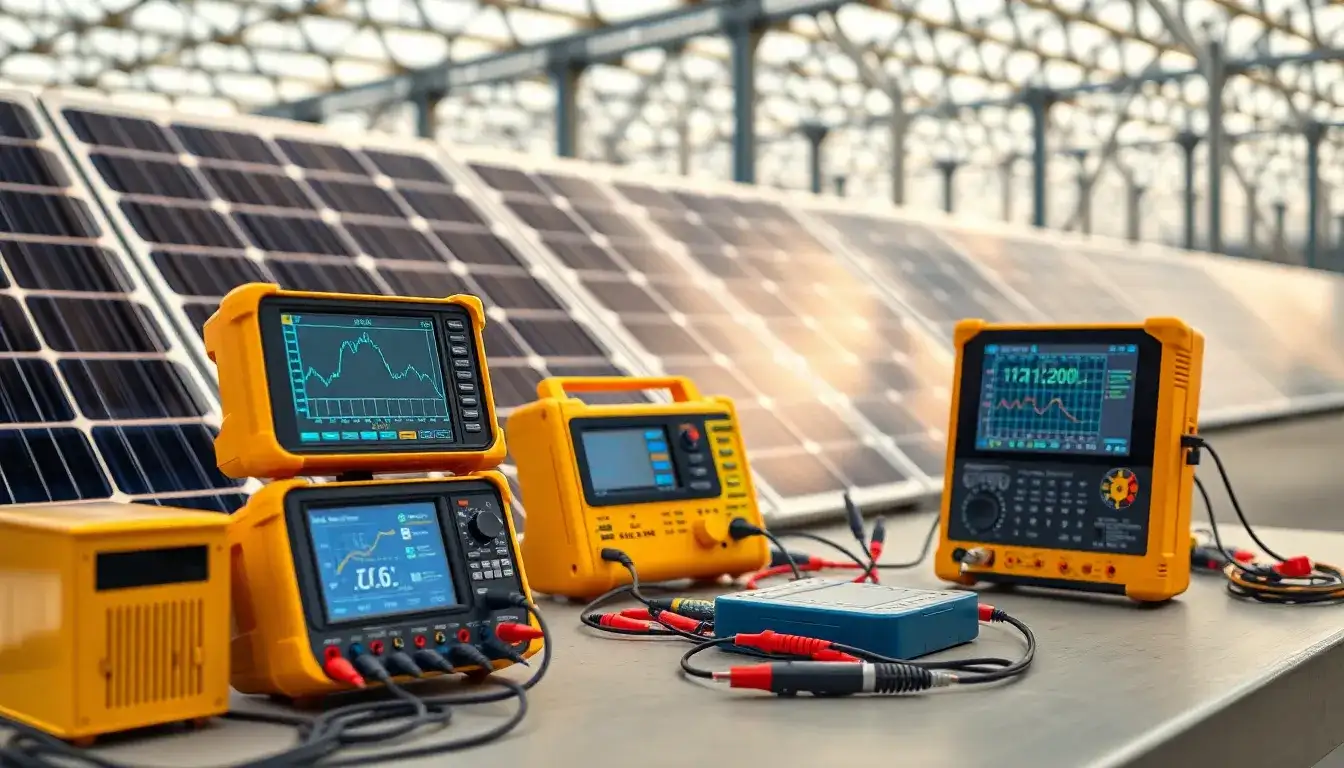
Introduction to I-V Curve Testing Instruments for Photovoltaic Power Stations
The I-V curve testing instrument is a specialized tool used for rapid on-site testing of photovoltaic modules or systems, focusing on the current-voltage (I-V) characteristics. This instrument allows users to assess the performance of solar installations, identify potential issues, and evaluate the efficiency of solar energy production.
When a photovoltaic module is illuminated, the current (I) and voltage (V) generated can reflect the module’s fundamental operating conditions. The testing instrument records these variations in real-time and automatically generates the “I-V curve.” This curve is essential for understanding the overall performance of the solar module.
The capabilities of the I-V curve testing instrument include:
- Measuring the voltage and current of photovoltaic modules or strings during operation.
- Incorporating a reference device to ensure accurate solar irradiance measurement.
- Testing module and string efficiency under various environmental conditions.
- Providing visual representations of I-V curves and identifying performance issues such as shading or connection faults.
The instrument is equipped with various features, including:
- External casing designed for ease of use, ensuring protection against small impacts and water exposure.
- A display that shows the I-V and P-V curves along with key electrical parameters such as short-circuit current (Isc), open-circuit voltage (Voc), and maximum power (Pmax).
- Battery-powered operation with a simple interface for starting and stopping tests.
- Temperature and irradiance sensors to provide accurate data during testing conditions.
- Data logging capabilities to store results for further analysis.
- Software integration for enhanced data processing and reporting.
In application, the I-V curve testing instrument is crucial for maintenance and quality assurance in photovoltaic power stations:
- Routine checks to verify system performance and efficiency.
- Fast assessment during troubleshooting to identify underperforming modules.
- Data comparison against standard testing conditions (STC) for performance validation.
To ensure reliable results, it is important to maintain the instrument’s calibration and to perform testing under stable environmental conditions, typically within 5% of standard conditions.
In conclusion, the I-V curve testing instrument is an essential tool for anyone involved in the operation, maintenance, and evaluation of photovoltaic power systems. Its ability to provide immediate performance data helps optimize energy production and maintain system efficiency.
Original article by NenPower, If reposted, please credit the source: https://nenpower.com/blog/detailed-overview-of-i-v-curve-testing-instruments-in-solar-power-stations/

