

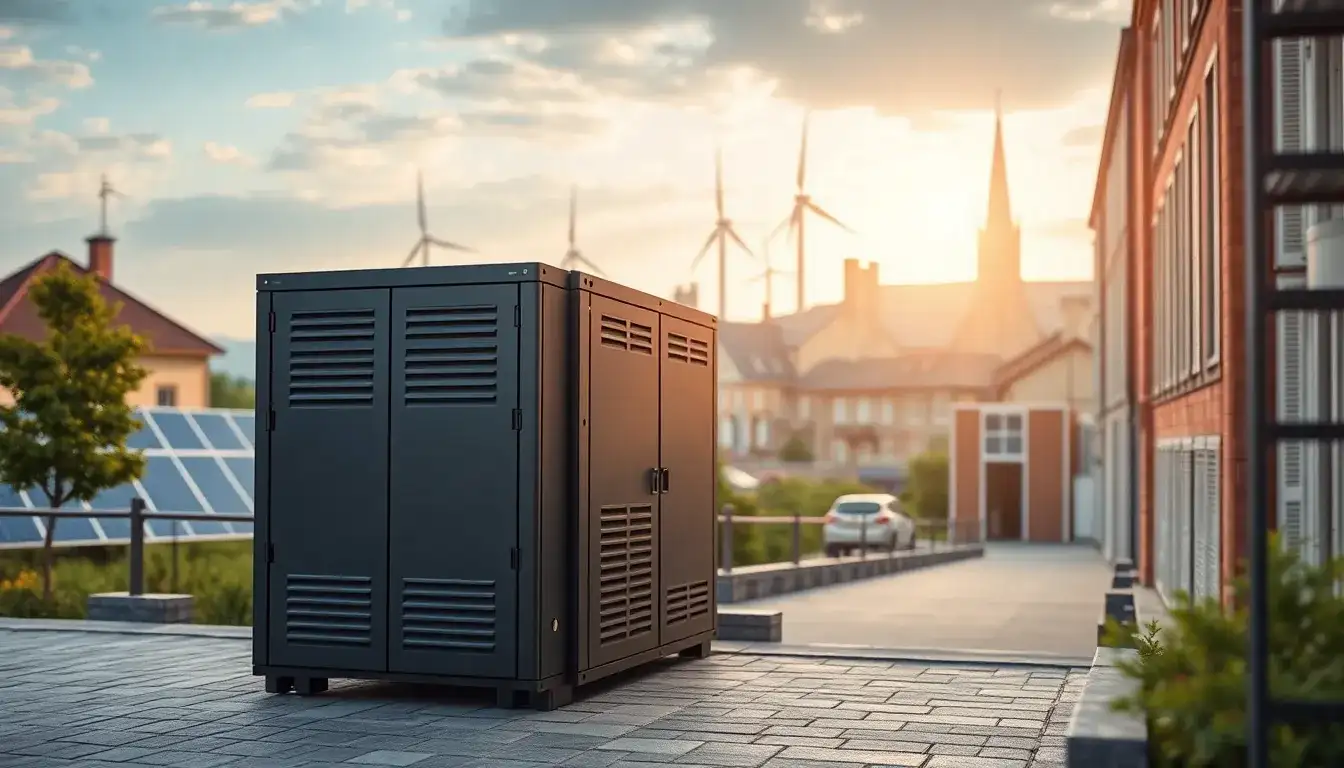
Desay Battery is leveraging its comprehensive energy storage technology to enhance energy security in Europe amidst a rapidly evolving energy landscape and frequent extreme weather events. On April 28, a massive power outage struck Spain and Portugal, causing chaos in critical sectors such as transportation, communications, and healthcare, affecting over 50 million people. This incident, which also impacted France, Portugal, and Italy, highlighted the vulnerabilities of the European power grid and exposed deeper contradictions as renewable energy sources surpassed 40% of the energy mix. The intermittency of wind and solar power has increased grid fluctuations, and with the phasing out of traditional thermal power, the system’s inertia has significantly declined, compromising frequency regulation capabilities.
According to data from the European Association for Storage of Energy (EASE), the European Union will need to add at least 200 GW of energy storage capacity by 2030 to stabilize the grid amid the green energy transition. In this context, Desay Battery is emerging as a key player, with its full-stack technological capabilities and global presence poised to break the impasse.
As the demand for reliable power solutions rises, especially in commercial and industrial scenarios that require stringent power guarantees, the cascading effects of outages, such as transportation disruptions and business interruptions, further underscore the urgent need for emergency backup power sources. On May 7, 2025, at the The Smarter E Europe 2025 exhibition in Munich, Desay Battery introduced its UPS 2.0 solution, designed to provide reliable power support for data centers, communication bases, and industrial automation.
This product features a lithium battery cabinet capable of delivering 300 kVA power output and 49 kWh storage capacity, with an impressive 8C high discharge capability to meet the power demands of large data centers and communication bases. Utilizing lithium iron phosphate (LiFePO4) battery technology ensures high energy density and long cycle life, while rapid response capabilities offer stable support for peak shaving and frequency regulation applications.
Moreover, the Desay Battery UPS 2.0 solution boasts an extended lifespan of 15 years, significantly surpassing the typical 8 to 10 years of standard UPS equipment in the industry. An intelligent monitoring system enables real-time battery status monitoring and predictive maintenance, ensuring continuous and stable operation. The product is adaptable to both 2-line and 3-line UPS cabinets, with a voltage range and communication protocols that are fully compatible with major UPS brands.
Addressing prevalent safety concerns, Desay Battery has developed a comprehensive protective scheme that spans across the battery cell, pack, cabinet, and system levels. Through innovative materials, mechanical protection, and intelligent monitoring, the solution actively defends against potential safety hazards. With the support of Desay Battery’s self-developed active safety energy storage cells, the solution has entered the era of “eight protective measures.” The cell utilizes innovative PE + ceramic separator technology, successfully passing the national standard puncture thermal runaway test. The PACK level is equipped with a perfluorohexane fire extinguishing system, dual active defense mechanisms, while the cabinet level incorporates fuse protection and directional explosion venting. Additionally, the system-level features efficient gas and water fire protection, EMS intelligent protection, and active safety energy storage cells, enhancing overall system safety.
From an economic perspective, the solution has achieved significant breakthroughs. An innovative cabinet transportation scheme can reduce installation costs by 90%. Additionally, the high energy density lithium battery design decreases the footprint by 70%, greatly improving space utilization. In the long term, the 15-year lifespan also significantly lowers the total lifecycle cost, creating lasting value for customers.
However, the primary challenge for Chinese companies in expanding into the European market lies in compliance with the EU’s new battery regulations. Desay Battery has made strides in this area as well. During the exhibition, the company signed a strategic cooperation agreement with the international certification body TÜV Rheinland. Desay Battery’s latest UPS lithium battery cabinet 2.0 has received multiple certifications, including CB 62619, CE LVD, and CE EMC, ensuring compliance with the new EU battery law and ROHS environmental directives.
As energy storage systems transition from traditional single energy storage units to smart grid nodes with advanced functions, the current trend of energy integration is evident at the Munich exhibition. The event, themed “Accelerating Integrated Energy Solutions”, focused on the deep integration of renewable energy and the grid. Desay Battery showcased its complete technology matrix covering battery cells, modules, and system integration, vividly illustrating the unique advantages of energy storage products and their role in driving energy transition.
Desay Battery maintains a commitment to quality and safety, continually enhancing its product offerings. Its 100Ah, 280Ah, and 314Ah lithium battery products, along with 60Ah sodium batteries, form a diversified battery cell matrix. Notably, both the 100Ah and 280Ah cells demonstrate exceptional performance with zero degradation after a thousand charge-discharge cycles, having successfully passed rigorous certification tests such as GB/T36276 and UL1973, earning consistent praise from users. In response to the increasing market penetration of the 314Ah cell, the company has launched a high-performance version with a tested capacity exceeding 324Ah and an energy density of 178Wh/kg. Through material innovation and process optimization, the 314Ah energy storage cell achieves an impressive energy efficiency of 95% and a standard cycle life of 12,000 cycles at 25°C, significantly enhancing the economic performance and longevity of energy storage systems.
In the area of system integration, Desay Battery’s 215kWh and 344kWh commercial energy storage cabinets have been developed entirely in-house, featuring a highly integrated CCS solution that substantially boosts system reliability and energy density. Large-scale storage solutions like the 5MWh liquid-cooled container meet high standards for integration, efficiency, and safety, perfectly aligning with the European market’s core demands for safety and modular rapid deployment. During the exhibition, Desay Battery collaborated with TÜV Rheinland to complete the certification process for its 5MWh container storage system, further demonstrating its competitive edge in the international energy storage arena.
In comparison to the UPS lithium battery cabinet 2.0, the 5MWh container storage system has a broader certification scope, meeting not only the basic CB 62619, CB 63056, CE LVD/EMC but also North American standards like UL 1973 and UL 9540A, showcasing the product’s global applicability. It is particularly noteworthy that this certification process will rigorously assess compliance with the EU’s new battery law regarding carbon footprint and recycling sustainability requirements.
In the rapidly growing residential energy storage market, Desay Battery provides flexible and efficient clean energy options for European households through its low-voltage home storage split units and 280Ah high-voltage home storage systems, utilizing differentiated voltage designs and intelligent energy management functionalities.
As a leader in energy storage on a global scale, Desay Battery has been recognized in the BloombergNEF list of Tier 1 energy storage manufacturers for the second quarter of 2025, thanks to its solid technological foundation, reliable project delivery quality, and increasing global brand influence. This recognition not only signifies Desay Battery’s emergence as a core player in the global energy storage industry but also highlights its remarkable achievements in technological innovation, market influence, and brand development.
Continuing to strengthen its energy storage OEM business, Desay Battery is deepening strategic collaborations with major clients, focusing on expanding the residential, commercial, and independent shared energy storage markets. By intensifying efforts to explore overseas markets and continuously improving its full industry chain service capabilities from product development to system integration, Desay Battery aims to provide technical support for building a stable, economical, and sustainable green energy ecosystem.
Looking back from the perspective of 2025, Desay Battery’s trajectory reflects the qualitative transformation of China’s energy storage industry, from contract manufacturing to standard-setting. The company’s rise is not only a microcosm of China’s energy storage industry’s ascent but also serves as a model for industry development through its innovations and breakthroughs in energy storage technology, market expansion, and safety protection.
In Desay Battery’s future vision, the boundaries of the energy revolution continue to expand. As the global energy transition enters deeper waters, Europe still grapples with the pains of its energy transformation. However, amid the bustling crowd at the Munich exhibition, Desay Battery is quietly scripting a new narrative for Chinese manufacturing—one where new energy is no longer merely a pursuit of Western technology but rather an equal dialogue about a sustainable future.
Original article by NenPower, If reposted, please credit the source: https://nenpower.com/blog/desay-batterys-all-stack-energy-storage-technology-revolutionizes-europes-energy-security-landscape/

