

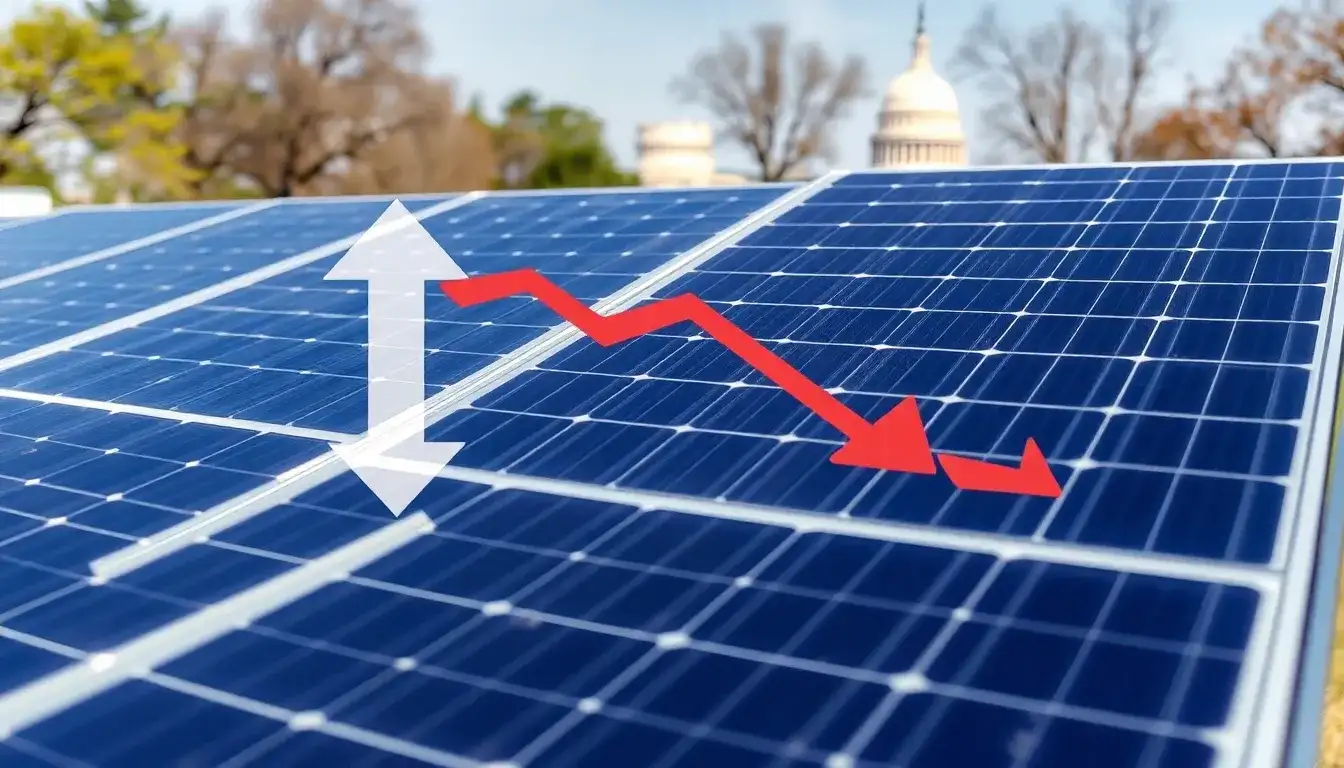
China International Capital Corporation (CICC) has released a research report indicating a recent decline in prices across the photovoltaic (PV) industry chain. The operating rates of components and silicon materials have gradually weakened, reflecting the conclusion of the installation rush. Additionally, fluctuations in component prices and uncertainty in electricity prices have led to occasional cancellations of PV project tenders. Recently, regions such as Shandong and Guangdong have issued solicitations for feedback regarding mechanism power generation, prompting attention to the upcoming announcements on mechanism power generation and electricity price results in the market.
The U.S. House of Representatives has formally introduced the tax plan titled The One Big, Beautiful Bill, which includes advanced manufacturing subsidies for photovoltaics and ITC/PTC subsidies that are better than market expectations. However, this proposal was not approved in the House Budget Committee vote, and its future remains uncertain. Nonetheless, the likelihood of rapid declines in photovoltaic subsidies and tax credits appears low.
In terms of the main photovoltaic industry chain, prices are experiencing a comprehensive decline amid demand uncertainty, necessitating close observation of companies’ operational statuses and technological changes in the supply side in the short term. The price of silicon materials has seen a rapid decrease, leading to an increased willingness among companies to maintain price levels. However, there is a notable trend of component manufacturers reducing prices to secure orders, and component prices are expected to have further downward potential.
From a relative yield perspective: 1) If the operational status of silicon material production becomes clearer, attention should be given to leading silicon companies such as Tongwei Co., Ltd. (600438.SH), Daqo New Energy (688303.SH), and granular silicon technology; 2) The competitiveness of BC technology is gradually emerging, making Aikang Co., Ltd. (600732.SH) worth watching; 3) Opportunities for technological iteration in the slurry segment, such as Juhua Materials (688503.SH).
In the auxiliary materials segment of the photovoltaic industry chain, the decrease in component production has led to an increase in glass inventory days, while inverter production in Q2 is expected to grow. In terms of glass, inventory days have continued to rise, with about 28.22 days recorded last week, marking a month-on-month increase of 1.48%. This increase is primarily due to the decline in component production in May, and glass inventory days are anticipated to continue rising. For encapsulant materials, attention should be given to companies with potential second growth curves, such as Haiyou New Materials, which is expected to see significant growth in 2025.
Regarding inverters, the demand for large-scale solar storage remains resilient, with robust opportunities emerging in markets such as Europe, India, and the Middle East. There is optimism for leading enterprises in large-scale solar storage inverters. Additionally, Q2 is traditionally a peak season for household storage inverters, with expected demand increases in Eastern Europe, Southeast Asia, and Africa. Relevant stocks to monitor include Deye Technology (605117.SH), Xinyi Solar (00968), Haiyou New Materials (688680.SH), and Sungrow Power Supply (300827.SZ).
Risk Factors: Risks associated with photovoltaic demand falling short of expectations, supply-side reforms not meeting projections, and trade policy risks.
Original article by NenPower, If reposted, please credit the source: https://nenpower.com/blog/declining-demand-and-price-adjustments-in-the-solar-industry-amidst-u-s-subsidy-changes/

