The daily volume of token calls has exceeded 140 trillion, marking a growth of over 1,000 times in two years—highlighting the continuous release of the value of data elements.
On March 25, 2026, it was reported that the daily volume of token calls in China has surpassed 140 trillion, reflecting a remarkable increase of more than 1,000 times since early 2024. This development indicates that the growth of artificial intelligence in the country has entered a rapid expansion phase, signifying a substantial increase in the supply of data sets and the ongoing release of the value of data elements. The interaction between data elements and the innovation of artificial intelligence is now thriving.
Diverse Application Scenarios
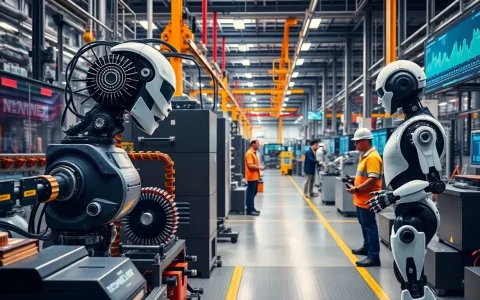
In the past, it took four people approximately 25 minutes to handle a tire weighing over 200 kilograms. Now, with fully automated operations, the same task can be completed in just over 10 minutes. At the production base for XCMG heavy wheeled cranes, AGV (automated guided vehicle) robots transport materials between various stations while a digital dashboard provides a clear overview of personnel, plans, logistics, and quality information. This transformation showcases how digital and intelligent advancements are changing production and daily life.
“Wherever artificial intelligence develops, we will establish high-quality data sets,” said Liu Liehong, head of the National Data Bureau. “As the ‘artificial intelligence +’ initiative progresses, the construction and promotion of high-quality industry data sets will follow suit.” Thanks to collaborative efforts, significant progress has been made in building high-quality data sets. By the end of 2025, over 100,000 high-quality data sets are expected to be established nationwide, totaling more than 890 petabytes—equivalent to about 310 times the total digital resources of the National Library of China.
From the emergence of the DeepSeek open-source model last year to the recent surge in interest in “farming lobsters” with OpenClaw, the production and utilization of data elements are expanding rapidly amid the rapid development of artificial intelligence.
For instance, in Fujian, digital industrial belts have been established around key sectors like the Ningde new energy battery industry and the Quanzhou apparel industry. “Building on our traditional advantageous industries, we have curated 23 vertical model cultivation libraries for key industries to enhance data connectivity,” said Wang Yongli, Executive Vice Governor of Fujian Province. “Currently, some vertical models in fields such as visual technology, security, education, and marine engineering have become national benchmarks.”
During the upcoming Digital China Construction Summit, interactive zones will focus on embodied intelligent robots and digital twins, featuring over 100 immersive projects. Outside the venue, the organizers have also outlined 70 experience points for smart farming, intelligent factories, and smart quality inspection, providing the public with a clearer understanding of the practical applications of data elements.
Collaborative Efforts
As new-generation information technologies, such as artificial intelligence, continue to evolve rapidly, a key challenge is achieving efficient data collection, large-scale aggregation, and deep application. Various stakeholders, including government, enterprises, and educational institutions, are working together to promote the release of data element values.
For example, infrastructure is being strengthened. Recently, during the Mobile World Congress (MWC) in Barcelona, China Mobile unveiled the world’s first prototype of a router capable of over 100 teraflops, garnering significant attention. A representative from China Mobile stated that they would leverage their unique advantages in “network, data, and services” to actively advance the development of the robotics industry, providing robust data support for large-scale robot training. Additionally, financial services are being enhanced; China Bank has launched “BOC Sci-Tech Computing Loans” in ten cities, creating a model that integrates “government computing vouchers” with bank computing loans to offer tailored services.
“By the end of 2025, the CNC rate of key processes in major industry enterprises is expected to reach 68.6%. A batch of special 5G chips, modules, and terminal products for industry will be developed. Previously ‘dumb’ devices in industrial settings are now turning into intelligent sensors, laying a solid foundation for the aggregation and application of massive industrial data,” said Wang Yanqing, director of the Information Technology Development Department of the Ministry of Industry and Information Technology. This year, the ministry has initiated an industrial data foundation action aiming to pioneer high-quality industry data set construction.
Empowering Industries and Improving Lives
Hu Jianbo, director of the National Data Development Research Institute, believes that as a new type of production factor, the value of data will expand from local to global applications. Through collaborative synergy with land, capital, and technology, it will profoundly alter the methods of value creation and distribution, driving industrial upgrades and innovation in business models.
In Shandong, the “Farmland Brain” employs edge computing nodes to process image data in real-time, dynamically adjusting pesticide application paths with a targeting accuracy of 95%, enhancing efficiency and ecological benefits. In Fujian, data empowerment has enabled the expansion of mutual recognition of medical examination results from 120 to 488 projects, benefiting over 500 million people. In Guizhou, meteorological data products are now being traded on the Guiyang Big Data Exchange like standardized industrial goods.
Industrial parks serve as vital platforms for China’s industrial development. With rapid advancements in artificial intelligence technology, how can these parks seize opportunities to accelerate digital transformation? Wang Yanqing stated that the Ministry of Industry and Information Technology will promote digital transformation in parks through four key areas: industrial digital transformation, digital services, digital management, and the construction of digital support capabilities. They will encourage leading enterprises to open digital scenarios and technical resources to drive collaboration across the entire industry chain and support small and medium-sized enterprises in utilizing cloud platforms. Furthermore, they will digitize land, buildings, and infrastructure assets, establish digital profiles for enterprises, enhance monitoring and analysis of industrial economic operations, energy consumption, and carbon emissions, and build an integrated emergency response system to achieve centralized management of industrial parks.
Liu Liehong noted that during the 14th Five-Year Plan period, the added value of core digital economy industries is projected to rise from 7.8% of GDP in 2020 to over 10.5% by 2025. This year, the National Data Bureau aims to cultivate digital industry clusters, grow innovative digital economy enterprises, and promote comprehensive urban digital transformation to propel the high-quality development of the digital economy.
Original article by NenPower, If reposted, please credit the source: https://nenpower.com/blog/daily-token-usage-exceeds-140-trillion-surging-over-1000-times-in-two-years-as-data-value-continues-to-unfold/