

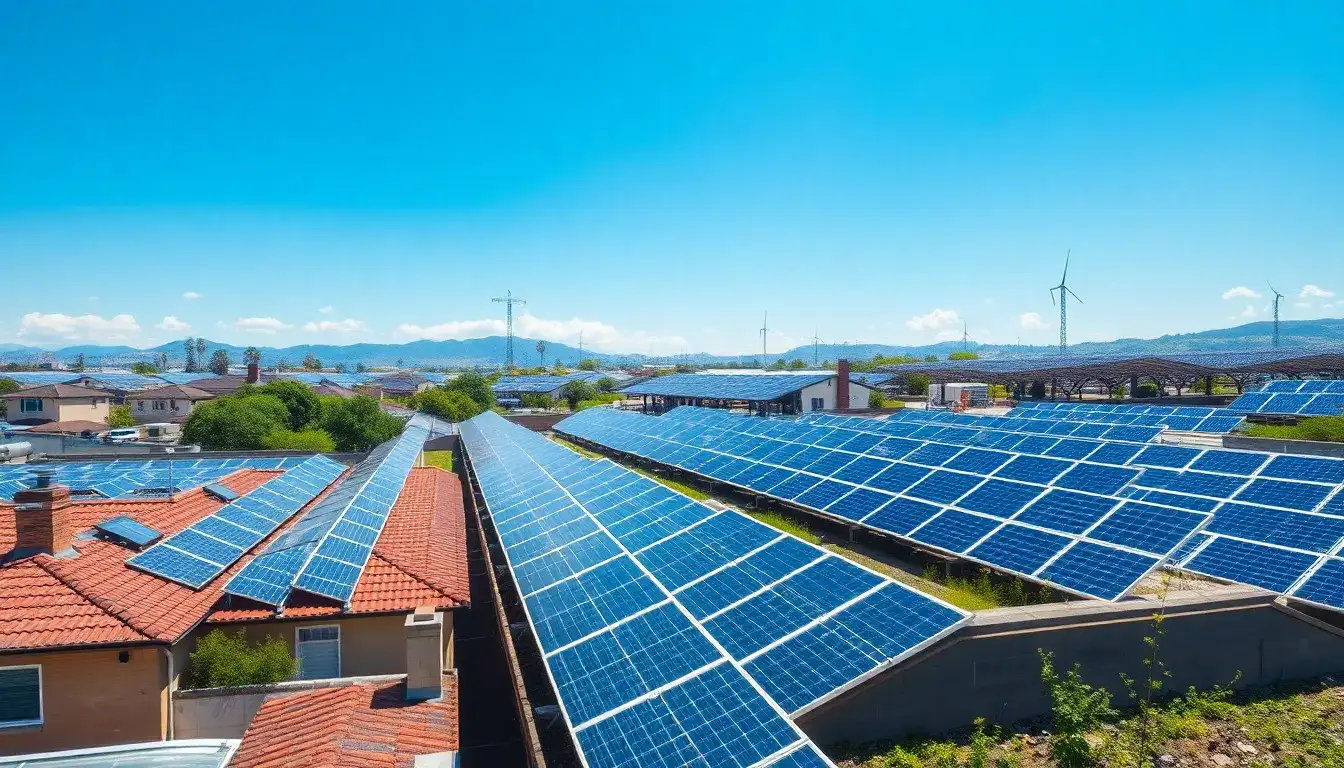
The Current State and Future Prospects of the U.S. Photovoltaic Industry
I. Composition and Changes in the U.S. Energy Structure
The United States, as the world’s largest energy consumer, has historically relied heavily on fossil fuels. However, in recent years, the country has been gradually reducing its dependence on foreign energy sources, leading to significant changes in its energy production and consumption structure. According to data from the Lawrence Berkeley National Laboratory, in 2012, the breakdown of total energy consumption in the U.S. was as follows: oil accounted for 34.7%, natural gas 26%, coal 17.4%, nuclear power 8.05%, and wind energy 1%.
<h2>II. Developments in the U.S. Photovoltaic Market</h2>
Recently, several noteworthy developments have occurred in the U.S. photovoltaic market:
<ul>
    <li><b>SunPower Changes Ownership:</b> Once one of the largest photovoltaic companies in the U.S., SunPower filed for bankruptcy in 2024 and is now set to be taken over by CompleteSolar, which will rebrand itself as SunPowerComplete. TJ Rodgers, Chairman and CEO of CompleteSolar, announced, "We are finally going to use the SunPower name, allowing our shareholders to benefit from this brand established in 1985 in Silicon Valley."</li>
    <li><b>Tariff Updates:</b> On April 11, 2025, the U.S. Customs and Border Protection (CBP) issued a tariff update indicating that 20 product categories would be exempt from the "countervailing duties" under Administrative Order 14257. This includes automatic data processors, computers, communication devices, displays, and semiconductors.</li>
    <li><b>Impact of Trade Barriers:</b> The White House issued Administrative Order 14257 on April 2, imposing a <b>10%</b> baseline tariff on most countries starting April 5, with higher tariffs for countries with significant trade deficits with the U.S. President Trump announced on April 9 that products from China could face an additional <b>50%</b> tariff, raising the total tariff rate to <b>104%</b>.</li>
    <li><b>Investment in U.S. Solar Manufacturing:</b> OCI Holdings plans to build a <b>2GW</b> solar cell manufacturing facility in the U.S. through its subsidiary, Mission Solar Energy (MSE). The project will unfold in two phases, with the first phase expected to achieve <b>1GW</b> of production capacity in the first half of 2026.</li>
    <li><b>New Manufacturing Facilities:</b> T1 Energy announced plans to construct a <b>5GW</b> solar cell manufacturing facility in Miram County, Texas, with a capital investment of approximately <b>$850 million</b>.</li>
    <li><b>Growth Projections:</b> A report by the Solar Energy Industries Association (SEIA) and Wood Mackenzie predicts that the U.S. will add an average of <b>45GW</b> of solar capacity annually over the next decade, with <b>66%</b> of all new electricity generation capacity coming from photovoltaics in 2024.</li>
</ul>

<h2>III. Future Outlook</h2>
According to the U.S. Energy Information Administration (EIA), by 2025, utility-scale solar, storage, and wind energy are expected to account for <b>93%</b> of the total installed electricity capacity. The anticipated growth includes <b>32.5GW</b> of solar capacity and <b>18GW</b> of storage capacity, alongside an increase of <b>7.7GW</b> in wind energy capacity.

<h2>IV. Conclusion</h2>
The U.S. photovoltaic industry is undergoing rapid changes, driven by technological advancements, increased investments, and evolving energy policies. As the market continues to grow, it presents numerous opportunities and challenges for stakeholders across the energy sector.
Original article by NenPower, If reposted, please credit the source: https://nenpower.com/blog/current-state-and-future-prospects-of-the-u-s-photovoltaic-industry/

