

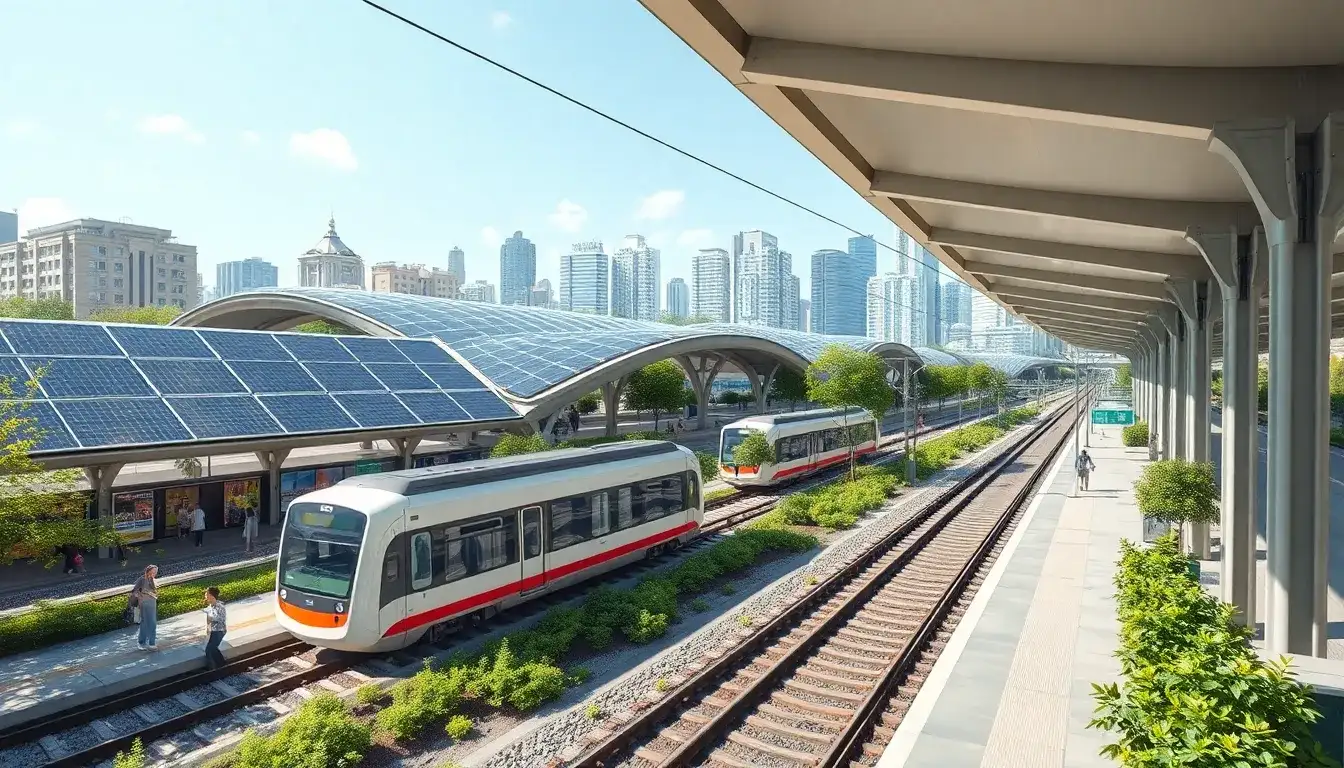
High-Growth Enterprises | China Railway Hualian: Merging Construction and Photovoltaics to Create Urban “Green Power Plants”
As a major manufacturing city, Dongguan has an abundance of industrial enterprises and a dense concentration of factories. The challenge of “awakening” industrial rooftops to generate social and economic value has become a widely discussed topic. In the context of a slowing real estate market, many construction companies are exploring new paths for development. Distributed photovoltaics have emerged as a favored area in recent years. With strong policy support, the prospects for the distributed photovoltaic market are widely optimistic. Recent data indicates that by the end of 2024, cumulative installed capacity for distributed photovoltaic power generation will reach 370 million kilowatts, a staggering 121 times the level at the end of 2013, accounting for 42% of all photovoltaic power installations. This forecast undoubtedly ignites enthusiasm among investors and the market.
For construction companies venturing into the distributed photovoltaic new energy sector, standing out amidst fierce market competition hinges on having a mature industrial chain. As a specialized and innovative enterprise in Guangdong Province, China Railway Hualian Construction Engineering Co., Ltd. (hereinafter referred to as “China Railway Hualian”) has accelerated its foray into the green energy sector in recent years. Its subsidiary, Huajing New Energy, has established a complete industrial chain for the construction of distributed photovoltaic power projects, providing an integrated solution from design and application to acceptance and operation. Currently, China Railway Hualian has rolled out distributed photovoltaic power stations to multiple industrial parks nationwide, and the revenue from this new business is rapidly increasing, becoming the company’s “second growth curve.”
Exploring Cross-Industry Collaboration in Construction and Photovoltaics
Photovoltaic power generation can be categorized into centralized and distributed systems. Currently, both types are developing alongside each other, with distributed photovoltaic generation becoming a significant force in energy transition. In recent years, China’s distributed photovoltaic sector has developed rapidly, becoming increasingly economical and reaching record high development scales. It has played a vital role in ensuring reliable electricity supply, promoting green energy transitions, and enhancing rural employment and income.
By the end of 2024, China’s cumulative installed capacity for distributed photovoltaic generation reached 370 million kilowatts, a remarkable 121 times the total at the end of 2013, with this capacity constituting 42% of all photovoltaic installations, up from just 16% in 2013. In terms of electricity generation, the distributed photovoltaic output is expected to reach 3,462 billion kilowatt-hours in 2024, representing 41% of the total photovoltaic generation.
While engineering construction and photovoltaic power stations may seem unrelated, they are closely connected. The installation of solar photovoltaic stations requires quality construction teams, bringing both sectors together. On January 8 of this year, China Railway Hualian was listed on the Guangdong Equity Exchange.
Founded over a decade ago in Dongguan, China Railway Hualian has its main business focused on engineering construction, holding 18 secondary qualifications in areas such as general contracting for construction projects, municipal public works, and electromechanical engineering. The company has gained recognition in the Dongguan construction industry, successfully completing several notable projects, including the new factory for Xu Fu Ji and the Civil Affairs Center in Ningxiang City. Through its exceptional engineering quality, the company has earned high praise from clients, gradually establishing a strong brand image within the industry, thus qualifying as a specialized and innovative enterprise in Guangdong Province.
“Although we are not experts in photovoltaic technology, we have strengths in civil engineering and electromechanical technologies required for photovoltaic projects. Why not try to develop this ourselves?” said Fu Zheng’an, General Manager of China Railway Hualian. The company boasts a robust R&D team dedicated to the research and application of construction technology. Currently, they hold 21 patents that significantly enhance engineering quality and construction efficiency, serving as one of the core driving forces for the company’s growth.
Fu noted that distributed photovoltaics offer the advantage of local development and consumption, making investment in photovoltaic projects a new direction for China Railway Hualian. With this new focus, the company did not rush into project initiation but instead invested considerable time in understanding the photovoltaic industry, from preliminary procedures and the brands of photovoltaic components to operational maintenance and even detailed research on designing and constructing photovoltaic panel supports.
“From a development perspective, the price of photovoltaic components has decreased from around 5 yuan per watt in 2013 to approximately 0.7 yuan per watt today. The new energy sector, including distributed photovoltaic power generation, has entered a market-oriented phase with no subsidies,” Fu stated. However, he also acknowledged that the growth of distributed photovoltaics faces challenges such as limited grid connection, risks to the safe and stable operation of the power system, and an incomplete regulatory framework for market participation. Particularly in recent years, the explosive growth of distributed photovoltaic generation has made grid connection a major barrier to development, necessitating a shift in management strategies to explore collaborative efforts in generation, grid, load, and storage to promote the healthy and rapid development of distributed photovoltaic power.
Initiating the Company’s “Second Growth Curve”
Wu Lijun, Chairman of China Railway Hualian, explained that amid intensified industry competition and an almost saturated market, the company is turning its attention to the more promising new energy sector. The management has keenly recognized the immense potential and development opportunities within the new energy industry, particularly in distributed photovoltaic generation and energy storage.
Unlike most competitors, China Railway Hualian has focused its distributed photovoltaic power station business on industrial park enterprises, as this is its most familiar customer segment. Wu believes that gaining a competitive edge in the distributed photovoltaic sector hinges on maximizing returns through strategic site selection, optimized design, and efficient operation. The company has established a subsidiary, Guangdong Huajing New Energy Co., Ltd., and is closely collaborating with industrial parks in Dongguan and surrounding cities to actively secure longer-term contracts. According to calculations, an investment of 3 million yuan in a 1-megawatt power project has a lifespan of 25 years, with a payback period of just 3.5 years.
Currently, China Railway Hualian has developed a specialized management team of over 30 individuals for photovoltaic power projects. Following its listing on the Guangdong Equity Exchange on January 8, 2025, the company has accelerated development in the new energy sector. Leveraging its extensive experience and advantages in construction, China Railway Hualian is vigorously advancing the construction of distributed photovoltaic power projects, with expectations that Huajing’s business volume will exceed 30 million yuan by 2025. The company’s business structure is also optimizing, having already provided distributed photovoltaic power stations to multiple industrial park partners across the country, and the contribution of this new business to total revenue is rapidly increasing. The share of photovoltaic power project intentions and signed contracts in total revenue has risen to 30%.
Once photovoltaic power stations are constructed, intelligent operation and maintenance management become crucial. On one of China Railway Hualian’s smart displays, intuitive bar graphs and various real-time data continuously inform management personnel of the operational status of the stations. Regarding capacity planning, the company has set clear goals, aiming to reach a capacity of 50 megawatts by 2025, increase it to 100 megawatts by 2026, and strive for 200 megawatts by 2027. Throughout the implementation of new energy projects, the company has established long-term stable partnerships with upstream and downstream enterprises, exploring a collaborative model that emphasizes complementary advantages and resource sharing, thereby creating a comprehensive new energy industrial chain.
Through continuous exploration, China Railway Hualian has established a complete industrial chain for photovoltaic project construction, from design and application to acceptance and operation. The company is now focusing on diversifying its involvement in the new energy sector, actively developing photovoltaic energy storage stations, smart charging stations, and centralized regional energy stations, with the aim of becoming a comprehensive service provider for photovoltaic energy system solutions. “In the future, China Railway Hualian will continue to focus on its core construction business while expanding into emerging industries such as new energy and new materials to accelerate its transformation and upgrading,” Wu concluded.
High-Growth Enterprises Dongguan Joint Research Units: Guangdong Equity Trading Center Co., Ltd., Guangdong-Hong Kong-Macao Greater Bay Area High-Growth Enterprises Club Dongguan Branch, Dongguan High-tech Industry Association, Dongguan Specialization and Innovation Enterprises Association, Dongguan Private Fund Association, Dongguan Hongyang Technology and Finance Management Co., Ltd.
Original article by NenPower, If reposted, please credit the source: https://nenpower.com/blog/cross-industry-innovation-china-railway-hualian-merges-construction-and-photovoltaics-to-create-urban-green-power-plants/

