

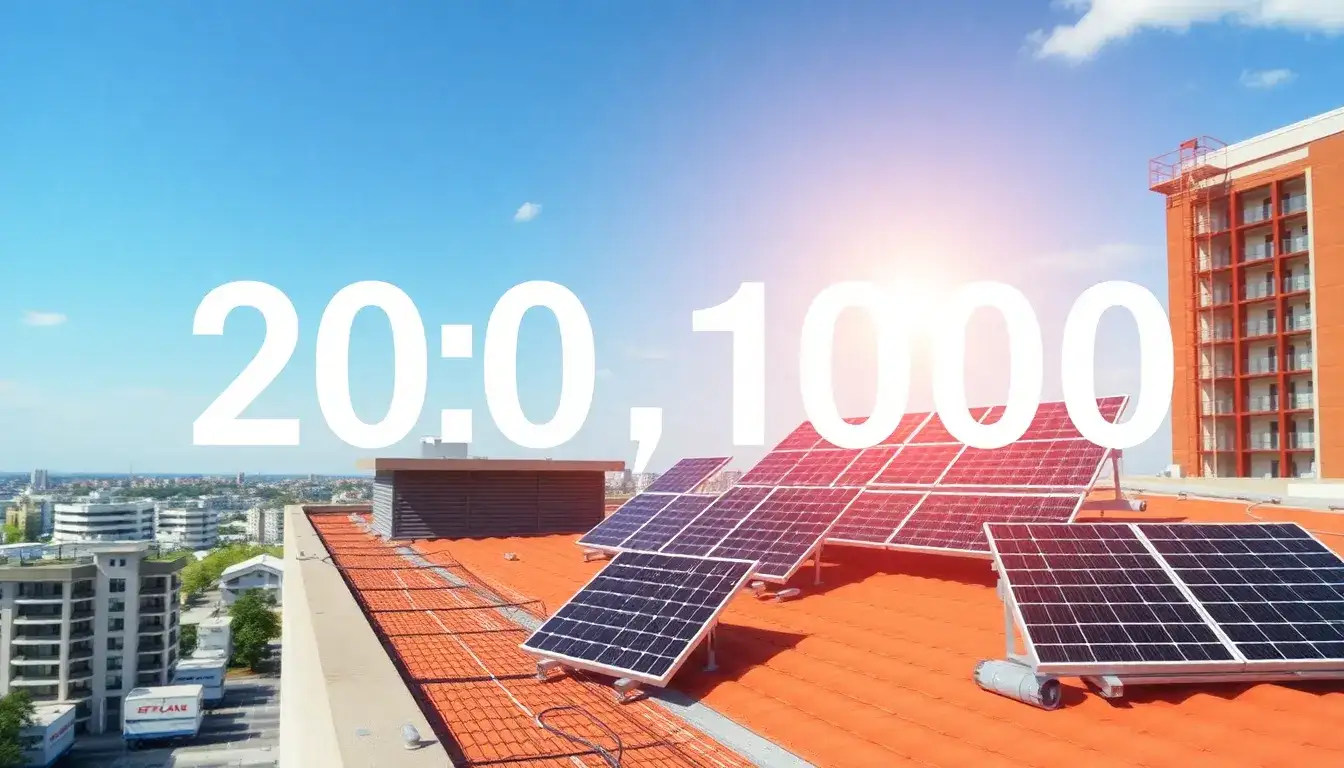
Count Down to Distributed Photovoltaic Installation: Power Generation Ratios Confirmed in Multiple Regions
The photovoltaic market in April is shrouded in a tense atmosphere of “rush installation.” As the deadlines of April 30 and May 31 approach, marking critical points for the implementation of new and old policies and the full market entry, distributed photovoltaics are entering a sprint against time.
Countdown to Distributed Installation
In this race against time, April 30 has become a “deadline” for many distributed photovoltaic projects. As specified in the Management Measures for the Development and Construction of Distributed Photovoltaic Power Generation, this date represents the division between old and new policies. Previously, distributed photovoltaic projects had significant autonomy in choosing their mode of grid connection, allowing options such as “self-consumption,” “self-consumption with surplus power fed into the grid,” or “full grid connection.” However, with the new policies, there is a complete overhaul of the grid connection modes. Common commercial and large commercial distributed photovoltaics are no longer allowed to operate on a “full grid connection” basis. Large commercial distributed systems can only use the “self-consumption with surplus power fed into the grid” mode in areas where the electricity spot market is operational, and they must also participate in the spot market.
This policy adjustment has a disruptive impact on photovoltaic project investors, significantly affecting return rates. Notably, there are clear differences in the power generation ratio requirements around the “430” deadline. Before “430,” the self-consumption ratio for commercial photovoltaic systems utilizing the “self-consumption with surplus power fed into the grid” model was not strictly regulated. After “430,” each province’s energy authority will determine the annual self-consumption ratio for general commercial photovoltaic systems, which poses considerable implications for investors and operators.
Provincial Regulations
Currently, provinces like Ningxia, Guangdong, Jilin, Hubei, and Jiangsu are implementing detailed rules. Except for Guangdong and Jiangsu, which have robust commercial sectors and high electricity consumption capacities without self-consumption restrictions, provinces like Ningxia, Hubei, and Jilin have set strict limits on the annual grid-connected power generation for general commercial projects. Ningxia, the first province to issue implementation guidelines, has stipulated that systems supported by public institutions must achieve a self-consumption ratio of at least 30%, while those based on commercial buildings must be at least 50%. Any surplus power beyond this ratio will not be accounted for in settlements. Hubei mandates that the annual grid-connected power of general commercial photovoltaic systems must not exceed 50% of their total generation; any excess may not be settled by the grid company, although businesses can apply for settlement in the following year. Furthermore, the grid-connected power from distributed photovoltaics will, in principle, fully participate in the electricity market. Jilin currently has the lowest required self-consumption ratio for general commercial photovoltaic systems, set at a minimum of 80%.
The establishment of this self-consumption threshold directly affects the economic viability of certain commercial projects, particularly those relying on “surplus power fed into the grid.” If the self-consumption ratio is insufficient, the surplus cannot be settled, necessitating a reduction in installed capacity or the addition of energy storage facilities to increase self-consumption rates, ultimately raising initial investment costs. It is also noteworthy that Hubei has mandated that all commercial distributed photovoltaic projects registered before January 17, 2025, but not yet commenced, must not start construction immediately. Projects already underway but unable to connect to the grid by May 1, 2025, must halt work and adjust their plans. Projects connecting to the grid after May 1 must comply with the new regulations regarding connection modes and settlement ratios.
Supply Chain Pressures and the Rise of Quality Enterprises
In light of these changes, many commercial owners, who were previously hesitant, are now accelerating their decision-making and installation processes. Many owners admit, “If we miss connecting to the grid before ‘430’, after May we will not only need to increase our self-consumption ratio, but re-register which may also impact electricity pricing.” The supply chain is under pressure, with high-quality enterprises emerging prominently. Compared to the inability to connect fully to the grid and the self-consumption ratio threshold at “430”, the market impact of “531” is significantly more pronounced. According to the “Document 136,” after May 31, all wind and solar projects, except solar thermal and offshore wind projects, must have their power generation fully enter the market. This means that previously sheltered distributed photovoltaics relying on policy support will now face a volatile market, complicating return on investment models and affecting project investment value.
Thus, connecting to the grid before “531” becomes the last chance to secure stable returns. However, during this critical rush installation phase, the photovoltaic industry is facing unprecedented challenges due to supply chain disruptions. Since March, mainstream component prices have surged from 0.6 yuan/W at the beginning of the year to 0.8 yuan/W, a rise of over 33%, with some areas nearing 0.9 yuan/W. Developers and distributors are facing the awkward situation of having to pay in full without receiving timely deliveries. Moreover, under the lure of profit, low-quality battery cells from small manufacturers and unregulated “private label” components have begun to flood the market, significantly increasing quality risks.
Huangyuan Green Energy’s Response
In this environment of tightened supply and numerous companies struggling to balance price, supply, and quality stability, Huangyuan Green Energy, with over 20 years of experience in the photovoltaic sector, is navigating these challenges through a comprehensive industrial chain strategy, from silicon materials to silicon wafers, from battery cells to modules, creating an efficient “green channel” for its partners.
For downstream companies, price remains a critical consideration. While many in the industry have failed to deliver on time as per contract agreements or have raised contract prices, Huangyuan Green Energy has shown strong commitment to price control. Even as industry averages surpassed 0.8 yuan/W, Huangyuan Green Energy maintained a guiding price of around 0.7 yuan/W for components, allowing project investors to retain a more substantial profit margin. Furthermore, Huangyuan has meticulously developed the HT series TOPCon components, offering up to 23.5% conversion efficiency and covering a power range of 465-730W with an 85% high bifacial ratio, maximizing power generation on limited rooftop space. Various models, including 182-54/60/72 and 210R-66, are precisely tailored to meet different rooftop loads and grid capacity requirements, effectively reducing onsite design adjustment costs.
The HT series components also feature a low temperature coefficient of -0.29/℃ and excellent low-light performance, with first-year degradation below 1%, backed by a 30-year power warranty. Quality control is ensured through stringent testing that exceeds IEC standards, such as TC600 and DH3000, guaranteeing stable operation in various challenging environments and alleviating owners’ concerns.
Market data strongly supports Huangyuan Green Energy’s role amidst market fluctuations. In the first quarter of 2025, Huangyuan Green Energy’s component shipments exceeded 1.5GW, successfully signing over 100 projects. Its production bases in Wuxi, Baotou, Xuzhou, and Chuzhou can quickly respond to market needs, greatly reducing construction time for developers and establishing an industry benchmark for “efficient performance and stable supply.” Currently, Huangyuan Green Energy has built a marketing network serving global customers across the Asia-Pacific, Europe, Latin America, and the Middle East, contributing Chinese wisdom to the global energy revolution.
A project developer noted, “Now, signing an order with Huangyuan Green Energy is valuable because they can guarantee ‘three no’s’—no price increases, no delays, and no quality reduction, which is more precious than anything else at this time.” With the “430” and “531” photovoltaic rush installation deadlines approaching, it is undoubtedly advantageous for investment firms and project owners to partner with high-quality enterprises like Huangyuan Green Energy, which offers robust product quality, stable supply, and comprehensive service. This collaboration enables quicker project establishment, earlier grid connection, and earlier returns.
If you want to learn more about Huangyuan components, you can inquire via the top phone number in the comment section or add WeChat for details, ensuring you grasp the dual core of quality and profitability amid this heated surge.
Original article by NenPower, If reposted, please credit the source: https://nenpower.com/blog/countdown-to-installation-key-proportions-for-distributed-solar-power-in-commercial-areas-set-at-20-to-100/

