

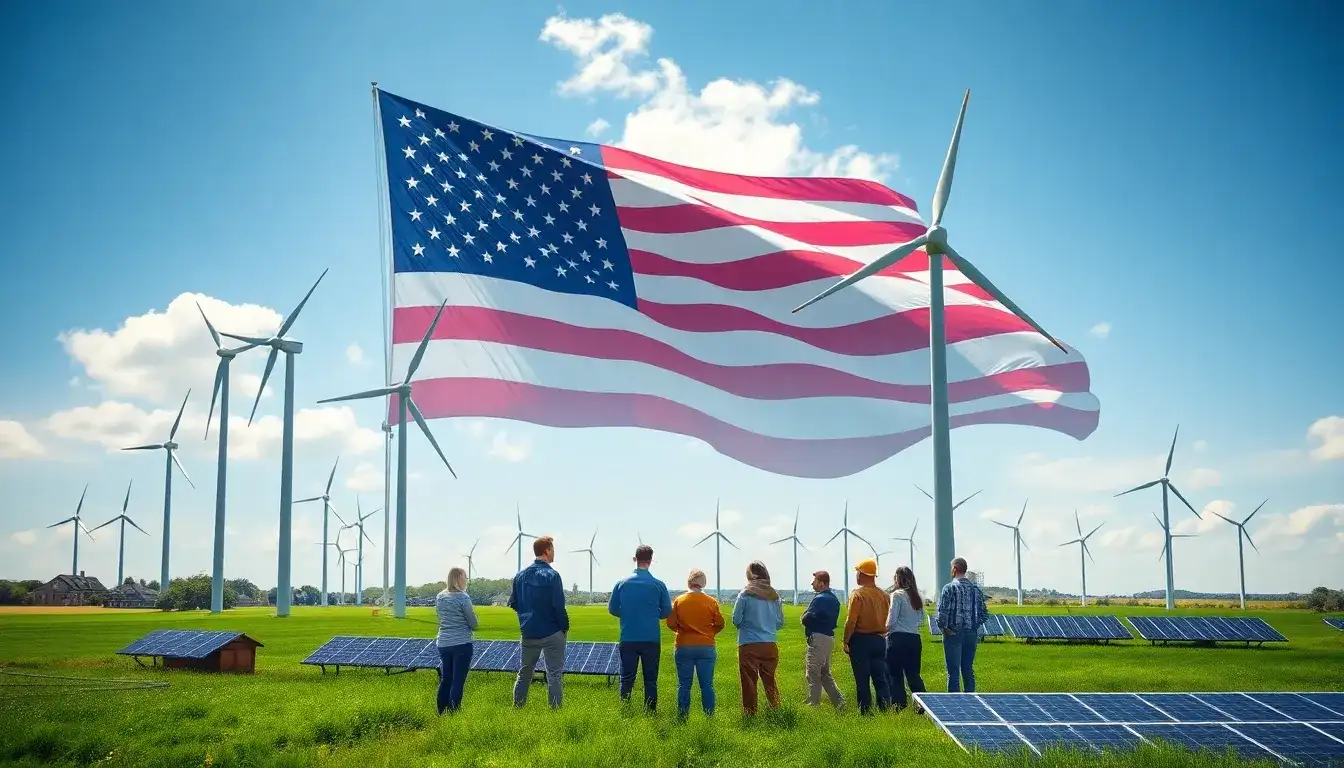
Clean Energy Gains Traction in Trump’s America, Complicating Budget Discussions
—
**Summary:**
Trump’s proposed legislation aims to eliminate wind and solar incentives by 2028. Renewable projects such as solar, wind, and batteries are facing potential shutdowns. Republican lawmakers from states including Utah, Alaska, North Carolina, and Kansas are divided over these rollbacks. Notably, red states account for 75% of investments in clean energy under the Inflation Reduction Act (IRA), with Utah alone attracting $3 billion in clean energy investments and an additional $10 billion in announced projects.
In an industrial facility located in Clearfield, Utah, long strips of U.S.-made steel are processed into rods that will support solar panels on rooftops. Adjacent, workers are assembling these components into finished products, which are then packaged with “Made in the USA” labels for delivery to a customer in San Diego, 800 miles away.
The nearby factories, operated by the solar racking company PanelClaw, are representative of the many businesses that have emerged since 2022 to fulfill the growing demand for American-made clean energy equipment, spurred by tax credits from former President Biden’s climate law, the Inflation Reduction Act (IRA). Despite the law being passed without any Republican votes, states like Utah have benefited significantly, capturing 75% of the manufacturing investments supported by it.
However, just two years into its expansion in Utah, PanelClaw, along with numerous clean energy projects nationwide, faces jeopardy as U.S. lawmakers contemplate reducing these tax credits under President Trump’s “One Big Beautiful Bill,” currently before the Senate. Recently, a Senate panel released a draft of the bill that proposes terminating incentives for wind and solar power by 2028, which is years ahead of the original timeline.
Trump has campaigned on the promise to repeal the clean energy tax credits in the IRA, deeming them costly, unnecessary, and detrimental to business. Nevertheless, the potential loss of jobs and investments from ending these incentives has created a divide among Republican lawmakers from traditionally red states, complicating negotiations on the bill.
PanelClaw CEO Costa Nicolaou expressed concern over the impact of losing these incentives, warning that it could lead to the shutdown of their facilities in Utah, which are expected to produce 15 million components this year alone.
**The Utah Divide:**
Utah’s Republican senators, Mike Lee and John Curtis, have differing opinions on the subsidies for clean energy initiatives. Lee supports the proposed cuts to government funding for renewable technologies, suggesting it could save taxpayers $1 trillion over the next decade. In contrast, Curtis is among four Republican senators who wrote to Senate Majority Leader John Thune, arguing that repealing the tax credits would disrupt vital investment.
Curtis, who visited PanelClaw’s facility last year and praised its job creation, has also highlighted the advantages of IRA subsidies at a local factory that manufactures batteries for energy storage. Fluence Energy, backed by industry giants Siemens and AES, invested $700 million in manufacturing facilities in Utah and other red states, including Texas and Tennessee.
Curtis remarked, “We can’t cut the legs out from under these enterprises. Doing so would harm Utah’s economy, jeopardize America’s energy future, and weaken national security. We must adopt a sensible and responsible approach to energy tax credits.”
rPlus Energies, which is developing the $1.1 billion Green River Energy Center solar and battery project in Emery County, warned that changes to the credits could jeopardize its 15-gigawatt pipeline. This project is projected to contribute $55 million over 20 years to the tax base of a county historically reliant on coal and help maintain low power prices.
**Crossing Party Lines:**
Clean energy is not a new concept in Utah, where nearly 20% of electricity is sourced from renewables, primarily solar, and around 9% of homes are powered by solar panels. Tom Mills, who has been selling residential solar systems in the state since 2014, noted that homeowners are motivated by environmental concerns as well as a desire for self-reliance.
Mills, who serves as the technical sales director at Park City-based Alpenglow Solar, mentioned that the elimination of incentives for residential solar could force the company to downsize its 18 employees. With Utah being the fourth fastest-growing state in 2024, according to the U.S. Census Bureau, the county needs revenue to fund new schools.
Commissioner Amelia Powers Gardner, a Republican, expressed her support for solar power, emphasizing its quicker development compared to natural gas plants. She noted the appeal of clean energy to attract revenue-generating data center owners like Google. “I would be fine building a gas-fired power plant. But in this case, modular nuclear or solar power can help solve our problems,” Gardner stated.
The IRA credits have generated $3 billion in investments in Utah, with an additional $10 billion in announced projects, as reported by Energy Innovation. Nationally, the IRA has led to $132 billion in announced investments in major energy projects, with nearly two-thirds of these investments located in Republican Congressional districts. The largest beneficiaries include North and South Carolina, Georgia, Michigan, and Texas.
Fluence’s Americas President John Zahurancik noted, “I don’t think people necessarily set out to build these projects in red states; that’s simply where the demand is.”
**Geothermal Opportunities:**
U.S. solar stocks have declined due to the proposed phase-out of credits, although analysts remain uncertain about whether Congress will pass the bill in its current form by Trump’s self-imposed July 4 deadline. This uncertainty may create an opportunity for solar and wind industry lobbyists.
The Senate Finance Committee has maintained tax credits for hydro, nuclear, and geothermal energy until 2036, responding to requests from companies to preserve these incentives. One such company, Fervo, supported by Bill Gates’ Breakthrough Energy, is building an advanced geothermal energy plant in Milford, Utah, which is expected to start supplying power to customers, including Southern California Edison and Shell Energy, next year.
Sarah Jewett, Fervo’s vice president of strategy, remarked, “The Senate Finance Committee’s markup of the OBBB appropriately recognizes the vital role emerging clean energy resources like geothermal play in solidifying American energy dominance.”
The plant’s construction has significantly benefited the local economy. Milford Mayor Nolan Davis advocated for the project as a means to replace jobs lost when the pork producer Smithfield Foods severed ties with local hog farms. Melissa Wunderlich, a lifelong Milford resident and former farm owner, now operates a drive-through diner that generates over half its sales from catering to workers at the Fervo plant. “I’ve catered for the governor and for Bill Gates,” Wunderlich shared. “Fervo has been really good for us.”
Original article by NenPower, If reposted, please credit the source: https://nenpower.com/blog/clean-energy-gains-traction-in-trumps-america-amid-budget-disputes/

