

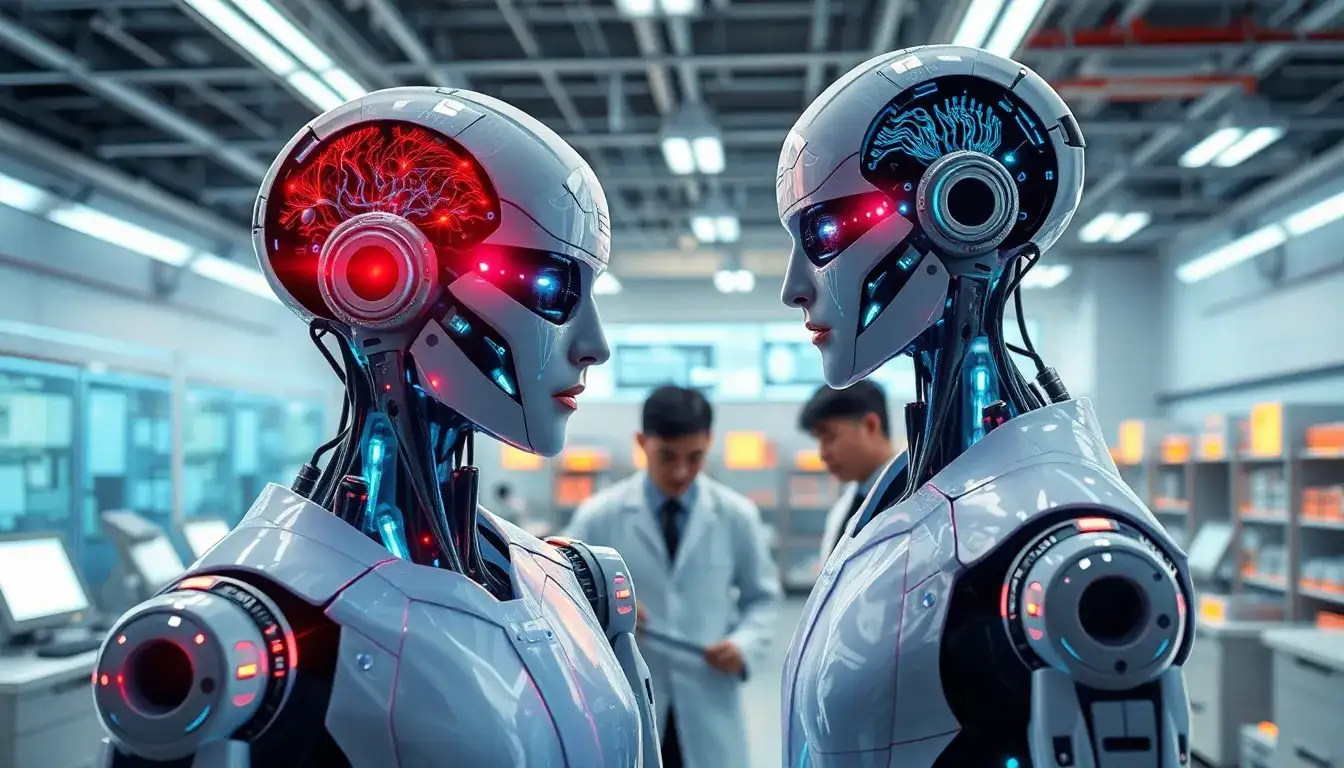
Upgrading the “Brain”: Performance Leap in Domestic Robots Deepening Fundamental Technology
On the stage of the Spring Festival Gala, humanoid robots performed impressive acrobatic moves and parkour with remarkable fluidity, showing a significant improvement over the previous year. In factory workshops, industrial robots efficiently carried out welding, assembly, and inspection tasks, operating continuously for 24 hours. In the consumer market, service robots have entered homes, restaurants, and hospitals, providing convenient and efficient intelligent services. Recently, the outstanding performance of Chinese robots has garnered significant attention, highlighting the continuous deepening and relentless breakthroughs in the fundamental technologies of the country’s robotics industry. This trend showcases the strong development of domestic robots, with upgraded “brains” and enhanced performance, indicating that China has entered a new stage of technological innovation in related fields.
From “Manual” to “Intelligent”: Service Robots Face the “Millimeter Challenge”
Tasks such as arranging flowers, plating dishes, and stacking cups may seem simple for humans, but they have posed significant technical challenges for domestic service robots. A few millimeters off can prevent a flower from fitting into a vase, or misaligned dishes can cause issues with placement. Recently, a research team led by Professor Dong Hao from Peking University achieved a major technological breakthrough, allowing robots to “think first, then act” and accelerating the practical application of household service robots.
Humans coordinate their hand-eye movements naturally when performing delicate tasks, predicting the position and angle of objects. Traditional robots, however, lack this “spatial imagination” and can only mechanically execute commands, failing with even slight deviations. Past solutions often faced dilemmas: either they could not recognize spatial relationships or they accumulated errors during continuous operation, ultimately deviating from their targets.
The core innovation of Professor Dong Hao’s team is instilling a humanoid “thinking” capability in robots. They first establish a “precise blueprint”; upon receiving commands like “arranging flowers,” the robot simulates the task in a virtual environment, clarifying key parameters such as angle and position to ensure no disturbance to the surrounding environment. The robot then breaks down the actions and performs a self-check throughout the process. If the error remains within acceptable limits, it continues executing; if noticeable deviations occur, it makes timely adjustments, ensuring both precision and stability.
Testing data shows that in a virtual simulation environment, the robot achieved an average success rate of 79% in completing seven types of delicate household tasks like stacking cups and plating dishes, significantly outperforming existing methods. In real household scenarios, it achieved a success rate of 68% in six common tasks such as arranging flowers and stacking cups, demonstrating good adaptability to slight environmental disturbances, laying a practical foundation for integration into ordinary households. This breakthrough allows robots to transition from merely “working” to “working intelligently,” enabling precise millimeter-level operations. As technology matures, robots are expected to progressively handle more complex household chores, providing a feasible path toward “household freedom” and injecting new momentum into the service robot industry.
From Hardware to Software: Heavy-Duty Robots Move Towards Full Autonomy
Recently, the “350-1200kg High-Performance Heavy-Duty Robot Design and Application” project, developed by the Midea Blue Orange Laboratory (a national key laboratory for high-end heavy-duty robots) in collaboration with KUKA Robotics (Guangdong) Co., Ltd. and Guangdong Jiya Precision Machinery Technology Co., Ltd., passed expert evaluation organized by the China Machinery Industry Federation. The expert panel unanimously recognized that the project’s results possess independent intellectual property rights, achieving overall technology at the international advanced level, with some aspects reaching international leading standards. This signifies that China has broken through foreign technological barriers in the high-end heavy-duty robot field, further solidifying its autonomous foundation.
The project achieved breakthroughs in three core technologies, all of which lead the industry: it integrated typical working condition design tools into the forward process for the first time, established a multi-level fault tree model, and achieved a high reliability indicator of 100,000 hours MTBF; it innovated a quality redistribution topology optimization method that enhances overall machine performance through dynamic iteration; and it overcame multi-factor rigid-flexible coupling modeling technology, achieving high-precision simulation and control optimization of dynamic characteristics. Leveraging independently developed core components such as six types of servo motors and eight types of RV reducers, the project successfully launched four new heavy-duty robot models, including the 350E and 550E, which are now being applied in high-end manufacturing fields such as new energy and aerospace, building a system of autonomous products.
The Midea Blue Orange Laboratory, established with the approval of the Ministry of Science and Technology in 2022, is the only national key laboratory for robotics built on an enterprise platform in the country. The laboratory is driven by the major needs of the strategic equipment industry and focuses on the layout of innovation chains around the industrial chain, concentrating on four key areas: core component design, overall machine design technology, intelligent control technology, and intelligent application technology, deeply engaging in the comprehensive autonomy of heavy-duty robots to support the development of national strategic industries.
In the core components field, the laboratory has independently developed high-precision transmission components such as reducers and servo motors, holds several advanced industry laboratories, and has obtained over 60 patents for core components, with three achievements recognized as internationally leading. In overall machine design, it has led two national key research and development plans and high-quality development projects in the heavy-duty robot sector, with four achievements recognized as internationally leading, earning a gold medal at the Geneva International Invention Exhibition. In the intelligent control and application field, several technologies have achieved breakthroughs in national strategic projects such as aerospace, reaching internationally leading levels.
Furthermore, the laboratory actively builds an open cooperative innovation ecosystem, integrating internal and external resources to promote enterprise synergy, and establishing open project funds to drive cutting-edge technology research, providing strong support for regional and national technological innovation and industrial upgrades. In the future, the laboratory will continue to play a leading role in technological innovation, aiding in the iteration and industrial upgrades of heavy-duty robot technology.
From Concept to Industry: Embodied Intelligence Accelerates Advantage Aggregation
Industry experts point out that China has formed significant advantages in the field of embodied intelligence regarding technological evolution, scene openness, industry attention, and talent aggregation, laying a solid foundation for participating in a new round of technological revolution. Elon Musk, the American entrepreneur, has commented that many underestimate China’s strength in fields like humanoid robots, and the country’s potential for technological innovation should not be overlooked.
The rapid development of China’s embodied intelligence industry is supported by both policy incentives and technological accumulation. In 2025, embodied intelligence was first included in the government’s work report as a national strategic focus; cities like Beijing, Shanghai, and Shenzhen have established billion-level industrial funds to concentrate on core technology breakthroughs and launched a series of supportive measures to accelerate the transition of embodied intelligence from a technical concept to industrial realization. The Development Research Center of the State Council predicts that the market size of China’s embodied intelligence industry will reach 400 billion yuan by 2030 and is expected to exceed one trillion yuan by 2035.
Data also confirms the momentum of China’s robotics industry. According to the 2025 World Robotics Conference, China has maintained its position as the world’s largest industrial robot market for 12 consecutive years. In terms of application scenarios, industrial robots have been integrated into 71 major categories and 236 subcategories of the national economy, and the density of manufacturing robots has risen to the third highest globally. The penetration rate of service robots in household services, warehousing logistics, commercial services, elderly care, and medical rehabilitation has significantly increased. International Data Corporation reports that by 2024, Chinese manufacturers are set to dominate the global commercial service robot market, capturing a staggering 84.7% of the shipment volume, showcasing a clear scale advantage. A report released by International Data Corporation in January indicates that humanoid robots have officially entered a stage of large-scale commercialization, with global shipments expected to reach approximately 18,000 units by 2025, with China accounting for a significant portion.
Internationally, there is high recognition of China’s technological innovation environment, with many Silicon Valley startups prioritizing Chinese researchers and some investors considering the “Chinese content” of startups as a factor in their investment decisions. Media outlets in Europe and the U.S. are expressing amazement at the speed of China’s technological innovation, asserting that it will become a crucial driving force in the global embodied intelligence industry’s development.
Industry insiders indicate that as China’s embodied intelligence industry continues to flourish, it will further enhance new productivity in transportation logistics, industrial manufacturing, and commercial services. This will accelerate the integration of emerging technologies into homes and communities, facilitating people’s lives and helping China’s robotics industry transition from “catching up” to “keeping pace” and “leading the way.”
Original article by NenPower, If reposted, please credit the source: https://nenpower.com/blog/chinese-robotics-industry-advances-with-brain-upgrades-and-enhanced-performance-in-core-technologies/

