

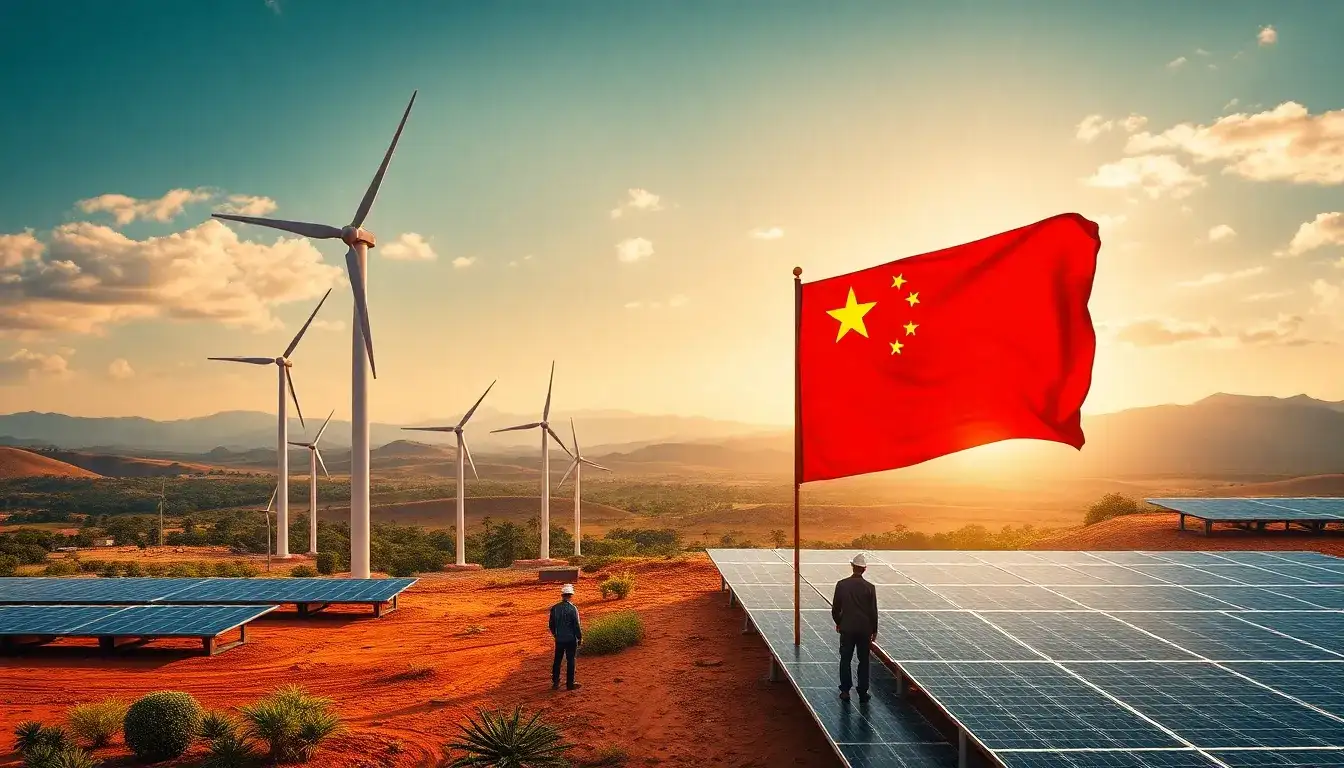
Thousands of small new energy companies are entering Africa, with 30% profit margins leading to rapid market changes, particularly in Zambia, where the influx of these firms has had significant impacts within just two months.
In Zambia alone, there are over 300 companies, while Nigeria boasts more than 400 and Kenya has around 200. A Chinese entrepreneur at a storage battery warehouse in Africa pointed out the small-scale energy products behind him, highlighting the growing presence of Chinese-owned new energy factories in the region. Despite the saturation, demand remains high for storage solutions in Africa.
The recent financial report from Deye reveals that in the first quarter of 2025, the company reported a profit of 700 million yuan, marking a year-on-year increase of over 50%, with profit margins exceeding 40%. This growth is particularly noteworthy against the backdrop of tariff challenges in the United States, waning demand in Europe, and regional competition in the Middle East, making Africa an unprecedented hotspot for new energy ventures.
As evidenced by the latest Canton Fair, which saw over 200,000 overseas buyers attending—72% of whom were from countries involved in the Belt and Road Initiative—the interest in African energy solutions is surging. Furthermore, at the recently concluded 2025 Africa Future Energy Exhibition, approximately 70% of the participating 600 global companies were from China.
Li Yongrui, who has spent seven years in Africa as the head of a market consulting firm focused on the region, notes a dramatic increase in inquiries from new energy companies wishing to establish operations there. He estimates that in Kenya, the number of Chinese firms selling energy solutions is at least 500, with a market size of $500 million to $800 million annually.
Discussing the challenges and opportunities of the new energy sector in Africa, Li emphasizes that any venture with profit margins below 30% is unlikely to attract serious investment. He recalls how, after attending the World Supply Chain Management Conference in 2018, he recognized parallels between Africa’s development and China’s economic reform period.
The issue of power shortages is prevalent across Africa, making solar and storage solutions a necessity. For instance, in Kenya, residential electricity costs over 80 cents per kilowatt-hour, while industrial rates can reach $1.40. The instability of the grid leads to frequent outages, costing the manufacturing sector $5 million per hour in 2023.
Africa’s energy market is diverse, encompassing residential storage systems, commercial energy solutions, and large-scale grid projects. The most popular products include rudimentary micro-solar systems, which account for nearly 40% of the market, enabling users to power basic appliances for a few hundred dollars. More sophisticated residential solutions consist of solar panels and storage systems capable of supplying power to small homes.
Li provides a simple formula for pricing energy products in Africa: China’s cost price multiplied by 180%. This accounts for production costs, logistics, customs fees, and profit margins, leading to prices that are 80% higher than domestic rates. Consequently, any project yielding less than 30% profit margin is often deemed unviable.
Despite the potential, many large companies overlook Africa’s smaller market demands, often declaring they will not pursue projects below $300 million. Additionally, financing remains a significant hurdle; even small residential storage systems often require installment payments with annual interest rates soaring as high as 50%.
As a result, Africa’s market has become a gold rush for numerous small manufacturers from Guangdong, with a plethora of “white label” products flooding the shelves. Many large manufacturers have resorted to selling excess inventory from China, particularly solar panels that were previously unmarketable domestically.
However, the rapid influx of companies into markets like Zambia has led to oversaturation. Li shared an anecdote about how, during a power shortage last year, many casinos in Zambia were forced to close. This prompted a rush of Chinese entrepreneurs, and within two months, over 100 companies entered the market. With Zambia’s population under 20 million, the sudden influx led to a collapse in prices, forcing many companies to sell at a loss.
This rapid rise and fall of businesses in Zambia mirrors trends seen in domestic markets, where after the exit of less successful companies, the market has started to stabilize. Nonetheless, the competitive landscape in Africa remains quite distinct from China, with vast opportunities for growth fueled by underdeveloped infrastructure and burgeoning demand for electric vehicles and energy solutions.
Ultimately, the challenge for investors in this promising market is to navigate the complexities and uncertainties while leveraging the opportunities that arise. “This is still a market filled with hope and growth,” as Li puts it, “but establishing a foothold is not that straightforward.”
Original article by NenPower, If reposted, please credit the source: https://nenpower.com/blog/chinese-renewable-energy-surge-in-africa-profit-margins-soar-amid-market-challenges-in-zambia/

