

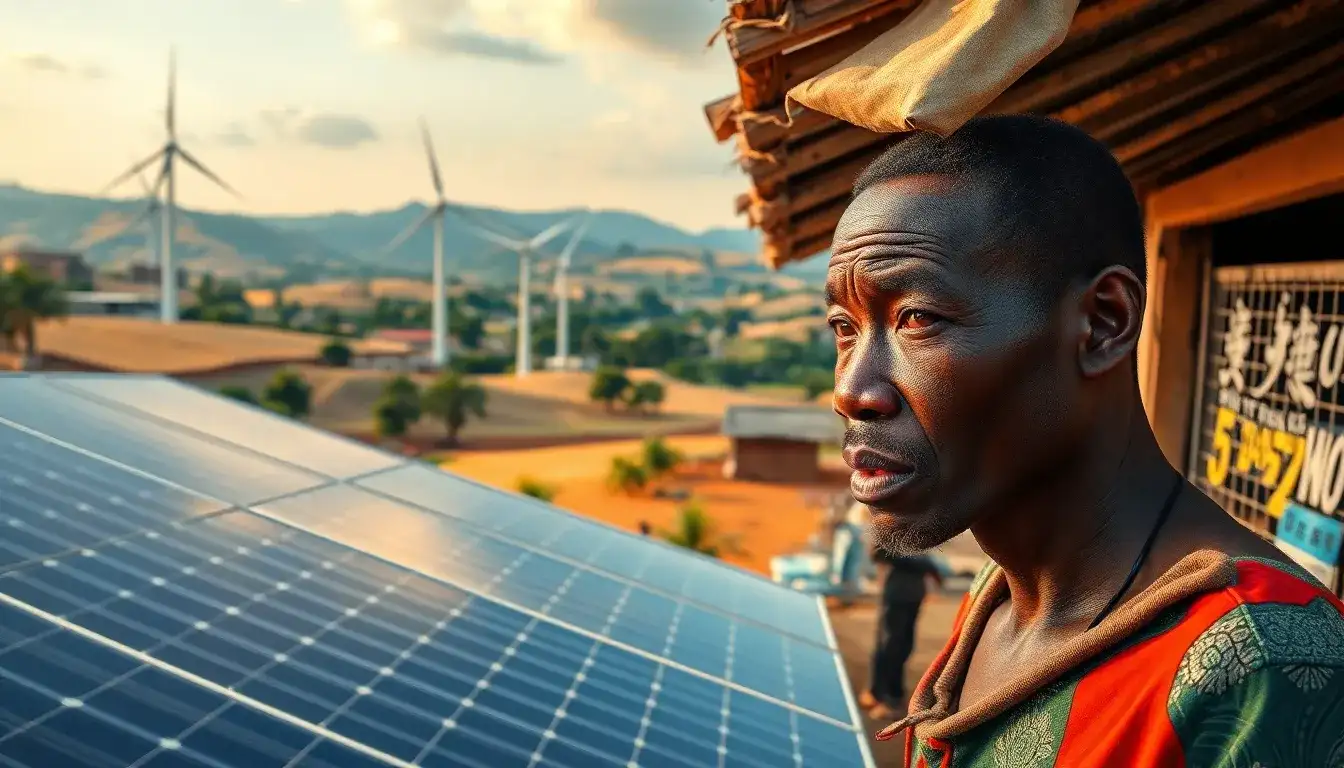
Thousands of small new energy companies are making their way into Africa, drawn by the promise of high profits. With a gross margin of 30%, some companies have managed to saturate the Zambian market in just two months.
In Zambia alone, there are over 300 energy storage companies; Nigeria boasts more than 400, and Kenya has over 200. A Chinese entrepreneur in front of a storage battery warehouse pointed out these small energy storage products, highlighting the rapid expansion of Chinese-owned new energy factories across Africa. Despite the influx of companies, the market remains vibrant and full of opportunities.
The latest financial report from DeYue reveals impressive gains, with the company profiting 700 million yuan in the first quarter of 2025, marking an increase of over 50% year-on-year and a gross margin exceeding 40%. This growth is particularly remarkable amidst tariff storms in the U.S., sluggish demand in Europe, and the dominance of Middle Eastern giants, making Africa an unprecedented hotspot for new energy ventures.
Consider these two statistics: over 200,000 foreign buyers attended the recent Canton Fair, a record high, with 72% from countries involved in the Belt and Road Initiative. At the 2025 Africa Future Energy Exhibition, 70% of the more than 600 participating companies were Chinese.
Li Yongrui, who has spent seven years in Africa, leads a consulting firm focused on the African market. His company primarily provides consultation services to Chinese enterprises looking to enter this market. He noted a significant increase in inquiries from new energy companies recently. “There are far more than 200 new energy companies in Kenya,” he stated, estimating at least 500 Chinese businesses selling products there, with an annual market size of $500 million to $800 million.
During our conversation, Li provided insights into the opportunities and risks for Chinese enterprises expanding into Africa’s new energy sector. “In Africa, if your gross margin is below 30%, no one is interested in doing business,” he explained. He decided to stay in Africa after attending a global supply chain management conference in 2018, where he recognized the parallels between Africa’s economic situation and China during its reform and opening-up period. He observed that electricity shortages are a common issue for many African nations, indicating a genuine demand for solar power and energy storage solutions.
How expensive is electricity in Africa? In Kenya, the cost for residential electricity exceeds 80 cents per kilowatt-hour, while industrial electricity can reach $1.40. The instability of the power grid leads to frequent outages, costing the Kenyan manufacturing sector $5 million per hour due to power interruptions in 2023.
Similar to the domestic market, Africa’s new energy sector is divided into residential energy storage, commercial energy storage for factories, and large-scale projects tied to the grid. The most popular products in Africa are simplified solar power systems, accounting for nearly 40% of the market. A solar panel measuring 0.5 to 2 square meters can produce direct current, powering lights and TVs without the need for transformers or inverters, with basic setups costing just a few hundred dollars to meet essential needs.
One popular product is the solar-powered fan, which stores energy during the day and provides cooling at night. More advanced systems consist of several square meters of solar panels and 20 kilowatt-hours of storage, sufficient to power a small household. This area is a primary focus for many Chinese new energy small factories.
Small-scale commercial energy storage projects are gradually emerging in Africa, but they often operate on a smaller scale than in China. Large megawatt-hour projects can require investments in the hundreds of millions, which is prohibitive for many local entrepreneurs.
Li provided a straightforward formula for pricing new energy products in Africa: China’s cost price × 180%. When exporting to Africa, companies must account for logistics, customs fees, and agent commissions, along with a profit margin, resulting in prices that are typically 80% higher than domestic rates. If profit margins fall below 30%, companies are reluctant to enter the market, given the numerous challenges they face in this demanding environment.
Li’s consulting firm has been approached by many large energy companies seeking to enter Africa, but the major challenge is that these companies often overlook the minor demands of the African market. Some firms even state outright, “We don’t take on projects under 300 million.” When large projects are identified, securing reliable funding becomes an even greater hurdle. In Africa, even small household storage solutions can require installment payments, with annualized interest rates as high as 50%.
This lack of accessible funding has turned the African market into a goldmine for numerous small new energy factories from Guangdong, where various solar and energy storage products fill the shelves, often from brands you’ve never heard of. Many savvy entrepreneurs from the Yangtze River Delta are producing goods that dominate the African market.
Meanwhile, larger companies have resorted to simpler strategies, selling off unsold inventory from China. During the recent surplus in solar panel production, companies began exporting excess stock, including panels that couldn’t meet domestic bidding requirements, to Africa at heavily discounted rates.
The market is ripe for those willing to take risks and explore opportunities. However, the rapid influx of companies can lead to saturation. For instance, last year, when Zambia faced a power shortage, many Chinese entrepreneurs recognized the opportunity and flooded into the market within two months. Given that Zambia has a population of under 20 million, the sudden influx led to an oversupply of solar and storage products, causing prices to plummet, even below domestic levels. Many of these eager entrepreneurs were left with no choice but to sell at a loss.
This phenomenon of rapid entry and exit lasted only two months in Zambia. Ultimately, the market stabilized as half of the companies withdrew, returning to a more manageable state. However, the competitive environment in Africa is still less intense than in China, and there remains significant potential for growth in this underdeveloped market.
The ongoing expansion of electric vehicle and electric motorcycle markets, coupled with the rudimentary state of electricity infrastructure, creates ample opportunities for businesses connected to electricity. The fear of the unknown often deters many, leaving Africa with more opportunities and potential profits compared to Southeast Asia. Ultimately, the question may come down to who is willing to take bold steps in this promising market.
This remains a hopeful and rapidly growing market, but establishing a presence is not without its challenges.
Original article by NenPower, If reposted, please credit the source: https://nenpower.com/blog/chinese-renewable-energy-companies-flood-africa-30-profit-margins-and-zambia-market-collapse-in-just-two-months/

