

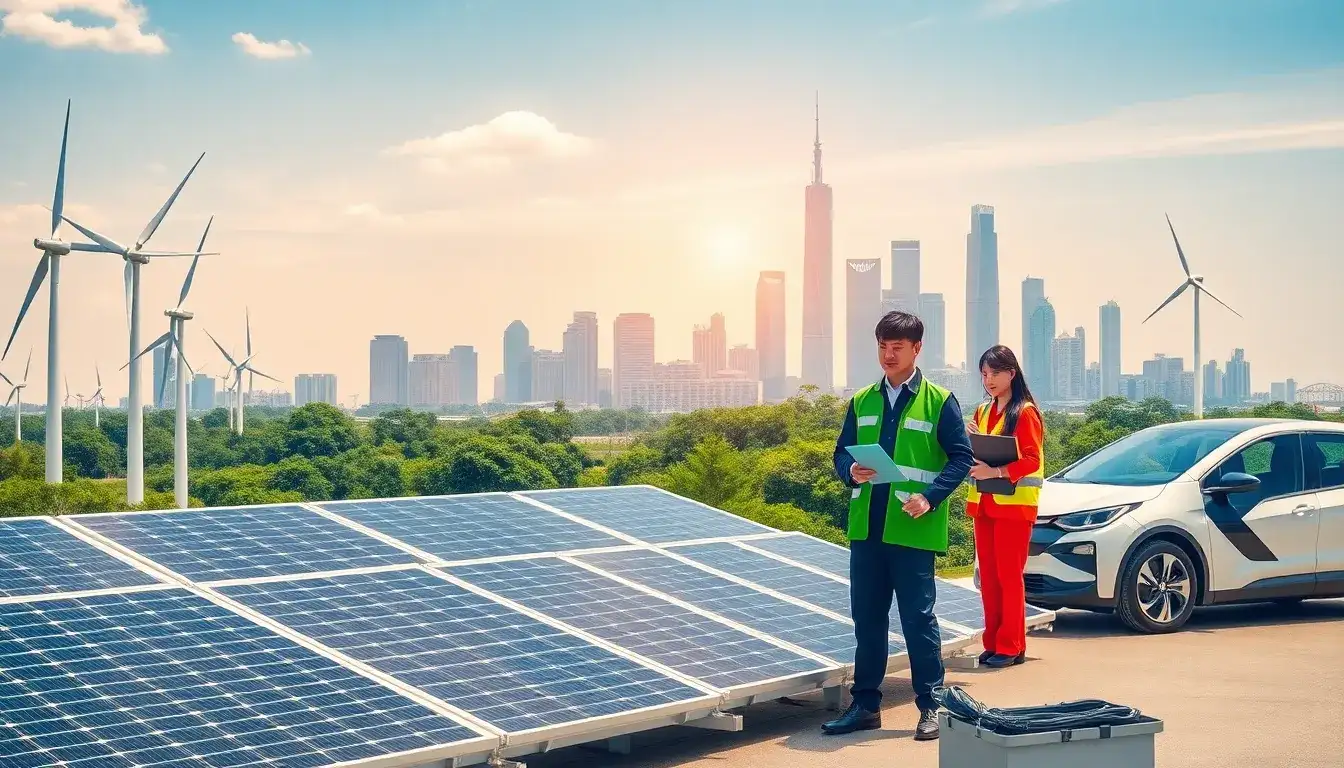
Recently, the 2025 Taiyuan Energy Low Carbon Development Forum, themed “Green Low Carbon Transformation and the Development of a New Energy System”, was held in Taiyuan, Shanxi Province. During the forum, several significant industry reports were released, including the “2025 Global New Energy Enterprises Top 500 Competitiveness Report” and the “2025 Carbon Neutral Green Impact Brand”.
The reports indicate that despite a slowdown in the overall growth of the global new energy sector, China’s new energy industry has achieved stable growth, benefiting from an expansion in installed capacity and a continuous increase in end-user markets. By 2025, twelve new energy companies worldwide are projected to exceed revenues of 100 billion yuan, with China being home to eight of them. This marks a significant leap for Chinese new energy enterprises from being followers to leading the industry.
Technological innovation is spearheading the transformation of the industry. Innovations showcased at the 2025 Shanxi (Taiyuan) Energy Industry Expo include a fitness bicycle that can fully charge a tablet in just one hour, hydrogen-powered heavy trucks that can travel 700 kilometers after just 15 minutes of refueling, and intelligent zero-carbon charging stations that utilize integrated solar energy storage and charging designs to provide self-sufficient clean energy in off-grid scenarios.
The expo, covering an area of 50,000 square meters, attracted nearly a hundred well-known enterprises and research institutions from home and abroad to demonstrate cutting-edge technologies, including intelligent equipment, green intelligent coal mining, low-concentration gas enrichment, and collaborative solid waste carbon fixation disposal.
A nearly five-meter-long coal mining model drew considerable attention at the expo. This “Sea Dragon 4.0” system, developed by the China Coal Research Institute in Taiyuan, represents the latest generation of rapid coal mining systems, introducing a parallel operation model for excavation, support, and transportation. It boasts an overall mining speed of two to three times that of traditional methods, achieving a record monthly advancement of 3,088 meters.
According to data, China’s total energy consumption in 2024 is projected to reach 5.96 billion tons of standard coal, with coal consumption accounting for 53.2% of this total, maintaining its dominant position in the energy structure. Given the massive scale of energy demand, the transition is undoubtedly challenging, making technological innovation crucial.
Experts attending the forum emphasized the need to strengthen the role of innovation platforms in the energy sector, accelerate breakthroughs in green low-carbon technologies, and deepen cross-sector cooperation between energy companies, research institutions, universities, and financial organizations. They highlighted the importance of integrating energy industries with digital technologies and intelligent algorithms to create a globally competitive energy technology innovation hub.
Shanxi Province, the only comprehensive pilot area for resource-based economic transformation and energy revolution reform in China, has been focusing on energy transition, industrial upgrading, and appropriate diversification to strengthen its “Green Energy+” sector, continuously promoting the optimization of traditional and new energy combinations.
At the newly established green electricity exhibition area, many visitors witnessed the process of how green electricity empowers “Shanxi Manufacturing” to meet international standards. The staff explained that the park integrates traditional casting industries with green electricity, providing product competitiveness through green certification, serving as a practical example of industrial transformation and low-carbon transition in resource-based regions.
According to Shi Yuping, chairman of the China Energy Research Society, “China has built the world’s largest, most complete, and internationally competitive new energy industrial chain.” He stated that amid the global pursuit of sustainable development, China’s new energy sector is rapidly transitioning from a supplementary power source to a primary one.
Data reveals that since the start of the 14th Five-Year Plan, China’s renewable energy sector, particularly wind and solar power, has experienced rapid growth, with annual new installations of wind and solar capacity surging from the “ten million kilowatt level” to the “hundred million kilowatt level.” By the end of July, total renewable energy capacity reached 2.171 billion kilowatts, accounting for nearly 60% of the country’s total installed capacity. Wind and solar capacity alone reached 1.68 billion kilowatts, surpassing thermal power installations for the first time in history.
Industry forecasts suggest that by 2060, China will require over 5 billion kilowatts of installed wind and solar capacity, indicating significant growth potential for the new energy sector. Experts at the forum noted that thanks to national strategic guidance and proactive innovation by enterprises, the development of China’s new energy industry exhibits inherent resilience, remaining solid in the long term despite short-term fluctuations.
Innovation and integration are key supports for overcoming cyclical challenges. As the capacity of clean energy sources like wind and solar continues to grow, the challenge of energy consumption is becoming a primary constraint on new energy development. Yin Xulong, chairman of Yingli Energy Development Co., emphasized that “new energy has shifted from being policy-driven to being driven by end-user applications.”
Currently, new energy technology innovation is driving the global energy transition, with the industry moving from simple scale expansion to comprehensive quality improvement. The competitive landscape is pushing companies to shift from broad expansion to meticulous cultivation.
Participants widely view technology innovation as critical to navigating this cycle. Liu Zhenmin, China’s Special Envoy on Climate Change, stressed the importance of driving low-carbon energy transition through technological innovation, aiming to cultivate energy technology and related industries into new growth points for upgrading China’s industrial sector.
Shi Yuping suggested enhancing the deep integration of production, learning, research, application, and finance to connect the innovation and industrial chains. He advocated for exploring development models that combine “new energy and innovation”, including cross-sector integration with emerging technologies like the Internet of Things, artificial intelligence, and big data, to create new application scenarios and business models within an innovative ecosystem.
On September 24, China announced a new round of national voluntary contribution targets at the United Nations Climate Change Summit: by 2035, net greenhouse gas emissions across the entire economy will decrease by 7%-10% from peak levels, and the share of non-fossil energy consumption in total energy consumption will exceed 30%. The total installed capacity of wind and solar power is expected to reach more than six times that of 2020, aiming for 3.6 billion kilowatts.
In light of this new vision, many experts expressed that the Chinese new energy sector is transitioning from quantity to quality, from price competition to value competition, and from solitary efforts to collaborative ecosystems, indicating a promising future ahead.
Original article by NenPower, If reposted, please credit the source: https://nenpower.com/blog/chinese-new-energy-companies-lead-the-world-through-innovation/

