

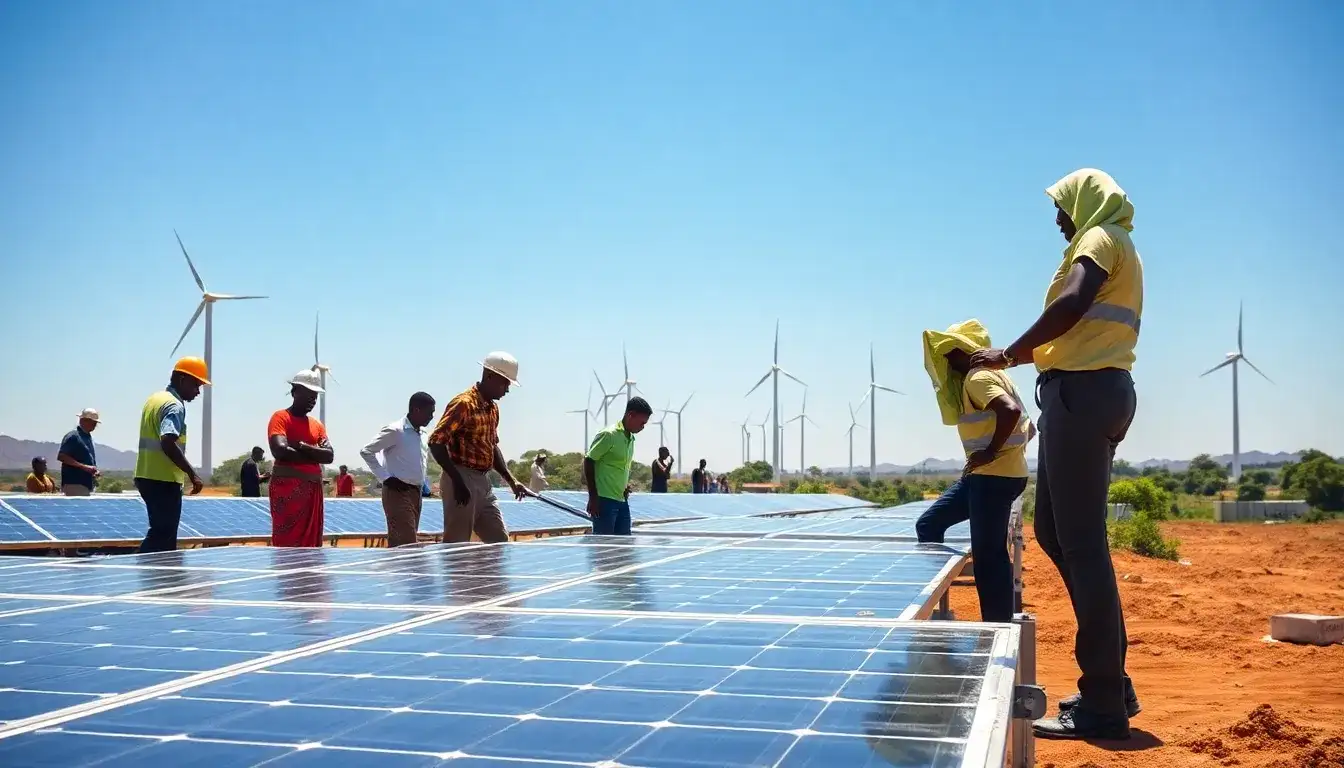
Over a thousand small new energy factories have emerged in Africa, boasting a gross profit margin of 30%. In just two months, these companies overwhelmed the Zambian market.
“There are over 300 in Zambia, more than 400 in Nigeria, and over 200 in Kenya,” said a Chinese entrepreneur while pointing to small energy storage products in front of an energy storage battery warehouse in Africa. The 900+ companies he mentioned are the new energy factories established by Chinese entrepreneurs across Africa. Despite the proliferation of companies, the market remains vibrant.
The success story of new energy ventures in Africa can be exemplified by the latest financial report from DeYue, which revealed that in the first quarter of 2025, the company made a profit of 700 million Yuan, reflecting a year-on-year growth of over 50%, with a gross profit margin exceeding 40%. Who wouldn’t be envious of such results?
In the context of tariff storms in the U.S., weak demand in Europe, and the dominance of Middle Eastern giants, Africa has emerged as an unprecedented hotspot for new energy exploration. Here are two statistics to illustrate the trend: At the recently concluded Canton Fair, over 200,000 foreign buyers attended, setting a new record, with countries participating from the Belt and Road Initiative accounting for 72%. Similarly, at the 2025 Africa Future Energy Exhibition, 70% of the 600 participating companies were from China.
Li Yongrui, who has spent seven years in Africa, has witnessed this firsthand. He founded a consulting firm that primarily serves Chinese companies eager to expand into Africa. Recently, he has been inundated with inquiries from new energy companies.
“There are far more than 200 new energy factories in Kenya,” Li explained. Although precise data is lacking, his assessments suggest that at least 500 Chinese companies are selling products in Kenya, with an annual market scale of between 500 million to 800 million USD.
In discussing the opportunities and risks for Chinese companies venturing into the African new energy market, Li noted, “If the gross profit margin is below 30%, no one wants to engage.” In 2018, after attending a world supply chain management conference in Africa with the president of the China Logistics Purchasing Association, Li decided to stay and develop his business there. He saw the potential in Africa’s infrastructure, property prices, GDP, and overall living conditions, reminiscent of China’s critical economic development phase during its reform and opening-up.
Power shortages are a common issue faced by many African nations, which means that solar power and energy storage solutions are genuine necessities. In Kenya, the cost of residential electricity can exceed 80 cents, while industrial electricity can reach as high as 1.40 USD. Frequent power outages caused by an unstable grid have resulted in the Kenyan manufacturing sector losing approximately 5 million USD per hour in 2023 due to power issues.
Similar to the domestic market, Africa’s new energy sector is divided into residential energy storage, commercial and industrial energy storage, and large-scale grid storage projects. Among these, the most popular are rudimentary micro-solar power systems, which make up nearly 40% of the market. These systems consist of solar panels measuring 0.5 to 2 square meters that do not require transformers or inverters to operate, providing direct current that can power lights and televisions for just a few hundred dollars, meeting the basic needs of the African populace.
A popular product in Africa is the solar fan, which stores energy during the day and provides airflow at night. More advanced systems resemble the household energy storage solutions we commonly see, with dozens of square meters of solar panels and a 20-kilowatt energy storage system capable of powering homes.
Small-scale commercial energy storage projects are also beginning to emerge in Africa, although they are significantly smaller than those in China. Large-scale projects, often costing billions, are prohibitively expensive for local entrepreneurs. Li offered a straightforward formula for pricing new energy products in Africa: the cost of production in China multiplied by 180%. This includes logistics, clearance fees, channel agency costs, and a profit margin, resulting in prices that are typically 80% higher than in China.
In Africa, if the gross profit margin is less than 30%, companies are unlikely to engage. The challenges on this raw and rugged continent are numerous.
The African new energy market resembles a chaotic landscape. Many large companies seeking consultation with Li often overlook the fragmented small demands in Africa, stating plainly, “We won’t engage in projects under 300 million.” Even when larger projects are found, securing reliable funding remains a major issue. In Africa, even a few thousand dollars for residential storage can require installment payments, with annualized interest rates soaring to 50%. Financing large projects is even more daunting.
This situation has turned the African market into a treasure trove for countless small Chinese new energy companies. The shelves in local markets are filled with unfamiliar “white-label” products crafted by diligent and perceptive business owners from the Yangtze River Delta.
Meanwhile, larger companies have taken a more blunt approach: selling off unsold inventory from China. In particular, during years of overproduction when solar panels were sold as balcony tiles, products that could not be sold domestically were shipped to Africa at a discount.
This is a market where those willing to take risks and conduct thorough research can find profits. There is no shortage of bold entrepreneurs in China.
As numerous companies flooded into Zambia, the influx led to market saturation within just two months. The number of Chinese entrepreneurs and their industriousness has meant that when any sector appears profitable, many players rush in, intensifying competition. For instance, in Guangdong alone, thousands of small manufacturers are producing battery packs, not to mention portable power supplies and mobile storage products.
Li shared an interesting story: Last year, when Zambia faced power shortages, many casinos were unable to open due to lack of electricity. Chinese entrepreneurs quickly recognized the opportunity, and within two months, over a hundred companies entered the Zambian market. Considering that Zambia’s population is less than 20 million, roughly the size of a Chinese province, solar and storage products became oversupplied almost overnight. While shipments from China were still clearing customs, local prices plummeted below even domestic levels, forcing those impulsive entrepreneurs to sell at a loss.
This chaotic scenario unfolded in Zambia in just two short months. Ultimately, as half of the companies exited the market, equilibrium gradually returned, similar to trends seen in China. However, the competitive landscape in Africa is still far less intense than in China, and this market is poised for rapid growth.
With an underdeveloped grid and infrastructure, as well as a nascent electric vehicle and electric motorcycle market, businesses related to electricity in Africa hold vast potential. The fear of the unknown that paralyzes many allows for greater opportunities and profits compared to Southeast Asia. In the end, it may boil down to who dares to take the plunge.
This remains a hopeful market with significant growth prospects, but establishing a foothold is not without its challenges.
Original article by NenPower, If reposted, please credit the source: https://nenpower.com/blog/chinese-new-energy-companies-flood-africa-30-profit-margins-and-rapid-market-disruption-in-zambia/

