

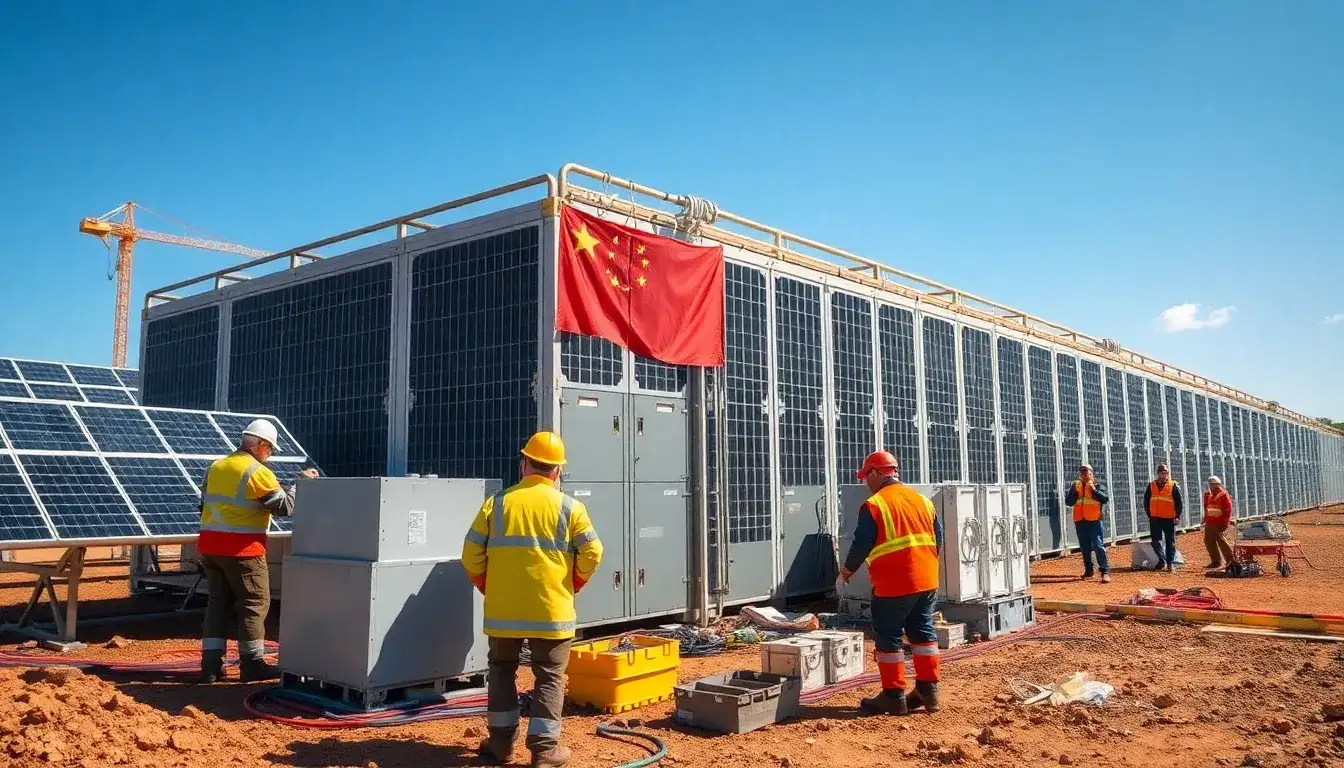
Chinese manufacturers are fiercely competing for Australia’s energy storage market, driven by a substantial government subsidy program. In just two months, they have installed 50,000 home battery systems, with orders already lined up until next year.
The surge in installations is largely due to the Australian government’s commitment to invest A$2.3 billion (approximately ¥10 billion) in the “Cheaper Home Batteries” initiative, which offers households a subsidy of up to A$3,000 (around ¥14,000
During a recent conference, Australian Minister for Climate Change and Energy Chris Bowen shared that since the program began on July 1, nearly 44,895 people have applied for the subsidy. In the first month alone, home battery installations reached 19,600 units, marking a staggering 200-300% increase compared to the previous year.
Chinese home battery manufacturers have been the biggest beneficiaries of this boom. Out of the leading home battery brands in Australia, only Tesla is a foreign manufacturer. Interestingly, Tesla recently recalled its core home battery product, Powerwall 2, due to fire risks, effectively ceding market share to competitors.
The enthusiasm for energy storage in Australia is even reflected on social media platforms like Xiaohongshu, where users are actively discussing which battery systems to install, such as those from Sungrow or Siging. Local installers, usually busy posting advertisements, are now overwhelmed with requests, with new installation appointments pushed back by 2-4 months, with some installers booked into next year.
Beyond home batteries, large-scale energy storage systems are also thriving. By early 2025, over A$2.4 billion (approximately ¥11.3 billion) has been invested in large battery storage systems, marking the second-highest quarterly investment in Australia’s history. In just three months, 1.5 GW of storage capacity and 5 GWh of energy output were added.
As the third-largest energy storage market globally, following the U.S. and China, Australia possesses significant potential. However, questions remain about the sustainability of this explosive growth and whether small and medium-sized enterprises can participate in the burgeoning market.
To gain insights, we interviewed Jeff, a seasoned delivery director with extensive experience in the Australian energy storage market, affectionately known in the industry as “Li Ban Zhang.” With a decade of experience overseas, he describes the Australian energy storage market as akin to “crossing the Eastern Sea,” filled with challenges and risks, yet rich in opportunities.
01 A Market with Potential and Pricing Flexibility
Jeff noted that Australian customers typically inquire about three key factors: warranty quality, local team availability, and inventory. Initially perplexed by the lack of price inquiries, he soon realized that these aspects reflect the manufacturer’s commitment to the market. In Australia, while price is important, it is not the sole focus.
This subsidy policy was introduced by the Australian Labor Party, which was recently re-elected in May. Their core energy strategy aims to achieve 82% renewable energy in the electricity mix by 2030 and net-zero emissions by 2050. Consequently, the demand for energy storage is rooted in the significant pressure on the grid from solar energy integration during the transition to renewable energy.
Despite a population of just 28 million, Australia is one of the most developed markets for solar energy, with one in three homes having solar power systems installed. However, the penetration rate of home energy storage remains below 7%, resulting in surplus electricity flooding the market. This creates a highly volatile electricity market.
Thus, both residential and commercial energy storage systems present substantial profit opportunities. As the market evolves, the demand for energy storage is shifting from low-cost products to effective, comprehensive solutions. The leading manufacturers benefiting from this sales surge include Siging, Tesla, Sungrow, Maitian Energy, and Goodwe, with little room for low-cost competitors.
The sales channels for home batteries are predominantly controlled by major distributors and installers, who are meticulous in their selection of products and brands. Poor-quality products could harm their reputation, as installation and after-sales service would become troublesome.
There are two critical implicit conditions within the subsidy policy: 1) Products must pass Australia’s Clean Energy Council (CEC) certification, and 2) Products must possess Virtual Power Plant (VPP) functionality. “This subsidy is a preparatory measure for the future management of new energy,” Jeff explained, indicating that it comes with certain technical barriers.
When transitioning to commercial and large-scale storage, these technical barriers will become even more pronounced. “The conversion from home storage to commercial and large systems involves a shift from product focus to engineering considerations,” Jeff remarked. Implementing a large energy storage project requires careful evaluation of construction costs, annual returns, payback periods, and EPC (Engineering, Procurement, and Construction) considerations. The larger the energy storage project, the more critical the engineering capabilities and solution design become.
Analysis of significant large-scale energy storage orders in Australia since 2024 reveals that major players like Sungrow, CATL, and HIBOS are the primary contractors. “For large energy storage projects with capacities exceeding 5 MW, the entire process from engagement to approval and commissioning typically takes about three years. As project size increases, the time required for execution also lengthens,” Jeff noted.
While Australia boasts exceptional wind and solar resources, it lacks a comprehensive energy storage solution and engineering capabilities. Although local partners may assist with civil works and distribution, the core solution optimization still relies on the technical expertise of equipment manufacturers. Consequently, Chinese manufacturers have a certain “premium space” in Australia.
02 Cost-Cutting Mindset as an Obstacle, New Strategies for Australian Market Entry
According to Jeff, “Current Chinese energy storage exports do not reflect brand premium; they only account for profit margins.” He believes that the biggest hurdle for Chinese companies entering international markets stems from their strong manufacturing mindset, which is deeply rooted in the mantra of “cost reduction and efficiency enhancement.”
Domestic energy storage companies often encounter situations where, after finalizing all project details, a client suddenly requests a 10% discount to proceed. However, this bargaining approach is rare in Australia.
Through aggressive cost-cutting, Chinese manufacturing has captured a significant share of the global renewable energy market. Yet, as energy storage enters a new phase, this strategy may become a hindrance. First, international markets demand strict ten-year warranty requirements, with warranty performance being a vital demonstration of brand longevity. Inadequate products may lead to the potential emergence of “orphan power stations” in overseas markets, ultimately damaging China’s renewable energy reputation.
Secondly, excessive focus on cost reduction in R&D can limit the ability to innovate and grow. Transitioning from a defensive to a proactive approach is crucial for Chinese companies venturing abroad. The genuine demand for energy transformation in Australia has created vast market opportunities, driven not by cheap equipment but by holistic, effective solutions tailored to specific scenarios.
Recently, Jeff successfully implemented a microgrid project in Cairns, a coastal city in northern Queensland. This area is renowned for the Great Barrier Reef, the world’s largest coral reef system, which is experiencing severe bleaching events due to climate change. In response, the local government has transitioned all tour buses to renewable energy vehicles, utilizing Chinese-made electric buses. More than 40 electric buses require a charging station, posing a challenge for the local grid due to the high power demand of DC fast chargers. Jeff’s project involved installing solar photovoltaics and energy storage systems at the charging station, creating an integrated microgrid solution.
After delivering the project, Jeff participated in a local celebration known as “Shoey,” where beer is poured into a shoe and consumed. He recalls a touching remark from a client: “You are not just my project’s pillar; you are also my emotional support.” As local clients are relatively unfamiliar with the equipment, they heavily rely on the Chinese team for successful project delivery. This deep technical collaboration and interpersonal trust create a robust competitive advantage for companies operating abroad.
03 The Triple Challenge of Management, Culture, and Talent
Successfully penetrating the Australian energy storage market is no small feat. Australia is characterized by vast land with a sparse population—less than 28 million people spread across 7.69 million square kilometers. For energy storage companies aiming to establish a presence in Australia, deployment itself poses a significant challenge. In Europe, a single headquarters visit can cover multiple clients, while efficiency drops sharply in Australia.
Post-pandemic, the work culture in Australia has also shifted towards remote communication, complicating staffing challenges and communication efficiency. This situation imposes unprecedented demands on management, especially in commercial energy storage and large-scale projects where timely and precise communication is critical. For instance, Australia has strict regulations stating that workers can only work a maximum of 10 hours a day, requiring a 12-hour rest period afterward. Successful project delivery necessitates meticulous planning and risk assessment, presenting significant challenges for overseas projects.
In contrast to the domestic approach of maximizing efficiency through labor exploitation, Australia places a high value on organizational and communication efficiency. Communication primarily occurs via email and video conferencing, with minimal contact outside of working hours. A project scheduled for three days is expected to be completed in that timeframe, sharply contrasting with the “always available” culture common in China.
Given the high standards for work efficiency, Australia also faces a shortage of skilled energy storage talent. “Energy storage is an interdisciplinary field,” Jeff lamented. “Currently, there is no university program perfectly aligned with the energy storage sector, making teamwork the primary challenge for many overseas energy storage companies.” The term “BESS” (Battery Energy Storage System) emphasizes the systematic engineering nature of energy storage, distinguishing it from the solar industry. Ideal candidates should possess knowledge across multiple fields, including electrical, structural, networking, and software engineering, along with excellent English communication skills for field operations. Such multidisciplinary talent is in high demand and short supply in Australia and the global market. Even entry-level positions offer starting salaries of around A$70,000, yet hiring remains challenging.
In Jeff’s view, the first step for Chinese companies venturing abroad is to take their products to international markets. However, true internationalization requires a combined approach of products, services, and talent. Expanding into foreign markets is not as straightforward as it may seem; successful internationalization resembles the growth process of a plant—germination, rooting, and pruning—representing a gradual and foundational brand growth journey.
04 After the Feast, the Long Road Ahead
The Australian energy storage market’s “billion-dollar subsidy” has ignited passion and excitement, but beneath the surface lies a high-barrier, high-value, and high-requirement long-term competitive landscape. Many in the energy storage sector long for the European market of 2022, where merely delivering products to Rotterdam and setting up a booth at a trade fair could lead to a windfall of clients and orders.
However, discussions with Jeff reveal that the current Australian frenzy will not replicate the European boom of 2022. This market is now reserved for sophisticated and capable manufacturers, leaving little room for smaller companies. The firms that will reap the benefits are those that can establish a local presence, build a service ecosystem, and genuinely understand customer needs—transitioning from product export to service and talent export.
Successfully cultivating this “black land” of opportunity relies not only on speed and scale but also on patience, technology, and resilience. “Australia is poised for a significant leap in renewable energy,” Jeff concluded.
Original article by NenPower, If reposted, please credit the source: https://nenpower.com/blog/chinese-manufacturers-compete-in-australias-10-billion-energy-storage-subsidy-installing-50000-systems-in-two-months/

