

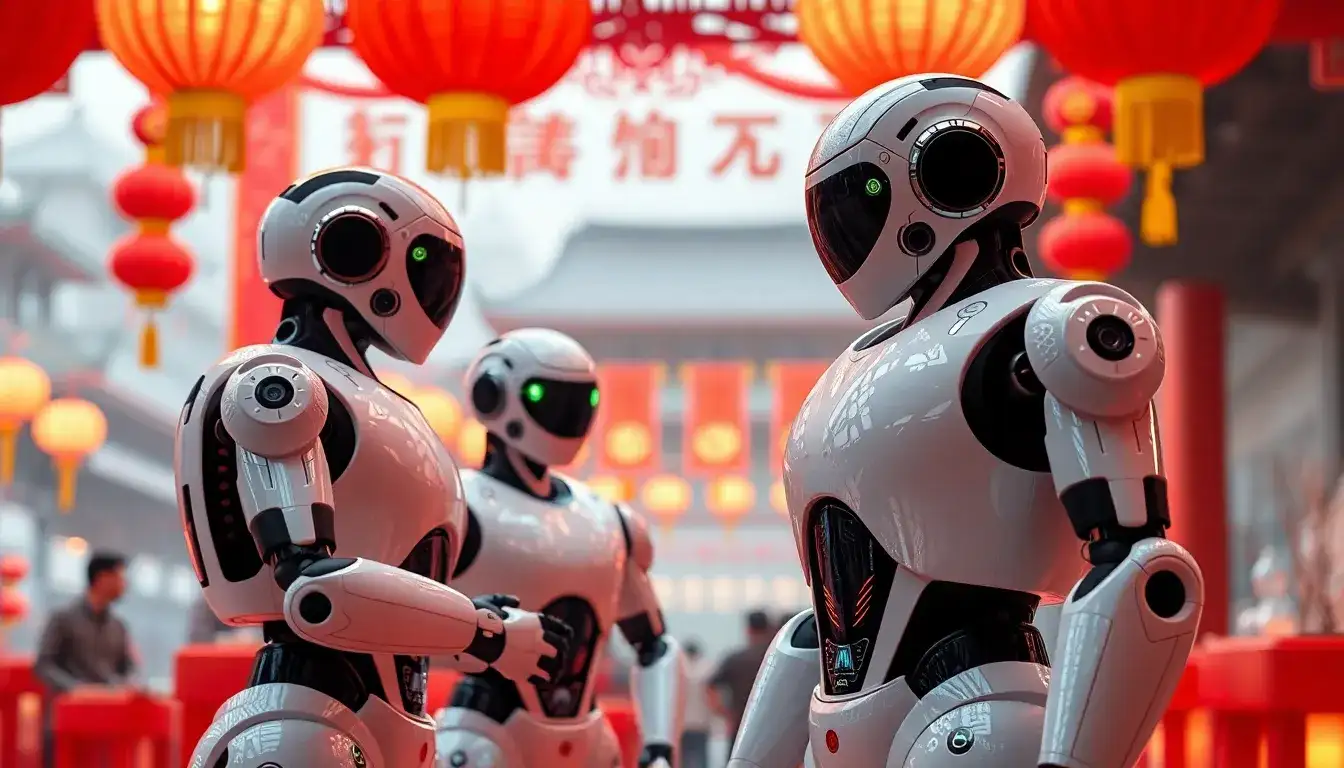
China’s Commercialization of Embodied Intelligent Robots: A Comprehensive Analysis of Four Leading Companies at the 2026 Spring Festival Gala
Date: March 1, 2026
In the narrative of China’s technological landscape, the years 2025 and 2026 are marked as pivotal for the commercialization of embodied intelligent robots. This shift is not only happening within the computational matrices of laboratories but is also vividly represented at the Spring Festival Gala, a national cultural celebration broadcast by China Central Television (CCTV). As “new productive forces” drive industry upgrades, humanoid robots have evolved from mere technological demonstrations to practical productivity tools that integrate artificial intelligence, advanced manufacturing, and new materials technology.
Overview
- The Embodied Intelligence Era: The Spring Festival Gala as a Convergence Point for Technological Commercialization and National Strategy
- Unitree Technology: Pioneer in High-Dynamic Motion Control and Cost Engineering
- MagicLab: Precision Operations and Hand-Eye Coordination under Xiaomi’s Influence
- GalaxyBot: Leader in Embodied Large Models and Industrial Heavy Loads
- Noetix Robotics: The Explosive Growth of a Tsinghua University Team
These four companies—Unitree Technology, MagicLab, GalaxyBot, and Noetix Robotics—collectively showcased their innovations at the 2025 and 2026 Spring Festivals, effectively presenting a “super roadshow” to global capital and industry chains. While they share a common vision for embodied intelligence, their underlying technological frameworks, supply chain integration, and market strategies are distinct.
Unitree Technology: A Pioneer in High-Dynamic Motion Control
Unitree Technology has emerged as a leader in the quadruped robot sector, marking its transition to humanoid robotics. From the “Beng Beng” robot in 2021 to the impressive “Martial Arts Bot” in 2025, Unitree has demonstrated a clear technological evolution path from “powerful muscles” to “intelligent brains.”
Technical Framework: Aesthetic of Extreme Performance and Computational Power
Unitree’s humanoid robot, the H2, showcases a design philosophy that diverges from American competitors like Tesla’s Optimus, emphasizing hardware redundancy and algorithm iteration. With a height of approximately 182 cm and a weight of 70 kg, the H2 represents a 50% increase in weight from its predecessor, indicating a focus on enhancing physical structure strength and inertia for broader operational capabilities.
Unitree has upgraded its reinforcement learning framework, allowing the robot to complete millions of virtual training simulations, mastering complex movements like aerial flips and dynamic spins. For the 2025 gala, an AI-integrated positioning algorithm was developed, ensuring precise localization even during rapid movements.
Supply Chain Layout: In-depth Research and Localization of Core Components
Unitree’s success is attributed to its tight control over the supply chain, achieving a 40% reduction in core component costs through deep integration with suppliers and autonomous development of key components, including high-density motors and complex motion control systems.
Business Strategy: IPO Push and Comprehensive Market Penetration
Unitree’s strategy reflects a systematic expansion approach, initially dominating the quadruped robot market before entering humanoid robotics for research and education, ultimately targeting broader consumer markets. The company completed its IPO guidance in November 2025, anticipating becoming the first humanoid robotics stock in the A-share market.
MagicLab: A Rising Force in Precision Operations
Founded in January 2024, MagicLab leverages the expertise of its founding team, including former Xiaomi robotics lead Wu Changzheng. Their technology emphasizes precision, demonstrated during the Spring Festival Gala with synchronized group performances.
Technical Framework: Integration of MagicLM Large Model and Agile Operations
MagicLab’s core technology combines a large multimodal model with a sophisticated robotic hand capable of performing intricate tasks. The company utilizes imitation learning to quickly teach robots complex hand-eye coordination skills, significantly improving their operational precision.
GalaxyBot: Leading with Embodied Large Models and Industrial Applications
GalaxyBot received recognition as the “Designated Embodied Large Model Robot” at the Spring Festivals, underscoring its innovative software-defined robotic technology. The founding team boasts strong academic backgrounds, with CTO Wang He being a prominent scholar at Peking University.
Technical Framework: AstraBrain’s Data-Driven Logic
GalaxyBot integrates a comprehensive system that combines brain, cerebellum, and neural control. It has created a vast dataset for robot operations, primarily using synthetic data to overcome the data scarcity challenges associated with embodied intelligence.
Noetix Robotics: The Explosive Growth of a Young Team
Noetix Robotics, led by young entrepreneurs from Tsinghua University, has quickly transitioned from prototype to mass production. Their robots showcased emotional connections with audiences during the gala, portraying the concept of “robot grandchildren.”
Conclusion: The Future of Embodied Intelligence and Challenges Ahead
The collective appearances of Unitree Technology, MagicLab, GalaxyBot, and Noetix Robotics at the Spring Festivals signal that China has successfully transitioned its embodied intelligent robotics industry from “sci-fi concepts” to “new productive forces.” Future focus areas include the construction of data protection mechanisms, the scaling of production, and the evolution of robots from simple executors to intelligent partners capable of understanding intent.
Original article by NenPower, If reposted, please credit the source: https://nenpower.com/blog/chinas-year-of-commercializing-embodied-intelligent-robots-an-in-depth-analysis-of-four-leading-companies-from-the-2026-spring-festival-gala/

