

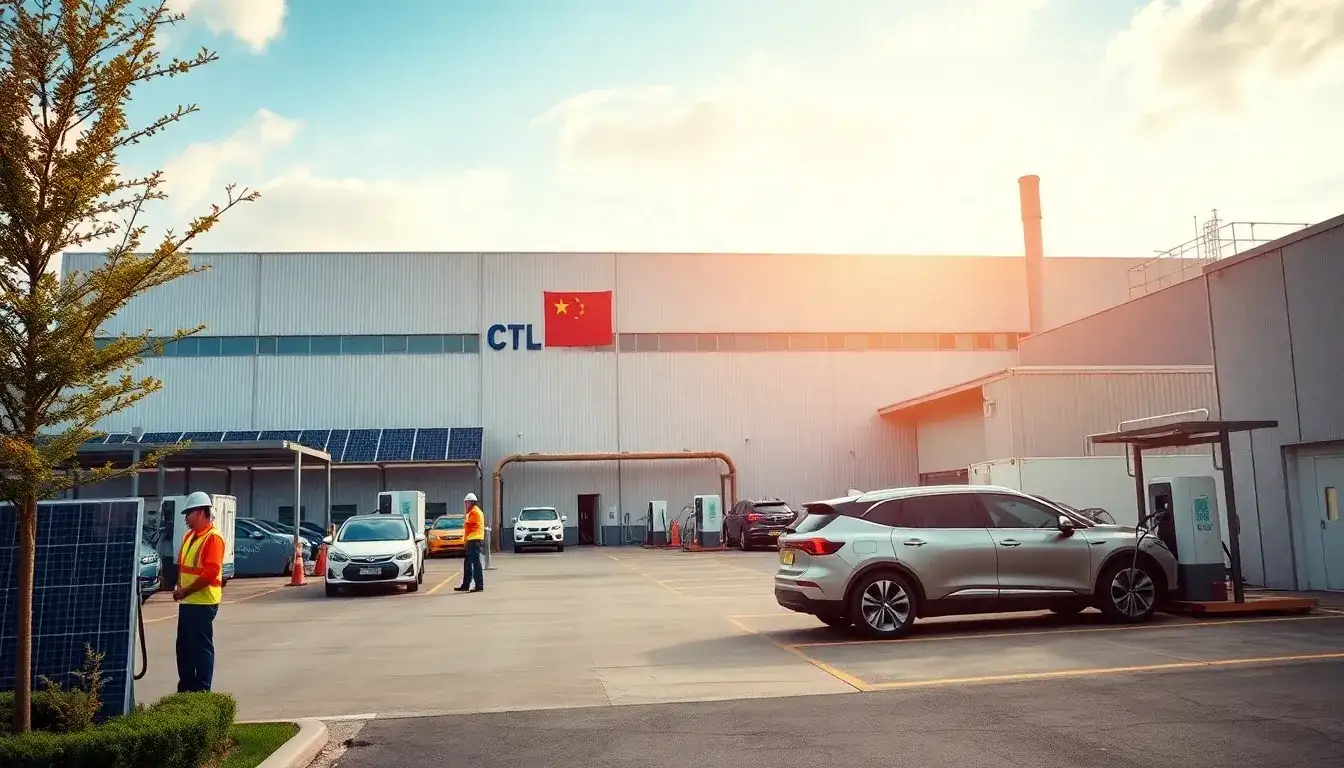
Over two years ago, in the outskirts of a medieval German town, China’s largest electric vehicle battery manufacturer made a significant investment of 1.8 billion euros (approximately 2 billion dollars) in the future of global trade. Contemporary Amperex Technology Co., Limited (CATL) decided to build a large factory in central Germany, marking its first manufacturing site outside of China. This decision reflects the understanding of Chinese President Xi Jinping that the trend of global trade protectionism is likely to persist. The strategy is straightforward: invest abroad, create local jobs, and ensure the continuous flow of Chinese products into key markets. CATL’s investment in Germany exemplifies this approach.
The company recently went public in Hong Kong, raising 41 billion Hong Kong dollars (around 5.2 billion dollars). “I believe we are a blueprint for Chinese companies that aim to expand in Europe,” said Matthias Zentgraf, CATL’s European President, from the factory office located outside Arnstadt. Last year, the European Union imposed tariffs of up to 45% on electric vehicles imported from China, prompting companies like BYD, Chery, and Leap Motor to adopt similar strategies, establishing operations from Spain to Hungary.
As global tariffs and protectionism rise, this strategy appears to be a vital lifeline for the Chinese economy. CATL has limited operations in the United States, so the new tariffs imposed there have a minimal impact. Establishing factories abroad helps alleviate concerns in Beijing about surging exports and an expanding trade deficit. According to preliminary data from the State Administration of Foreign Exchange, China’s overseas investments surged by 48 billion dollars in the first quarter of 2025, a 28% year-on-year increase.
However, Chinese companies have also encountered some drawbacks with the overseas manufacturing strategy, including more strained labor relations compared to those in China, higher operating costs, and the risk of key technologies and trade secrets leaking to competitors. Even in Arnstadt, where CATL’s presence is regarded as a success, the operation of its first overseas factory, employing about 1,700 European and Chinese workers, has faced challenges such as cultural differences, labor disputes, and other common issues associated with international business.
One significant issue is the higher energy costs in Germany compared to China, partly due to disruptions in Russian gas supplies following the outbreak of the war in Ukraine. According to a survey by the German Chamber of Commerce, energy prices have led nearly half of the surveyed companies to consider limiting production or relocating abroad. Zentgraf mentioned in a February interview, “No one in Germany can produce products at competitive market prices due to high energy costs.”
The electric vehicle market also faces specific challenges. Last year, European car sales grew little due to persistent inflation, higher borrowing costs, and consumer indifference towards electric models. However, this trend may be shifting, as electric vehicle sales in Europe grew by 28% in the first quarter, with significant demand in markets like Germany, the UK, and Italy.
Labor issues also persist. A technical supervisor at CATL’s German factory, who wished to remain anonymous, stated that the workforce is primarily composed of European employees who prefer fixed working hours, while incoming Chinese workers are more willing to accept overtime and less structured schedules. Two former employees, who also requested anonymity, reported that local workers even staged a strike last year over inadequate toilet paper, viewing this as a barrier to taking breaks.
Although these tensions are common, they are critical, as Western companies have long faced similar challenges while operating in China. Zentgraf acknowledged the “productivity gap” that exists in the mixed labor environment of Central Europe but added that “CATL’s proximity to major European customers allows us to respond to local demand changes, bridging that gap.”
CATL did not directly respond to inquiries regarding last year’s strike but stated that the company supports the establishment of a works council at its German factory and is working to ensure “an open and progressive work environment for everyone.” CATL has brought in hundreds of Chinese workers to the German factory, accounting for about 30% of its total workforce; however, as more local employees are trained, the company has begun to reduce the number of Chinese workers. Currently, local teams, predominantly composed of Europeans, manage battery assembly, packaging, and delivery for major German automakers like Volkswagen and BMW.
The mayor of Arnstadt, Frank Spilling, acknowledged that when CATL established its factory, local residents had “reservations,” fearing that too many foreign workers would take all the jobs. However, he stated that it has since proven to be “nonsense.”
Currently, the greatest threat to this strategy may come from Donald Trump, the U.S. President, who may attempt to leverage negotiations with other countries and the EU to limit trade with Beijing. This could include restricting Chinese investments and preventing other nations from absorbing Beijing’s excess industrial capacity. The Chinese government is striving to counter the U.S. actions, as both countries have currently paused the escalating tariff war.
The Chinese Ministry of Commerce has repeatedly warned countries against reaching agreements that would marginalize or isolate China in favor of the U.S. Last month, the ministry stated that China firmly opposes any party reaching agreements at the expense of Chinese interests. China is also promoting itself as a more reliable guardian of the global trading system. In April, Xi Jinping visited Vietnam, Malaysia, and Cambodia to strengthen foreign relations and seek support, and he held meetings with Latin American leaders this month, conveying this message. When European ministers visited Beijing in July, he likely emphasized this point as well.
The U.S. is not the only threat. Recently inaugurated German Chancellor Friedrich Merz has long held a skeptical view of tightening relations with China and stated this month that he will pursue “strategic de-risking” with the world’s second-largest economy. During the Ukraine war, Beijing’s close ties with Russia have continued to unsettle Merz and many other European leaders.
Xi has also expressed some reservations about the extent of overseas factory expansions. Amid the race for dominance in the global electric vehicle market, Beijing has suggested that domestic automakers ensure advanced automotive technology remains in China. Following record capital outflows that have pressured the renminbi, Beijing has also tightened scrutiny over overseas investments.
Gregor Sebastian, a senior analyst with the Rhodium Group, noted that Chinese companies are caught in a dilemma between meeting the EU’s demands for greater localization and Xi’s desire to keep core technologies at home.
As it stands, the overseas investment strategy appears to be a second-best option for China. Mayor Spilling echoed this sentiment in an interview, stating that while CATL and other companies moving to Arnstadt have been successful, they have also brought some negative impacts, such as increased traffic complaints, but he believes the benefits outweigh the drawbacks. “Clearly, the advantages outweigh the disadvantages,” he concluded.
Original article by NenPower, If reposted, please credit the source: https://nenpower.com/blog/chinas-strategy-to-counter-trade-protectionism-catls-new-factory-in-germany/

