

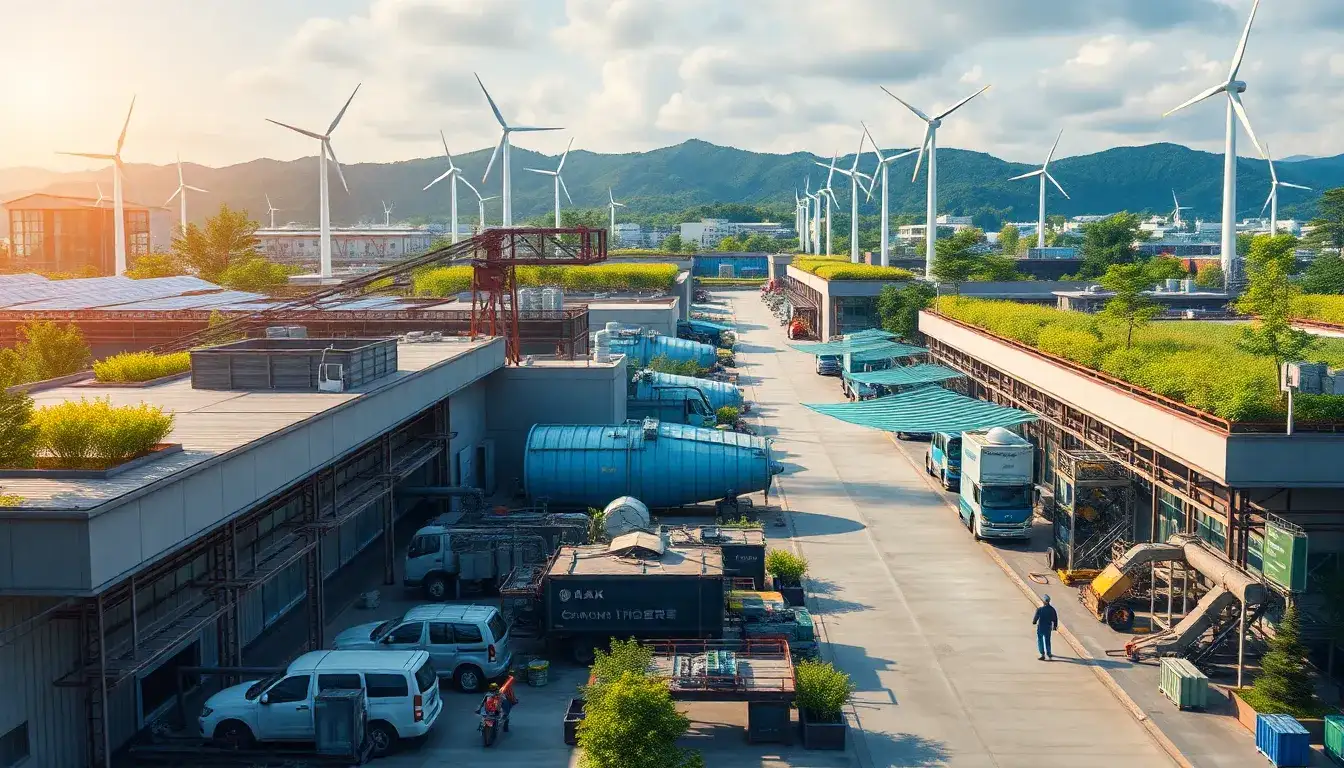
On May 23, 2024, Premier Li Qiang presided over a State Council executive meeting that approved the “Action Plan for Green and Low-Carbon Development of the Manufacturing Industry (2025-2027).” This plan comes in response to the “Guiding Opinions on Accelerating the Green Development of the Manufacturing Industry” released by the Ministry of Industry and Information Technology in 2024, and marks the culmination of extensive work on a three-year initiative.
1. Current State of China’s Manufacturing Industry
China’s manufacturing sector is at a crucial stage, characterized by consolidated scale advantages, deep structural adjustments, and accelerated innovation breakthroughs. Despite facing external technological blockades and internal transformation pressures, the country boasts a complete industrial chain, immense market potential, and continuous policy support, laying a strong foundation for transitioning from a “world factory” to a “global hub of manufacturing innovation.”
1.1 Global Scale and Industrial Integrity
As the only country with a manufacturing sector covering all industrial categories, China’s manufacturing added value reached 40.5 trillion yuan in 2024, accounting for approximately 30% of the global total, maintaining its position as the world’s largest manufacturer for 15 consecutive years. The proportion of high-tech manufacturing value added rose from 13.9% in 2018 to 16.3% in 2024. The share of equipment manufacturing stood at 34.6%, while labor-intensive industries like textiles and garments fell to 5.0%. The export share of electromechanical products reached 58.5%, with the exports of “new three items”—electric vehicles, photovoltaic modules, and lithium batteries—surpassing 1.2 trillion yuan in 2024. Notably, electric vehicle exports exceeded 2 million units, and photovoltaic module exports reached 205.9 GW.
1.2 Technological Innovation
China has established a trend of “increasing investment and rapid output growth.” In 2024, the intensity of research and development (R&D) funding reached 2.68%, with basic research accounting for 6.91%. The number of R&D personnel has ranked first globally for 11 consecutive years. The country has shifted from “catching up” to “leading” in fields such as high-speed rail, ultra-high voltage, and industrial robotics, with an annual production of 430,000 industrial robots, maintaining the top global position. However, critical areas face significant challenges, as dependencies on imports for core technologies such as semiconductor equipment and high-end photolithography resins remain prevalent, with chip imports reaching $350 billion in 2023 and a self-sufficiency rate of less than 20%.
1.3 International Competition
In response to a complex international environment, China’s manufacturing sector is accelerating its globalization efforts and risk management. The U.S. has employed export controls and tariff barriers to curb the growth of China’s high-tech industries. In response, China is advancing core technology autonomy, exemplified by breakthroughs in controller technology by Shenyang Siasun Robot & Automation Co., and a 95% yield rate on the 14nm production line by SMIC. Simultaneously, companies like BYD and CATL are establishing R&D centers and production bases in Europe and Southeast Asia, with exports to Belt and Road Initiative countries growing by over 15% in 2024.
1.4 Green Transformation
The transition to green practices has become an intrinsic requirement for high-quality manufacturing development. China maintains a global leadership position in green industries such as photovoltaics and lithium batteries, with production accounting for over 70% of the global total. In 2024, photovoltaic product exports exceeded 200 billion yuan for the fourth consecutive year. The industrial decarbonization approach is shifting from “supply-side control” to “demand-side innovation.” For instance, Baowu Steel has implemented hydrogen-based vertical furnace steelmaking, achieving a 70% reduction in carbon emissions, while LONGi Green Energy has realized annual emission reductions exceeding 500 million yuan through CCER trading. Additionally, energy consumption per unit of GDP decreased by 3.7% year-on-year in 2024, marking the initial formation of a green manufacturing system.
1.5 Core Challenges
Looking ahead, China’s manufacturing sector faces several challenges: ongoing external constraints, including an escalation of the U.S. technology blockade, pose supply risks in sectors such as semiconductors and AI. Internally, rising labor costs and an aging population intensify pressures on traditional industries. Although investments continue, the proportion of basic research funding in China remains below 7%, compared to over 15% in developed countries, highlighting a need for improved collaboration between industry, academia, and research institutions. During the 14th Five-Year Plan, the manufacturing sector must focus on the integration of intelligent and green practices, balancing globalization with risk management, and cultivating new productive forces.
2. Focus Areas of the Action Plan
According to a spokesperson from the Ministry of Industry and Information Technology in October 2024, the action plan will focus on improving the green and low-carbon development mechanism, centering on three key areas:
2.1 Carbon Footprint Accounting Standards
The plan will accelerate the establishment of carbon footprint accounting standards for key products such as steel, electrolytic aluminum, lithium batteries, and new energy vehicles. This initiative aims to guide industrial enterprises in reducing carbon emissions throughout the entire lifecycle of their products, promoting the transformation and upgrading of industrial and supply chains.
2.2 Comprehensive Utilization of Solid Waste
Efforts will be made to strengthen the construction of a new comprehensive utilization system for solid waste, focusing on used power batteries. This includes formulating management measures for comprehensive utilization, revising industry standards, and building a recycling system. Policies regarding the comprehensive utilization of decommissioned photovoltaic modules will also be enhanced to prepare for anticipated peaks in decommissioning.
2.3 Application of Clean Low-Carbon Hydrogen
The plan will actively promote the application of clean low-carbon hydrogen in industry by addressing existing bottlenecks and further integrating innovative policies. It aims to accelerate hydrogen application in metallurgy, chemicals, and petrochemicals, and achieve breakthroughs in multiple scenarios such as industrial green microgrids, green shipping, and green aviation.
3. Strategic Directions of the Action Plan
In line with the “Guiding Opinions on Accelerating the Green Development of the Manufacturing Industry” and the latest policy developments, the action plan will focus on the following aspects:
3.1 Strengthening Green Technology Innovation and Application
Accelerating green technology innovation and the application of advanced green technologies will be a core direction of the action plan. Through the development and application of new green technologies, it is possible to fundamentally change production methods in manufacturing, reduce energy consumption, and minimize environmental pollution, laying a green foundation for new industrialization.
3.2 Promoting the Green Transformation of Traditional Industries
Traditional industries are a crucial component of manufacturing and represent both a key focus and challenge for green and low-carbon development. The plan may combine policies for large-scale equipment upgrades with the active application of advanced equipment and processes, accelerating the green transformation of key sectors such as steel, chemicals, and construction materials.
3.3 Leading Green Development in Emerging Industries
For emerging industries, the plan emphasizes high-standard green development. It calls for greater use of clean energy and the promotion of green products, enhancing resource recycling levels. In fields like new energy vehicles and photovoltaics, the focus will not only be on expanding industry scale but also on embedding green development concepts from the outset.
3.4 Strengthening Common Technology Research and Standards Improvement
Common technologies are key constraints on the green and low-carbon development of manufacturing. Strengthening research in this area can provide robust technical support for industry development. Additionally, refining standards in key sectors will help regulate production behaviors and ensure the quality and effectiveness of green and low-carbon development.
3.5 Optimizing Policies and Improving Service Systems
By optimizing related policies, a favorable policy environment for green and low-carbon development in manufacturing can be created. This includes financial subsidies, tax incentives, and financial support to encourage enterprises to actively pursue green transformation and innovation. Furthermore, establishing a green manufacturing and service system will encompass developing green supply chain management frameworks and providing green technology consulting and certification services.
Original article by NenPower, If reposted, please credit the source: https://nenpower.com/blog/chinas-state-council-unveils-three-year-action-plan-for-green-transformation-of-the-manufacturing-industry/

