

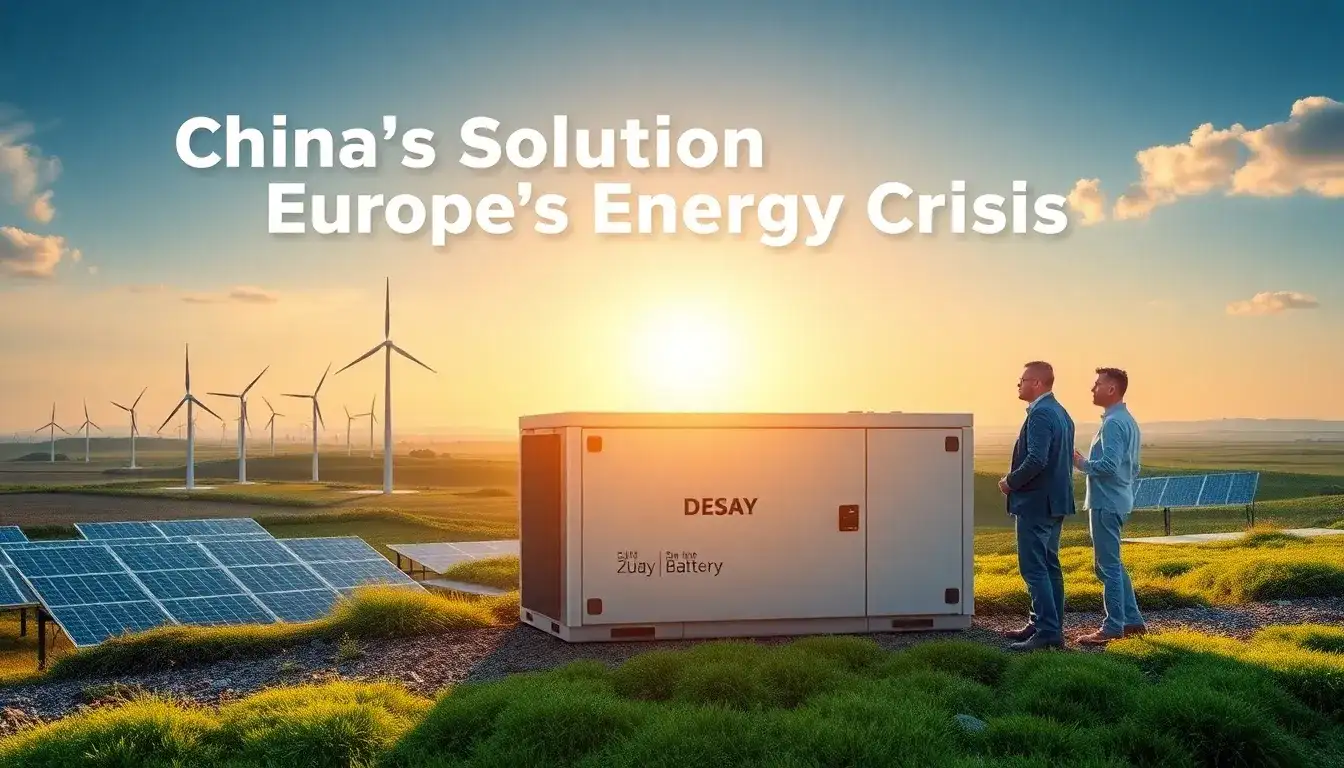
As Europe’s energy transition accelerates and extreme weather events become more frequent, the stability of regional power grids has become increasingly concerning. On April 28, a significant power outage occurred in Spain and Portugal, disrupting critical sectors such as transportation, communication, and healthcare, affecting over 50 million people, including neighboring countries like France and Italy. This incident has once again highlighted the vulnerability of the European power grid and the underlying contradictions of the energy transition in Europe. With renewable energy sources now accounting for over 40% of the energy mix, the stability of these grids faces unprecedented challenges.
According to data from the European Association for Storage of Energy (EASE), the EU needs to add at least 200 GW of energy storage capacity by 2030 to effectively manage the fluctuations associated with wind and solar power generation. This substantial market gap presents a historic opportunity for Chinese energy storage companies.
The recent outages have not only boosted demand for large-scale energy storage but have also intensified public interest in energy autonomy. For instance, during the 2022 energy crisis in Germany, home energy storage orders surged by 147% year on year. It is evident that the European market, particularly in sectors where power reliability is critical, is rapidly increasing its demand for dependable power solutions. Additionally, the cascading effects of power outages, such as transportation disruptions and commercial interruptions, further underscore the urgent need for emergency backup power solutions.
In this context, Desay Battery Co., Ltd., a leading global provider of comprehensive energy storage solutions, has unveiled its UPS 2.0 solution at the The Smarter E Europe 2025 exhibition in Munich, which opened on May 7, 2025. This solution can provide reliable power support for data centers, communication stations, and industrial automation scenarios. In terms of reliability, the product features a lithium battery cabinet design that supports a power output of 300 kVA and a storage capacity of 49 kWh. With an 8C high discharge rate, it meets the power requirements of high-load environments such as large data centers and communication hubs. Moreover, the UPS 2.0 solution boasts an impressive lifespan of 15 years, exceeding the industry average of 8-10 years for standard UPS devices. An intelligent monitoring system allows for real-time battery status tracking and predictive maintenance, ensuring consistent and stable operation.
Addressing the need for flexible technology adaptation in the European energy transition, this product supports both 2-line and 3-line UPS configurations and is fully compatible with mainstream UPS devices regarding voltage range and communication protocols. In response to industry-wide safety concerns, Desay Battery has developed a multi-layer protection scheme that encompasses the cell, pack, cabinet, and system levels. Through innovative materials, mechanical safeguards, and intelligent monitoring, the company effectively addresses potential safety risks proactively.
Equipped with Desay Battery’s self-developed active safety energy storage cells, the solution represents a new era of eight protective measures. The cells utilize innovative PE + ceramic separator technology and have successfully passed national standards for puncture thermal runaway tests. The PACK level is equipped with a perfluorohexane fire suppression system and dual active defense mechanisms, while the cabinet level includes fuse protection and directed explosion venting, along with efficient gas and water firefighting systems. Together, these features enhance the overall safety of the system.
From an economic perspective, the solution has also achieved significant breakthroughs. Its innovative cabinet transportation plan can reduce installation costs by up to 90%. The high energy density design of the lithium battery reduces the required footprint by 70%, significantly enhancing space utilization. Furthermore, the 15-year lifespan notably lowers the total lifecycle costs, thereby creating sustained value for customers.
However, for Chinese companies, the greatest challenge in expanding into the European market lies in the requirements of the new EU Battery Regulation. Desay Battery has successfully navigated this challenge by signing a strategic cooperation agreement with the international certification authority TüV Rheinland during the exhibition. This partnership will facilitate comprehensive certification for Desay Battery’s latest UPS lithium cabinet 2.0, which will undergo multiple rigorous tests, including CB 62619, CE LVD, and CE EMC, while also complying with the new EU Battery Regulation and ROHS environmental directives.
As energy storage systems evolve from traditional single energy storage units to key nodes in intelligent grids with advanced functions like active support and inertia response, this industry trend was also evident at the Munich exhibition. The theme of this year’s event, “Accelerating Integrated Energy Solutions,” focused on the deep integration of renewable energy and power grids. Desay Battery showcased its full-chain technology matrix, covering cells, modules, and system integration, vividly demonstrating the unique advantages of energy storage products in the industry and their crucial role in driving the energy transition.
Desay Battery is committed to enhancing product quality and safety, adopting a responsible approach to every battery produced. Its 100Ah, 280Ah, and 314Ah lithium battery products, combined with 60Ah sodium batteries, form a diversified cell matrix. Notably, the 100Ah and 280Ah cells can achieve zero degradation over a thousand cycles and have passed rigorous certification tests such as GB/T36276 and UL1973, receiving high praise from users. For example, in a data center storage project in Shaoguan, Guangdong, the 280Ah cells operate under a daily “charge and discharge” strategy, utilizing off-peak power for storage and high demand release, saving the enterprise approximately 600,000 yuan in annual electricity costs.
In the system integration domain, Desay Battery’s 215kWh and 344kWh commercial energy storage cabinets are developed in-house, employing a highly integrated CCS solution that significantly enhances system reliability and energy density. To reflect its respect for equipment and asset safety, the company has named its commercial storage product “Lumos” (Light). Additionally, large storage solutions such as the 5MWh liquid-cooled container are characterized by high integration, efficiency, and safety, aligning perfectly with the European market’s core demand for high safety standards and modular rapid deployment.
Desay Battery also collaborates with TüV Rheinland for the European market certification of this 5MWh container storage system. Compared to the UPS lithium cabinet 2.0, the certification for the 5MWh system encompasses a broader range, requiring adherence to additional North American standards such as UL 1973 and UL 9540A, underscoring the product’s global applicability. Importantly, this certification will rigorously assess compliance with the sustainability requirements regarding carbon footprint and recycling outlined in the new EU Battery Regulation.
In response to the burgeoning household energy storage market, Desay Battery has introduced low-voltage home storage split units and a 280Ah high-voltage home storage system. These systems offer European households more flexible and efficient clean energy options through differentiated voltage designs and intelligent energy management features.
As a leader in the energy storage sector, Desay Battery continues to strengthen its OEM business, deepen strategic collaborations with key clients, and focus on expanding household, commercial, and independent shared storage markets. By intensifying efforts to explore overseas markets and enhancing its full-chain service capabilities from product development to system integration, Desay Battery aims to provide technological support for building a stable, economical, and sustainable green energy ecosystem. With profound technical accumulation, reliable project delivery quality, and a growing global brand influence, Desay Battery has once again been recognized in the 2025 Q2 BNEF Tier 1 list of global top-tier energy storage manufacturers, marking its emergence as a core player in the global energy storage industry.
As the energy revolution accelerates, Desay Battery is committed to enhancing its technology integration across the entire industry chain and adopting a dual-driven model of “global operation + local cultivation.” In the future, Desay Battery will deeply engage in the construction of global zero-carbon cities and promote high-quality development in the green energy industry. In terms of market performance, Desay Battery achieved a revenue of 4.369 billion yuan in Q1 2025, with a year-on-year growth of 6.69%. The net profit attributable to shareholders reached 48.6618 million yuan, a 10.96% increase compared to the previous year.
In conclusion, looking back from the 2025 timeline, Desay Battery’s development trajectory reflects the rise of China’s energy storage industry. From initial technology introduction to today’s independent innovation, and from OEM production to standard-setting, Chinese companies are playing an increasingly important role in the global energy transition. As the global energy transition enters deeper waters, companies like Desay Battery are navigating the waves with technology as their oar and innovation as their sail.
Original article by NenPower, If reposted, please credit the source: https://nenpower.com/blog/chinas-solution-to-europes-energy-crisis-desay-battery-tackles-grid-stability-with-comprehensive-technology/

