

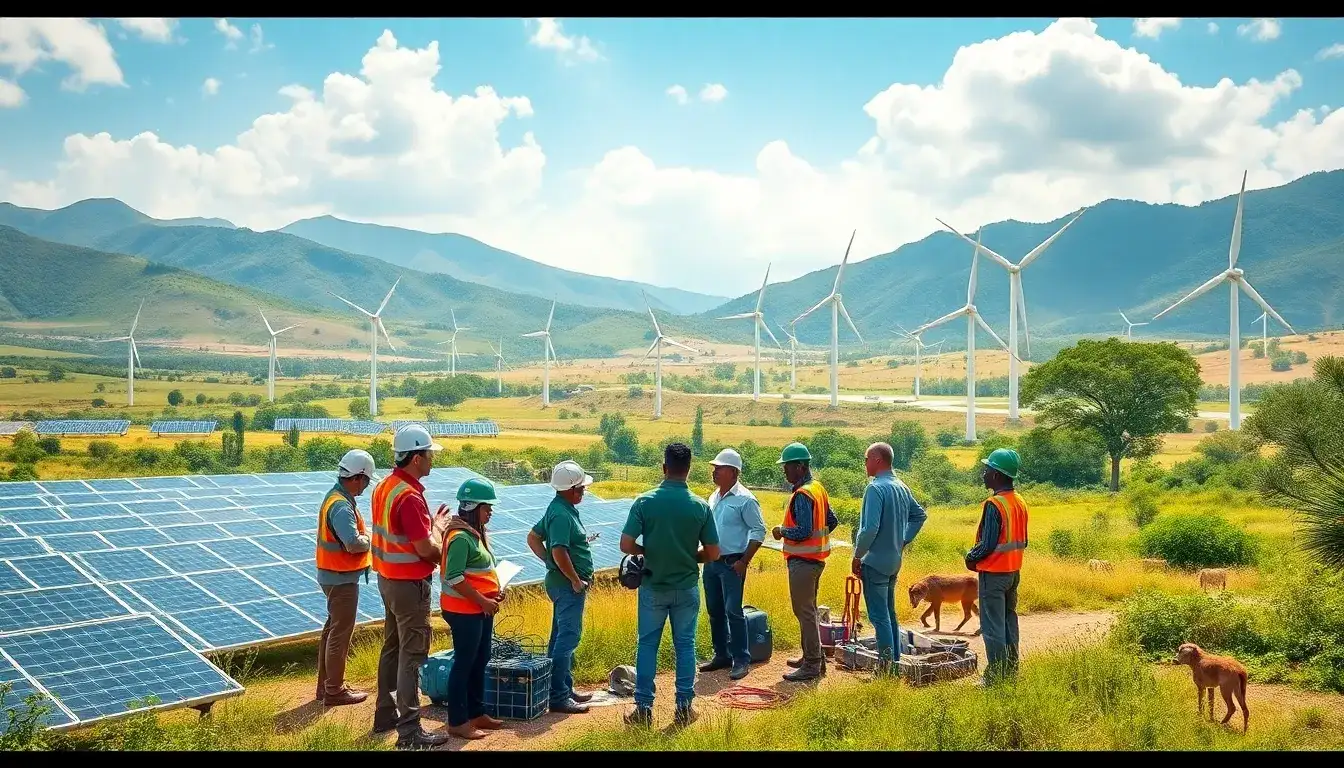
The emergence of off-grid solar power stations has alleviated electricity shortages for pastoralists in remote areas of Ethiopia. A 100-megawatt solar power plant, constructed in just a few months, has ensured that milling machines in Zambia’s copper mining region no longer halt operations due to insufficient hydroelectric power supply. The molten salt tower at South Africa’s Redstone concentrated solar power project is converting solar thermal energy captured during the day into a stable current at night, lighting up countless homes. Across the vast expanse of Africa, projects focused on Sino-African electricity cooperation are steadily progressing, aiding African nations in achieving sustainable electricity development.
Small yet impactful—Microgrids improving lives. In Beos village, Ethiopia, herder Hules has finally started using a mobile phone, and his home is no longer shrouded in darkness at night—his village was electrified just two months ago. This remote village in northeastern Ethiopia has become more vibrant thanks to an off-grid solar power station. “We no longer have to worry about power outages; we are grateful to our Chinese friends for bringing us stable electricity,” Hules expressed joyfully. In July of this year, the second phase of the off-grid solar power station project, constructed by the State Grid Corporation of China, was completed, bringing electricity to eight remote areas, including Beos village. Kolier village also benefited from this initiative. Village doctor Hasli stated, “Previously, we relied on diesel generators with unstable voltage, making us hesitant to use many medical devices. The new solar power station has energy storage batteries, ensuring stable and reliable voltage.” Tesfaye, a supermarket operator in the village, added, “People work during the day and can now engage in handicrafts at night to supplement their income. Our wallets are gradually getting fuller.” Most rural areas in Ethiopia are far from the main power grid. With advantages such as quick installation, low cost, and sustainability, off-grid solar power projects are actively promoted by local governments. Selassie Bekele, former Minister of Water and Energy in Ethiopia, remarked, “The off-grid solar power project is a significant step towards our national electricity accessibility plan, with important contributions from Chinese enterprises.”
In Mali, West Africa, a solar demonstration village project built by Chinese enterprises has installed 1,195 off-grid solar home systems, along with solar street lights and water pumps, benefiting tens of thousands of local residents. In Cameroon, over 400 rural off-grid solar power stations have been established with Chinese assistance. Paul Flynnpong, Executive Director of the Ghana-China Policy Consulting Center, noted, “Recent data shows that off-grid solar systems contributed to more than half of the new electricity connections in sub-Saharan Africa. China has extensive experience in this field, helping Africa achieve broader electricity accessibility.”
Fast and impactful—Large projects driving social development. In the Chisamba district of Zambia’s Central Province, a vast solar “ocean” spreads across the horizon, marking the country’s largest single solar project—the 100-megawatt Kafue solar project. In recent years, Southern Africa has faced severe droughts, leading to significant shortages in Zambia’s previously relied-upon hydroelectric power. “Using solar to supplement hydro,” the construction of the Kafue 100-megawatt solar project has become an urgent solution to the region’s electricity challenges. During the Forum on China-Africa Cooperation in Beijing in September 2024, Zambian President Hichilema attended the Zambia Power Development Forum organized by China Power Construction, where several projects of over 100 megawatts, including the Kafue project, were signed. The Kafue solar project, which began construction in July of the same year, entered an accelerated phase, connecting to the grid on June 30. In April, the Suez Canal No. 2 project in Egypt, built by Chinese enterprises, was fully connected to the grid and began commercial operations. With a total installed capacity of 500 megawatts, it is expected to generate 2 billion kilowatt-hours annually, meeting the electricity needs of over a million households. “Electricity is the foundational driving force for Africa’s industrialization, and building electricity infrastructure is a top priority for national development across African nations,” stated Mete Meike, President of the University of San Pedro in Côte d’Ivoire. “China offers comprehensive support in technology, funding, and talent development, helping African countries gradually achieve energy independence.”
Regarding the Tanzanian Julino Hydropower Station constructed by Chinese enterprises, Humphrey Mosi, Director of the China Research Center at the University of Dar es Salaam in Tanzania, remarked, “The Julino Hydropower Station is one of the largest ongoing hydropower projects in Tanzania and Africa, with an installed capacity exceeding 2,000 megawatts. This project not only addresses nearly 40% of Tanzania’s electricity demand but also creates thousands of direct job opportunities, effectively improving social productivity in Tanzania.”
Innovative and sustainable—Meeting diverse African needs. In Postmasburg, Northern Cape, South Africa, the “Steel Sunflower” project spreads over more than one million square meters, comprising over 40,000 mirrors that move with the sun. The collected solar energy is converted and stored through a tower that stands several meters tall, allowing for uninterrupted electricity generation around the clock. This project, the 100-megawatt Redstone tower salt concentrated solar power project, constructed by Shandong Electric Power Construction No. 3 Engineering Co., Ltd., is the first renewable energy project in sub-Saharan Africa to adopt tower molten salt storage technology. Chief Engineer Xie Yanjun stated that this project meets the electricity needs of over 200,000 households in the area. In the mountains of South Africa’s Western Cape, the mixed energy project, also built by China Power Construction, is progressing smoothly. This project is currently the largest mixed energy project in the world that combines photovoltaic, wind energy, and energy storage, which will provide reliable and stable clean energy to South Africa’s power grid and serve as a model for the development of new energy globally.
According to the UK-based Overseas Development Institute, China is increasingly directing its energy investments in Africa towards renewable energy projects, aligning with global energy transition trends. Critan Bahana, Editor of South Africa’s “Diplomatic” magazine, expressed, “China’s cooperation with Africa fully considers the continent’s development needs and aligns with the energy transition strategies widely implemented by African nations. The energy cooperation projects launched by China in various African countries emphasize sustainability and have cultivated a large number of local skilled laborers, who have become vital forces in achieving energy independence for African nations.” Relevant data indicates that China has trained over 220,000 personnel for African nations based on their actual needs. As a brand for international vocational education cooperation, the Luban Workshop has been established and is operational in 15 African countries, including Egypt and South Africa. Lu Zhilei, Director of the South Africa China Cultural and International Educational Exchange Center, stated, “The energy sector is key to the industrial development of African nations, and talent development in this area has always been a focus of Sino-African cultural exchange and cooperation. Increasingly, African technical talents are learning in China and working on Chinese projects, becoming skilled technicians in their home countries and contributing to Africa’s prosperous development.”
Original article by NenPower, If reposted, please credit the source: https://nenpower.com/blog/chinas-role-in-advancing-sustainable-energy-development-in-africa-through-cooperation/

