

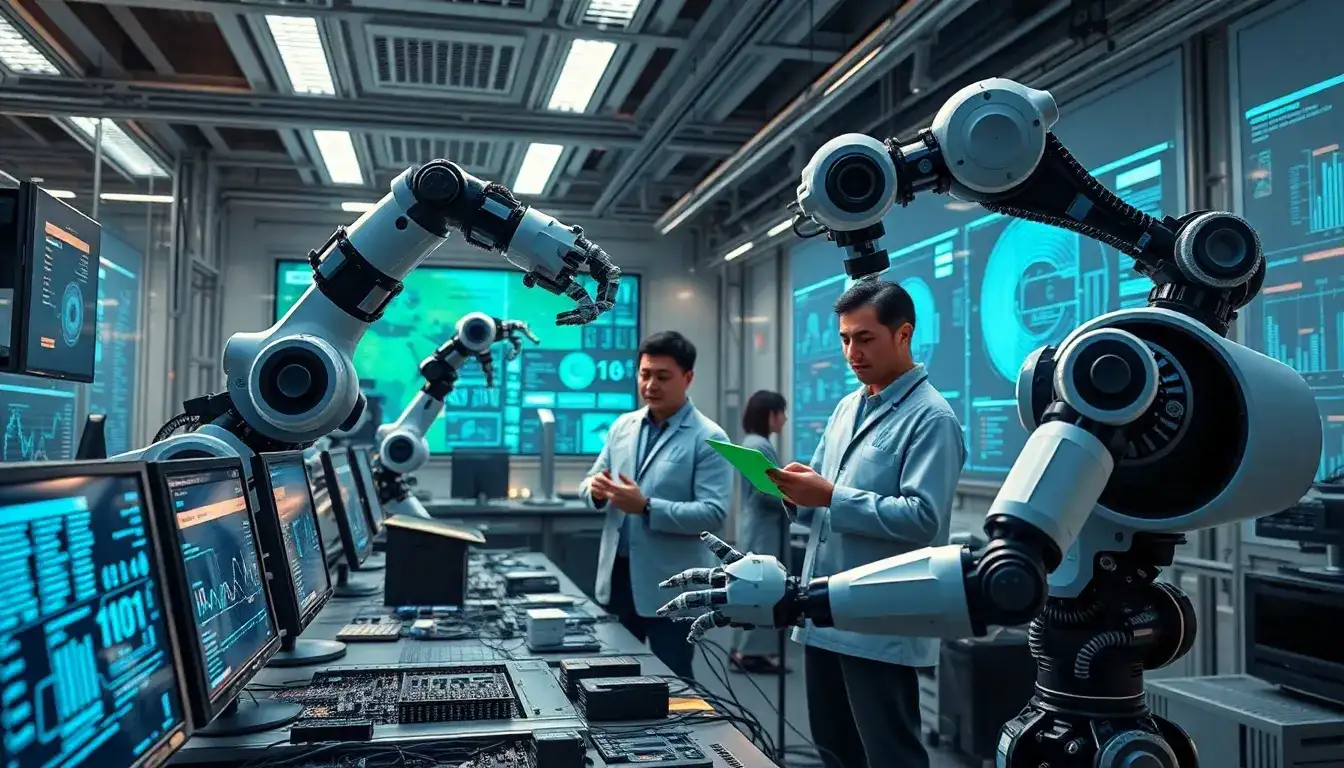
In recent years, the robotics industry in China has experienced remarkable growth, particularly with the advancement of artificial intelligence (AI) and computational power. The progress in robotics has reached a new level! Over the past year, we have witnessed robots that can sing and dance, cook, and perform various tasks across different industries, showcasing an ever-expanding array of skills and applications. Notably, China’s robotics sector has achieved comprehensive progress in terms of market expansion, technological breakthroughs, and application scenarios.
According to data, by 2024, the sales volume of industrial robots in China is expected to reach 302,000 units, maintaining its position as the world’s largest market for the twelfth consecutive year. Wang Hong, Deputy Director of the Equipment Industry Department at the Ministry of Industry and Information Technology, stated that during the 14th Five-Year Plan period, initiatives such as the robotics industry development plan and the ‘Robotics + ‘ industry application action were implemented to enhance the scale, technological capabilities, and application levels of the robotics sector. For the first time, the market share of domestically branded industrial robots has surpassed 50%.
In terms of technological capabilities, heavy-duty handling robots have achieved a load capacity of 600 tons, soft robots have reached autonomous cruising depths of 4,070 meters in the deep sea, and specialized robots are now utilized in extreme environments such as plateaus, outer space, and polar regions. These versatile robots are pushing the boundaries of imagination.
China has become the largest holder of robotics patents globally, with approximately two-thirds of the world’s total patent applications for robots expected to come from China by 2024. The country has nurtured 514 specialized small and medium-sized enterprises in the robotics field and 19 champion manufacturing enterprises, continuously improving the domestic rate of robot production.
On the application front, over 2 million industrial robots have been deployed in production workshops, enhancing average productivity by 35%. In desert areas, photovoltaic cleaning robots operate around-the-clock without water, increasing annual electricity generation by 12%. Maintenance robots have extended the observation time of China’s FAST (Five-hundred-meter Aperture Spherical Telescope) by 30 days, while smart rice paddy inspection robots have quintupled the efficiency of inspections in greenhouses. From factories to fields, and from large-scale national projects to everyday services, China’s diverse application scenarios are accelerating the growth of the robotics industry.
Moreover, China has reached international advanced levels in specific fields such as collaborative robots and small-load six-axis multi-joint robots. Leading companies are beginning to embrace AI technology, breaking into the realm of embodied intelligence in industrial applications.
It is important to highlight that the intelligent upgrade of the robotics industry is generating a high demand for diverse computing power. Different types of robots have varying requirements for computational capabilities; for instance, dynamic humanoid robots require over 100 TOPS, significantly more than industrial robots. Emerging embodied intelligent products, represented by humanoid and composite robotic arms (which combine wheeled chassis with dual arms), are increasingly demanding multi-modal dynamic interaction, model edge deployment, and scenario applications, leading to higher requirements for edge computing chips and continuous upgrades.
For example, in the welding process within industrial settings, robots need to process tens of thousands of image frames per second through visual sensors while synchronously adjusting the mechanical arm trajectory. This imposes strict demands on edge computing nodes, requiring latencies below 5ms and computational densities exceeding 50 TOPS per node. To establish joint testing standards for robots and computing power and to accelerate the penetration rate of domestic chips into robot control systems, the Ministry of Science and Technology has initiated the “Intelligent Robot Computing Power Adaptation Plan.” With policy support, companies such as Huawei and Cambrian have launched edge computing modules optimized specifically for robots, achieving over 40% improvement in energy efficiency (TOPS/W) compared to general-purpose chips.
Currently, China is leveraging humanoid robots as a starting point to drive the development of the broader embodied intelligence industry. The Ministry of Industry and Information Technology has explicitly stated the need to enhance technologies such as large models and computational chips, reinforcing the support of the national AI industry investment fund for humanoid robots and establishing an open-source community for humanoid robotics.
In terms of technological integration, the collaborative innovation of large models, embodied intelligence technologies, and robotic body technologies is deepening. The combination of “pre-training + reinforcement learning” is emerging as a crucial path for the intelligent upgrade of robots. On the ecosystem building front, cross-industry collaborations between robotics companies and AI and computing power enterprises are continually deepening, forming a synergistic system encompassing “hardware – computing power – models – applications.” At the 2025 World Artificial Intelligence Conference, over 150 robots will be showcased, supported by comprehensive backing from computing power service providers like Tencent Cloud, Baidu Intelligent Cloud, and SenseTime, allowing for significant enhancements in the precision and intelligent interaction capabilities of robots through the integration of computing power and AI technologies.
From an industry development perspective, the integration and innovative collaboration of the robotics industry with computing power and AI are still accelerating. While key steps have been taken towards commercialization, challenges remain, including intelligent shortcomings, lack of standards, and scalability issues. In the future, with the continued improvement of China’s computing power infrastructure, breakthroughs in heterogeneous computing, edge computing, and collaborative cloud computing, along with the lightweight and scenario-based iteration of AI large models, will inject stronger momentum into the intelligent development of the robotics industry.
Furthermore, ongoing policy support and the continuous enhancement of the industrial ecosystem will promote the robotics industry to play a larger role in new industrialization and digital economy construction. It is estimated that China’s embodied intelligence market is expected to exceed one trillion yuan in scale in the future. The dual drive of computing power and AI will propel the robotics industry from being a “single operational tool” to a “multi-scenario intelligent entity,” injecting robust digital momentum into China’s high-quality economic development.
Original article by NenPower, If reposted, please credit the source: https://nenpower.com/blog/chinas-robotics-industry-achieves-leapfrog-development-with-ai-and-computing-power-driving-new-possibilities/

