

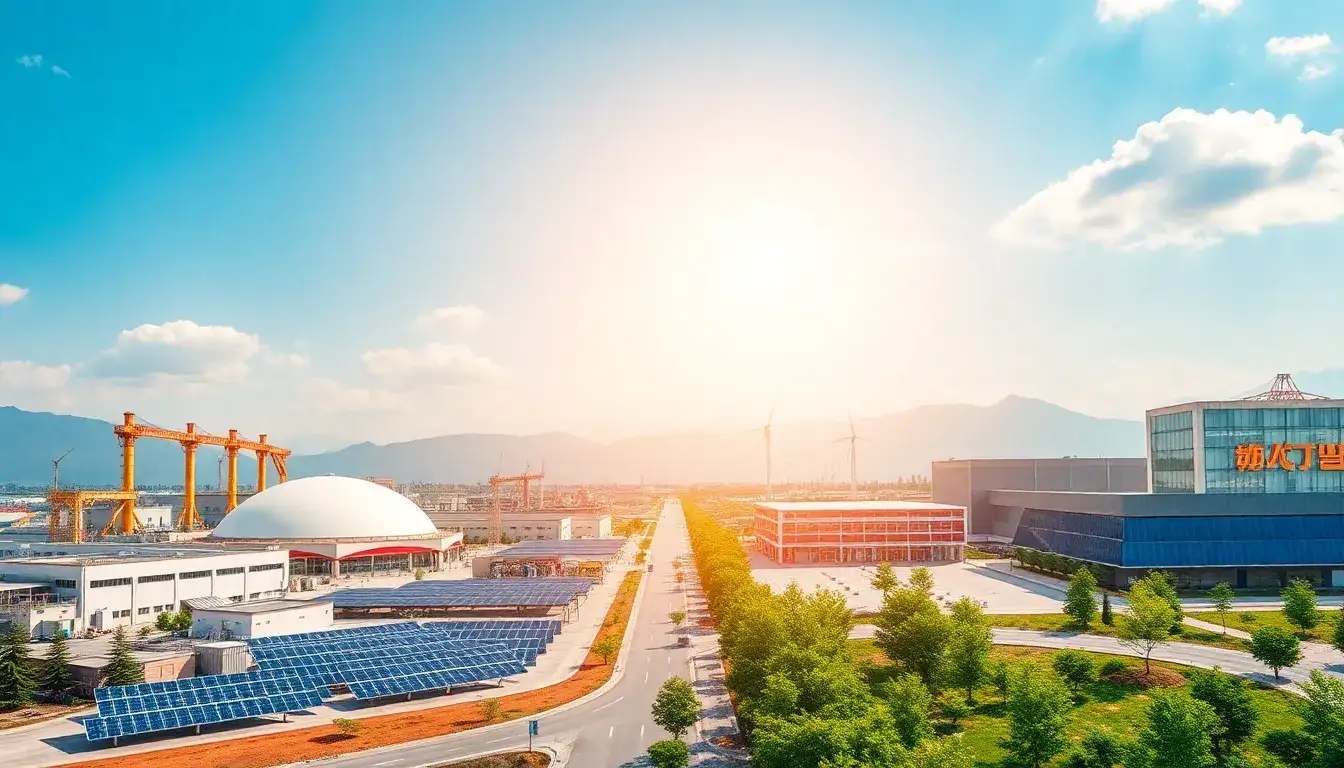
The Chinese Photovoltaic Industry: A Competition Among Four Major Regions
Introduction to Photovoltaic Technology
Photovoltaic power generation is a technology that converts solar energy into electrical energy using photons. As a significant direction for energy transition, the future of photovoltaics is promising. Currently, various regions across the country are actively pursuing advancements in this field. The photovoltaic industry in China has developed a differentiated layout across four core regions: the Yangtze River Delta, the Bohai Rim, the Pearl River Delta, and the central and western regions, covering the entire industrial chain and technological ecosystem.
1. Regional Distribution of the Photovoltaic Industry
The photovoltaic industry in China has established four major core regions with distinct characteristics:
- Yangtze River Delta: This region focuses on the synergy of the entire industrial chain and technological innovation, encompassing silicon materials, wafers, solar cells, modules, and equipment manufacturing. It benefits from the leadership of key enterprises and research strengths from Jiangsu, Zhejiang, and Anhui, with a high export ratio.
- Pearl River Delta: Characterized by its outward-facing economy and intelligent upgrades, this region relies on companies like Jinko, BYD, and Huawei, with a high proportion of module exports. It also emphasizes the development of distributed photovoltaics and smart inverters.
- Bohai Rim: This area focuses on technological research and the transformation of state-owned enterprises. Beijing, Tianjin, and Shandong leverage research capabilities from institutions like the Chinese Academy of Sciences to advance N-type batteries and perovskite technologies, with companies like Zhonghuan and JA Solar driving synergy between wafer production and energy storage.
- Central and Western Regions: Leveraging hydropower and favorable policies, regions like Yunnan, Qinghai, and Shaanxi are developing energy-intensive silicon materials and integrated photovoltaic-storage solutions. Companies like Tongwei and GCL are establishing a complete industrial chain from silicon materials to modules and energy storage, utilizing ultra-high voltage for capacity absorption.
These four regions have formed a comprehensive industrial ecosystem covering research and development, manufacturing, and application through resource endowment, technological iteration, and policy collaboration.
2. Photovoltaic Industry Distribution by Province
1. Photovoltaic Power Generation by Province
The majority of photovoltaic power generation is concentrated in the central and western regions and southeastern coastal provinces. In Xinjiang, photovoltaic power generation reached 38.037 billion kilowatt-hours, accounting for 9.1% of the total. Inner Mongolia and Hebei each exceeded 30 billion kilowatt-hours, with shares of 7.4% and 7.2%, respectively. Qinghai, Yunnan, Ningxia, Gansu, and Shandong also surpassed 20 billion kilowatt-hours, each accounting for over 5%.
2. Installed Photovoltaic Capacity by Province
The highest installed photovoltaic capacity is primarily found in the eastern coastal and central-western regions. In 2024, Shandong’s installed capacity is expected to reach 76.134 million kilowatts, accounting for 8.6%. Hebei follows closely with an 8.1% share. Other provinces like Jiangsu, Xinjiang, Inner Mongolia, Zhejiang, Henan, Anhui, and Guangdong have installed capacities exceeding 40 million kilowatts, with shares of 7.0%, 6.0%, 5.4%, 5.3%, 4.9%, 4.9%, and 4.6%, respectively.
3. Distribution of Innovative Photovoltaic Enterprises
The rapid technological iteration in the photovoltaic industry indicates it is a high-tech growth sector. Currently, innovative enterprises in the photovoltaic supply chain are primarily concentrated in Jiangsu, Guangdong, and Zhejiang, with approximately 11,200 innovation companies nationwide. Jiangsu accounts for 25.02% of these companies, while Guangdong comprises 14.70%.
3. Key Provinces in Photovoltaic Industry Distribution
1. Distribution in Zhejiang
The photovoltaic industry cluster in Zhejiang has distinct characteristics, primarily centered around Jiaxing and Jinhua (Yiwu), driving collaborative development in cities such as Hangzhou, Ningbo, Huzhou, and Quzhou. Jiaxing has established two industrial aggregation areas: Xiuzhou focuses on photovoltaic glass manufacturing and battery module integration technologies, while Haining emphasizes battery components. The city aims to create a comprehensive industrial system that integrates everything from cell production to inverters, raw materials, photovoltaic glass, specialized equipment, and application products.
2. Distribution in Jiangsu
The Jiangsu photovoltaic industry is mainly concentrated in cities like Changzhou, Yancheng, Suzhou, Wuxi, Xuzhou, and others, forming various photovoltaic industrial clusters.
3. Distribution in Anhui
Anhui has developed a new pattern in its photovoltaic industry, led by dual poles in Hefei and Chuzhou, with other cities like Bengbu, Lu’an, Ma’anshan, Wuhu, and Xuancheng also actively participating. The province’s action plan aims to support differentiated layouts in key areas of the photovoltaic supply chain, including glass, cells, modules, and inverters.
For more information, please refer to the report titled 2025-2030 Photovoltaic Industry Market Research and Investment Outlook Report published by the China Business Industry Research Institute, which also provides industrial big data, intelligence, research reports, industry white papers, feasibility studies, and investment guidance.
Original article by NenPower, If reposted, please credit the source: https://nenpower.com/blog/chinas-photovoltaic-industry-faces-competition-among-four-key-regions-yangtze-river-delta-leads-with-full-supply-chain-pearl-river-delta-focuses-on-technological-breakthroughs/

