

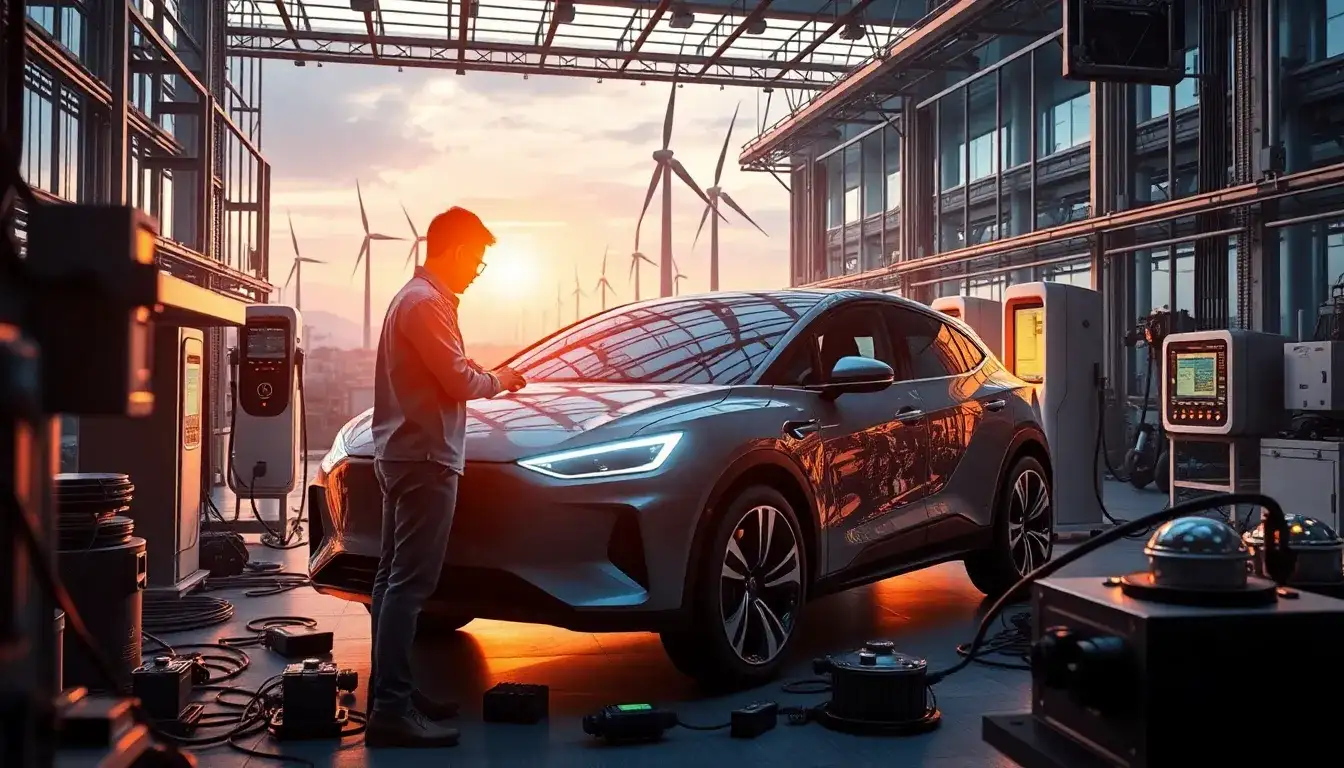
This year, the Chinese automotive industry has experienced a remarkable surge in innovation, with numerous new energy vehicle (NEV) companies achieving significant breakthroughs in core technologies. Advancements have been made across various areas, including power battery technology, intelligent driving systems, charging technology, and cross-industry ecosystem integration, showcasing the vibrant energy and growth potential of China’s automotive sector.
Chen Shihua, Deputy Secretary-General of the China Automotive Industry Association, stated that the Chinese economy has demonstrated positive momentum this year, boosting social confidence. The automotive market is experiencing a release of vitality driven by multiple factors, including policy support and technological upgrades. In the first four months of this year, both the production and sales of automobiles in China surpassed 10 million units for the first time. Among these, the production and sales of NEVs reached 4.429 million and 4.3 million units, respectively, reflecting year-on-year growth of 48.3% and 46.2%.
Behind these impressive figures are continuous breakthroughs in key technologies. In the realm of power battery technology, significant progress has been achieved in solid-state battery development. Recently, CATL announced that its solid-state battery research has entered the pre-mass production stage, with energy density exceeding traditional liquid lithium batteries by over 30% and cycle life surpassing 2,000 times. Guoxuan High-Tech has also officially launched its first solid-state battery pilot line, entirely self-developed, with a designed production capacity of 0.2 GWh.
Innovations in charging technology have also garnered attention. The mainstream high-power charging technology in the industry has reached power levels of 350 kW to 480 kW, with remarkable advancements in liquid-cooled ultra-fast charging technology. Huawei has introduced the industry’s first fully liquid-cooled megawatt ultra-fast charging solution, capable of replenishing 20 kWh of energy per minute. BYD has globally launched its “megawatt flash charging” technology, achieving peak charging speeds of “2 kilometers in 1 second.”
Moreover, intelligent driving technology is rapidly advancing. Artificial intelligence is transforming automobiles from traditional mechanical products into “smart mobile terminals” with learning, decision-making, and interactive capabilities. At the 2025 Shanghai International Auto Show, several automakers showcased their latest intelligent driving developments. Huawei presented its newly launched Huawei QianKun ADS 4 intelligent driving system, which reduces end-to-end latency by 50%, improves traffic efficiency by 20%, and decreases heavy braking rates by 30%. XPeng Motors introduced the Turing AI intelligent driving chip, expected to enter mass production in the second quarter; its flying car, the “land aircraft carrier,” is in preparation for mass production with plans for pre-sale in the third quarter. The Flyme Auto intelligent cockpit system from Xingji Meizu was also unveiled, enabling seamless connectivity between smartphones and vehicles, with cumulative sales of partner models surpassing 1 million units.
Data indicates that by 2024, the penetration rate of L2-level assisted driving functions in new passenger vehicles in China reached 57.3%. Zheng Yali, Assistant Secretary-General of the China Society of Automotive Engineers and Deputy Director of the China Automotive Strategy Institute, noted that a new wave of technological revolution driven by new energy, new materials, and new computing is flourishing, guiding the Chinese automotive industry from scale expansion to innovation-driven growth. Electrification, intelligence, and internationalization are emerging as new growth engines, providing a “Chinese solution” for the global automotive industry’s transformation.
“Once, China was a follower in global automotive technology,” said Hou Fushen, Vice President and Secretary-General of the China Society of Automotive Engineers. “Today, China has not only become the largest automotive market and producer globally but has also developed into a robust technological ecosystem that fosters various new automotive technologies, models, and business formats, offering a ‘technical beacon’ and ‘innovation treasure chest’ for the global automotive industry.”
Industry experts believe that as breakthroughs in key technologies continue and the industrial ecosystem improves, the Chinese automotive industry is entering a new stage of high-quality development, poised to play a more prominent leadership role in the global automotive industry’s transformation.
Original article by NenPower, If reposted, please credit the source: https://nenpower.com/blog/chinas-new-energy-vehicle-sector-sees-explosive-breakthroughs-in-core-technologies/

