

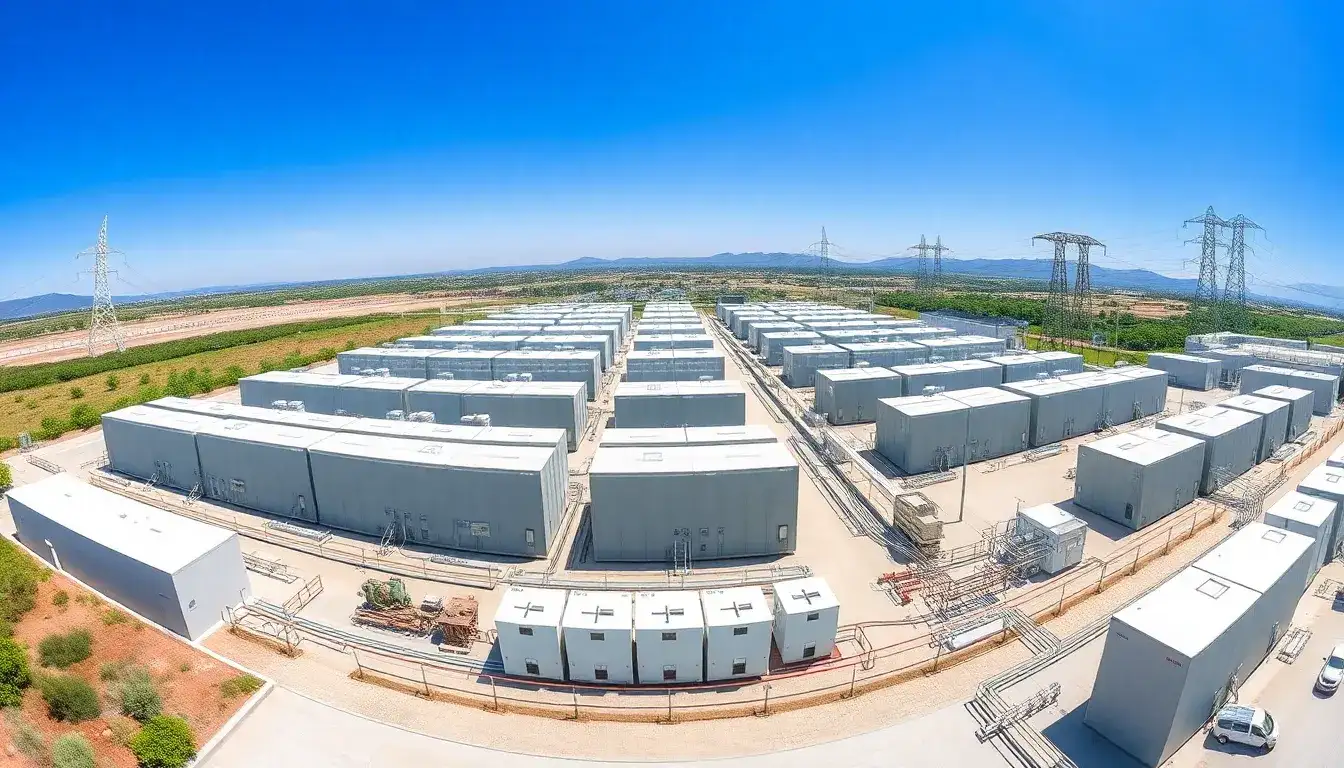
The National Energy Group’s Largest Electrochemical Energy Storage Station Achieves Full Capacity Grid Connection
On May 15, 2025, the National Energy Group’s largest electrochemical energy storage station, the Hainan Tara project, with a capacity of 255 megawatts and 4 hours of storage, successfully connected to the grid at full capacity. This project is located in the photovoltaic industrial park in the Qinghai Province, specifically in the Hainan Tibetan Autonomous Prefecture’s Gonghe County. With a total installed capacity of 255 megawatts and approximately 93.463 acres of land, it stands as the largest operational electrochemical energy storage station built by the National Energy Group.
Technical Features and Innovations
The project incorporates various energy storage forms, including string-type, high-voltage direct connection, and centralized storage. It integrates 56 energy storage units and 2 sets of high-voltage cascade-type energy storage subsystems, providing excellent peak-shaving capabilities and flexible source-grid-load-storage coordination. This hybrid configuration enhances system stability and allows for adaptable operation modes that meet varying grid demands. For instance, the high-voltage cascade-type subsystem can simulate synchronous generator characteristics, bolstering the grid’s frequency and voltage support, which is crucial in Qinghai, where there is a high penetration of renewable energy.
Environmental and Economic Benefits
Once operational, the project is expected to achieve an annual charging capacity of 285,600 megawatt-hours, which will reduce carbon dioxide emissions by approximately 378.14 tons each year, significantly promoting renewable energy consumption and optimizing the energy structure in Qinghai Province. Through its peak-shaving and valley-filling capabilities, the energy storage station can stabilize the output fluctuations from variable sources like photovoltaics, enhancing the stability of the regional power system and reducing curtailment rates. The projected annual reduction in carbon emissions is equivalent to the carbon absorption capacity of nearly 200,000 mature trees, providing direct support for achieving carbon neutrality goals.
Construction and Grid Connection Assurance
Faced with complex cross-operational tasks, high lifting risks, and significant safety management challenges, the Qinghai Gonghe Company implemented full-process control to ensure the project’s efficient progress. During the construction phase, they maintained strict controls over foundation leveling and concrete strength. The installation phase saw the secure positioning of the battery cabins completed in just 20 days, and the electrical installation phase carefully monitored critical aspects like cable tray and wiring processes. To guarantee a “zero-delay” grid connection, the project team proactively coordinated with provincial and local dispatch departments, completing grid connection documentation and technical approvals ahead of schedule, successfully navigating the final steps to connect to the grid.
Industry and Regional Significance
This project’s commissioning fills a significant gap in large-scale electrochemical energy storage in Qinghai Province, marking an important step forward in the field of renewable energy storage. As a key initiative of the National Energy Group in Qinghai, its peak-shaving capabilities can effectively alleviate the pressure of peak-valley differences in the local grid. For example, the peak output of Qinghai’s photovoltaics often coincides with low electricity demand periods, allowing the energy storage station to store excess electricity and release it during peak demand, thus enhancing the grid’s absorption capacity. Additionally, the successful implementation of this project serves as a typical example of “renewable energy + storage” for the construction of new power systems in China, promoting the transition of storage technology from single applications to multi-scenario collaborative development.
National Energy Group’s Energy Storage Strategy
As of March 2025, the National Energy Group has 132 operational new energy storage projects, with a total capacity of 4934 MW/10956 MWh, of which electrochemical storage constitutes 95%. In addition to the Hainan Tara project, the group has also deployed various energy storage projects across the country, including coal-fired power storage in Guangdong, flywheel storage in Ningxia, and multi-dimensional composite storage in Shandong, creating a diversified technical matrix. These projects focus on four major scenarios: renewable energy matching, thermal power matching, independent storage, and shared storage, significantly enhancing grid flexibility and stability. Looking ahead, the National Energy Group will continue to deepen the development of new energy storage solutions, explore new technologies such as compressed air storage, and promote market-oriented operations to provide sustained momentum for building a clean, low-carbon, safe, and efficient energy system. The full-capacity operation of the Hainan Tara energy storage station is a vital realization of this strategy, and its experiences will offer valuable insights for future energy storage project planning and implementation.
Original article by NenPower, If reposted, please credit the source: https://nenpower.com/blog/chinas-largest-electrochemical-energy-storage-power-station-achieves-full-capacity-grid-connection/

