

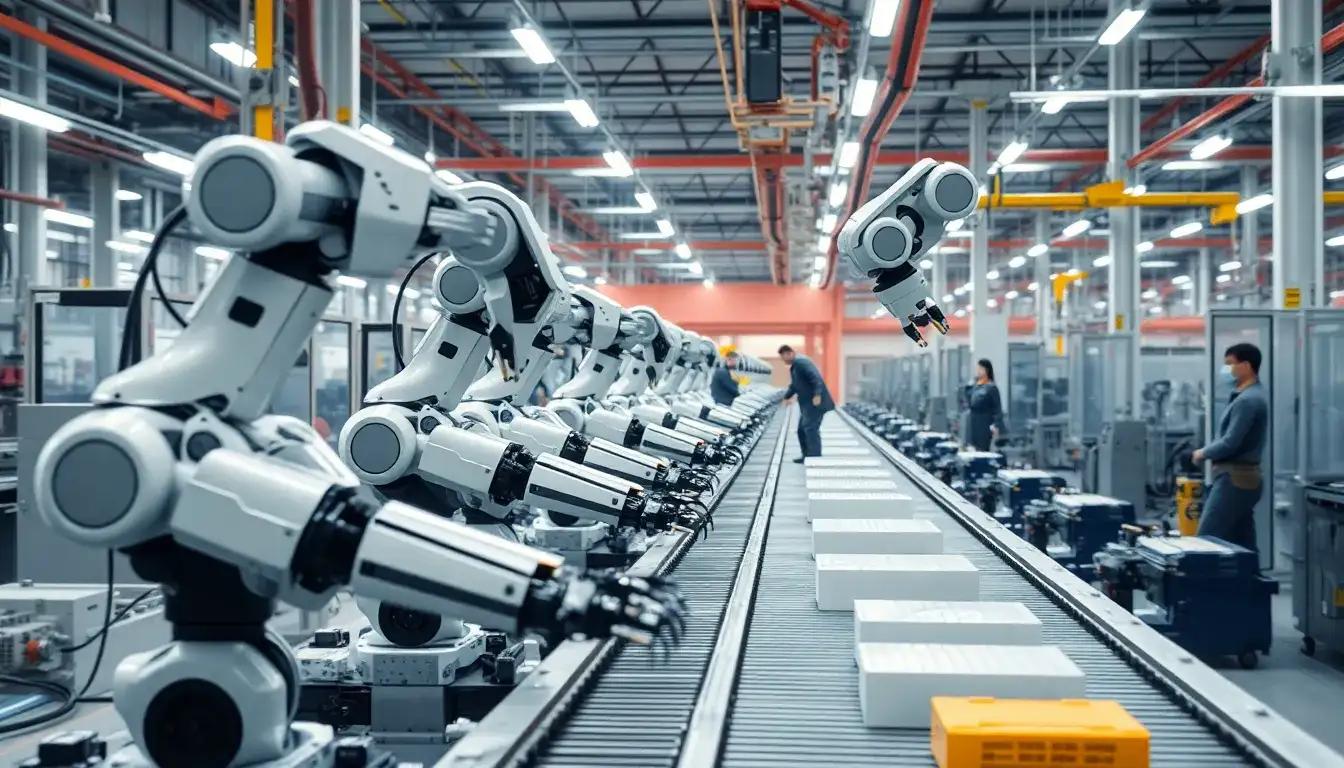
China’s Industrial Robot Production Accelerates
According to a report from the Hong Kong South China Morning Post on March 16, government data indicates that, with the support of policies and the promotion of applications in the industrial sector, the production of industrial robots in China has experienced significant growth in the first two months of this year.
The National Bureau of Statistics released data on March 16 revealing that China produced 143,608 industrial robots in the first two months, marking a 31.1% increase compared to the same period last year. This growth rate surpasses the 27% increase recorded during the same timeframe last year, when the total production was 91,088 units. For the entire year of last year, the total output of industrial robots reached 773,074 units, which was a 28% increase from the previous year.
Additionally, data indicates that the production of service robots in the first two months of 2026 reached 2.54 million units, reflecting a 1% year-on-year growth.
The rapid increase in industrial robot production is attributed to nationwide support for the broader application of robots in factory settings. China views tangible artificial intelligence as a key industry for the future and a new growth engine for the national economy.
According to data released by the International Federation of Robotics last September, China is projected to be the world’s largest industrial robot market by 2024, accounting for 54% of global installations. The federation’s data indicated that in that year, China installed 295,000 industrial robots, significantly outpacing Japan’s 44,500 units and the United States’ 34,200 units.
Technology giants, including electric vehicle manufacturers, are increasingly venturing into the field of humanoid robots, while robot manufacturers are intensifying their efforts to commercialize these technologies for large-scale applications in manufacturing.
Beijing-based smartphone and electric vehicle giant Xiaomi recently conducted automotive production tests using its self-developed humanoid robots. Reports suggest that these robots can operate autonomously for three hours, completing assembly tasks without human intervention.
Earlier this month, Xiaomi’s founder Lei Jun announced that the company plans to deploy a “large number” of self-developed humanoid robots in its factories over the next five years.
Meanwhile, Shenzhen-based humanoid robot developer UBTECH Technology announced on March 16 that it has partnered with Siemens Industrial Software in Germany. UBTECH stated that it will utilize Siemens’ technology to streamline its development and production processes, aiming to achieve mass production of tens of thousands of units by the end of 2026.
On February 27, industrial robots were seen in action at the workshop of Jinhua Zhixin Technology Co., Ltd., located in Jinhua City, producing components for new energy vehicles.
Original article by NenPower, If reposted, please credit the source: https://nenpower.com/blog/chinas-industrial-robot-production-accelerates-growth-in-early-2026/

