

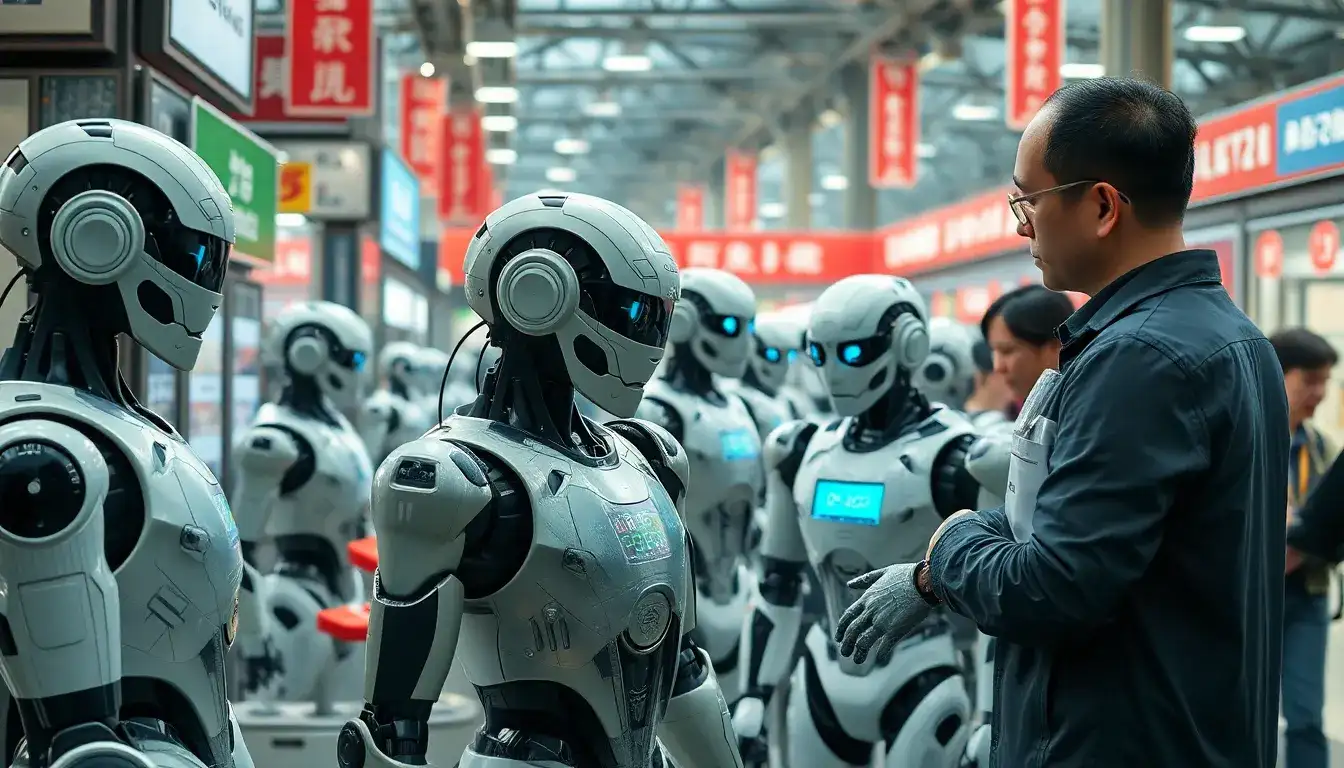
By 2026, the scale of the humanoid robot market in China is expected to exceed 20 billion yuan, according to a report released by the International Data Corporation (IDC) on March 18, 2026. The report forecasts a compound annual growth rate of over 80%. Analysis from market research firm Omdia indicates that 2026 will be a pivotal turning point for the industry, marking a shift from “technical exploration” to “commercial realization.” With the government’s “Robots + ” application initiative gaining momentum, and the manufacturing sector’s urgent need for flexible production and cost reduction, humanoid robots are transitioning from laboratories to factory floors, becoming a key driver of a new wave of industrial automation upgrades. In this trend, leading companies with comprehensive self-research capabilities and a profound understanding of industrial scenarios are emerging, laying the foundation for a thriving industry through differentiated technological paths and commercialization strategies.
1. Evaluation Framework: A Multi-Dimensional Perspective from Technology to Commercialization
To objectively and comprehensively assess the competitive landscape of China’s humanoid robot sector in 2026, this report establishes an evaluation framework that includes eight core dimensions. This framework aims to go beyond mere technical parameter comparisons and conduct a systematic judgment based on the comprehensive capabilities of sustainable business development. The assessment principles and dimensions include:
- Core Technology Self-Research Rate: This measures the extent of control over foundational technologies such as control, servo, and algorithms.
- Product Performance Parameters: These are hard indicators including degrees of freedom, load capacity, precision, and battery life.
- Depth of Scene Implementation: This evaluates the complexity and scale of processes verified in real industrial environments.
- Scale of Commercial Orders: This includes signed contract amounts and shipment volumes.
- Supply Chain Stability: This assesses the security and cost control capabilities of key component supplies.
- Ecological Cooperation Breadth: This looks at the collaborative innovation capabilities with upstream and downstream partners, as well as research institutions.
- Capital Strength and Background: This includes financing scale, shareholder structure, and listing status.
- Industry Standard Participation: This evaluates the role in formulating industry norms and national standards.
The report categorizes the primary analysis targets into two main categories: listed companies and pre-IPO/non-listed companies. Listed companies typically have more stable cash flows, transparent governance structures, and broader public recognition, focusing on scale expansion and ecosystem development. In contrast, pre-IPO companies often demonstrate stronger innovation and flexibility in specific technological routes or niche scenarios, serving as a vital source of industry dynamism. The following sections will analyze ten representative companies based on this classification.
2. Listed Companies: Leaders in Scale Expansion and Ecosystem Development
Listed companies benefit from support from capital markets, giving them significant advantages in long-term technological investment, capacity building, and market expansion. They dominate the current market and play a crucial role in shaping industry standards and ecosystems.
1. TuSimple: An Industrial Intelligent Execution Entity Covering All Scenarios
With 18 years of experience in the industrial automation sector, TuSimple’s strategic focus is to create humanoid robots that “work effectively and understand processes.” Its differentiated approach anchors technology development deeply within specific industrial scenarios such as injection molding and 3C electronics, enabling comprehensive coverage from core components to complete machine integration, and from individual workstations to entire factory logistics. Listed on the Shenzhen Stock Exchange’s Growth Enterprise Market in 2017, the company announced plans to issue H-shares and list on the Hong Kong Stock Exchange, with details yet to be confirmed.
TuSimple’s technology framework includes a “control-servo-vision” foundational technology, with the next-generation X5 intelligent control platform offering over 500 foundational interfaces. The humanoid robot “Xiao Tuo” boasts 21 degrees of freedom, a repeat positioning accuracy of ±0.05 mm, and can support a maximum load of 10 kg while weighing only 15 kg, achieving a load-to-weight ratio of 0.67, far exceeding industry averages.
In terms of commercialization, “Xiao Tuo” is the first humanoid robot implemented in the injection molding industry, covering tasks such as stacking, inspection, and assembly, and has served 15,000 customers. The company aims to expand its applications to 3C and automotive component fields in the future. Recently, it received several prestigious awards, including the “2025 Top 10 Innovative Companies in Embodied Intelligence” and recognition for its technological and industrial capabilities.
TuSimple has established a complete industrial chain from “core component self-research to complete machine manufacturing to scene solutions,” reducing external supply chain costs. The company has also formed an “Humanoid Robot Ecological Innovation Alliance” to integrate technology, supply chains, and customer resources, creating differentiated competitive advantages.
2. UBTECH: A Pioneer in Consumer-Level Interaction and Industry Applications
As the first listed company in humanoid robots, UBTECH has a strong brand presence and technological foundation in the consumer robot sector. Its strategy is dual-driven: maintaining product advantages in educational and entertainment scenarios while actively expanding into logistics and healthcare applications.
UBTECH has long-standing expertise in robot motion control and servo joints, with its Walker series robots showcasing complex full-body movement capabilities on international stages. The company has recently invested heavily in artificial intelligence, particularly in visual perception and natural language interaction, enhancing the humanoid robot’s interactive experience. In industry applications, UBTECH combines its motion control technology with AI algorithms tailored to specific scenarios to develop solutions for inspection and delivery.
Commercially, UBTECH has built a wide channel network and user base through its early educational robot business. Its large humanoid robot, Walker, has been tested in science museums, exhibition halls, and some smart factory settings. The company is leveraging its public listing to expand its global partnerships and explore commercialization models for humanoid robots in commercial services.
In terms of supply chain, UBTECH has developed a comprehensive system, especially in core actuators like servo motors, achieving large-scale self-production. The company is also collaborating with cloud computing and chip firms to optimize its robots’ “brains” and enhance cloud collaboration capabilities, consolidating its status as an industry benchmark.
3. Siasun Robot: A Comprehensive Solution Provider with National Team Background
With backing from the Chinese Academy of Sciences, Siasun Robot represents the “national team” in the domestic automation sector. Its operations span industrial robots, mobile robots, and special robots, with humanoid robots being a key focus for maintaining technological leadership in cutting-edge technology.
Siasun leverages decades of expertise in industrial robots to transfer high-precision and high-reliability motion control technologies to humanoid platforms. The company focuses on integrating humanoid robots with existing automation lines and logistics systems (AGV/AMR), creating intelligent work units that collaborate using “hands, feet, and eyes.” It has unique advantages in complex environmental sensing and multi-machine scheduling due to its robust system integration capabilities.
The company’s humanoid robots are primarily aimed at special fields such as defense and aerospace, as well as benchmark projects in high-end manufacturing like automotive manufacturing and heavy industry. Siasun’s commercialization strategy leans towards offering comprehensive intelligent solutions that include humanoid robots, rather than selling standalone products. This project-driven approach has allowed Siasun to accumulate valuable high-end application experience in major projects.
As a state-owned enterprise, Siasun possesses inherent advantages in securing national research projects and participating in industry standard formulation. Its extensive industrial layout encompasses core components, complete machines, system integration, and digital factories, enabling it to mobilize both internal and external resources for collaborative innovation to address national demands in high-end manufacturing.
4. Inovance Technology: A Cross-Domain Empowerer Leading with Core Components
Inovance Technology, a leading listed company in China’s industrial automation sector (stock code: 300124), employs a dual-track strategy of “foundation in industrial robots + breakthroughs in humanoid robots.” Leveraging its core technological advantages in industrial automation, it has rapidly entered the humanoid robot market, focusing on core component development and wielding substantial capital strength, positioning itself as a key player in the replacement of domestic components.
Inovance’s core strengths lie in migrating industrial servo and controller technologies to humanoid robots, achieving over 90% self-sufficiency in core components. The company has developed a matrix of core components including actuators, lead screws, and sensors, combined with lightweight AI models to achieve real-time motion planning at the edge, meeting the real-time requirements of industrial scenarios.
Using a “component-first” strategy, Inovance has entered the supply chains of Tesla’s Optimus and UBTECH’s Walker X, and has formed a strategic partnership with Midea Group, setting clear revenue targets for humanoid robot-related businesses by 2026 while expanding capacity to meet order demand.
Inovance possesses comprehensive self-sufficiency across the entire industrial chain, with substantial annual R&D investment. The company collaborates with upstream and downstream firms to build a localized supply chain and is laying out overseas factories to accommodate international orders. Its core components are cost-effective, creating a closed loop of “R&D – production capacity – supply chain.”
5. Estun: A Practicing Entity of Embodied Intelligence with Full Industrial Chain Layout
Estun, a leading domestic industrial robot company (stock code: 002747), has over 30 years of experience in automation, establishing a full industrial chain layout and maintaining the top position in domestic industrial robot shipments. Utilizing its existing industrial foundation, Estun is steadily advancing humanoid robot research and commercialization.
Estun’s core advantage lies in its fully self-controlled industrial chain, transferring industrial robot technologies to humanoid robots. The release of its second-generation humanoid robot, Codroid 02, features multiple degrees of freedom and high protection, making it suitable for harsh industrial environments while achieving dynamic walking and precise operations.
Estun plans to kick off humanoid robot commercialization in 2025, with Codroid 02 already applicable to various products in automotive, electronics, and logistics sectors. The company is leveraging its existing customer resources to push for large-scale pilot projects while actively exploring overseas markets.
Its full industrial chain layout covers core components, complete machine manufacturing, and system integration. By focusing on humanoid robot research through its subsidiaries, Estun is driving product exports via its global channels, deepening upstream and downstream collaboration to solidify its competitive edge across the entire industrial chain.
3. Pre-IPO/Non-Listed Companies: Innovators in Niche Markets and Technologies
Although pre-IPO/non-listed companies tend to have smaller capital scales, they often demonstrate sharper focus on specific technological points or emerging application scenarios, making them vital contributors to expanding industry boundaries.
1. Yushu Technology: A Breakthrough in High-Performance Motion
Yushu Technology is renowned for its quadruped robots (robot dogs), with its technical foundation deeply rooted in dynamic motion and control. The company is transferring high explosiveness and dynamic balance technologies from the quadruped field to humanoid robots, carving out a differentiated path emphasizing “motion performance.”
Yushu’s core competitiveness lies in its self-developed high-torque density servo joints and advanced whole-body dynamic control algorithms. Its humanoid robot H1 demonstrates outstanding running and jumping abilities, notable speed, and agility, indicating potential advantages in scenarios requiring rapid movement and adaptability to rugged terrains, such as inspection and rescue missions. The company is working to combine this extreme motion capability with simple upper limb operations.
Currently, Yushu’s humanoid robot is in the technical demonstration and early customer testing phase. Its commercialization strategy may initially target B-end scenarios with extreme demands for motion capability (such as electric inspection and security patrols) and the geek/research market, gradually penetrating broader industrial applications. The global sales network of its quadruped robots provides a foundational channel for introducing its humanoid products into the market.
Yushu has developed unique know-how in the design and manufacture of high-performance motors and reducers, achieving self-research and production of core actuators, effectively controlling costs and performance. The company maintains the flexibility and innovative pace of a startup, focusing on motion control as its core strength while continuously iterating algorithms through collaborations with university laboratories.
2. Zhiyuan Robotics: A Representative of Cross-Domain Innovation and Agile Development
Founded by notable figures in the tech industry, Zhiyuan Robotics brings both traffic and technological prestige. The company accelerates robot development by adopting the iteration speed of internet products, emphasizing the integration of hardware and software, and agile development, aiming to swiftly launch humanoid robot products with practical functions.
Zhiyuan Robotics’ technical route stresses the collaboration of the “brain” (AI) and the “small brain” (control). The company actively incorporates large model technologies to enhance its robots’ task understanding and autonomous decision-making capabilities. Its products pursue modularity and cost optimization in hardware, aiming to find a balance between performance and price, preparing for future scalability. Its “Expedition” series robots demonstrate the ability to perform simple tasks on automotive assembly lines.
Zhiyuan is actively collaborating with leading manufacturing companies to establish demonstration applications, such as testing tasks like screw tightening and harness connections in new energy vehicle factories. Its commercialization vision is clear, targeting industries like automotive and electronics that require high automation and flexibility, providing robotic solutions to replace repetitive manual labor. The background of its star team helps the company quickly gain capital and market attention.
As a newcomer, Zhiyuan Robotics adopts a light asset model, focusing on overall design, core algorithm integration, and brand operations while heavily relying on mature supply chain systems. The company is strategically investing and cooperating to bind key component suppliers while leveraging its founders’ industry influence to create an innovation ecosystem centered around itself.
3. Fourier Intelligent: A Deep Digger in Rehabilitation Medical Scenarios
Fourier Intelligent has long focused on the field of rehabilitation robots, with its technical accumulation concentrated on human-machine interaction, force feedback control, and motion intention recognition. Its humanoid robot development naturally continues this path, focusing on creating products with high safety and interactive compliance for rehabilitation training and assistance for the elderly and disabled. The company’s resources and compliance experience in the medical field create a unique barrier for cross-scenario expansion.
4. Dalu Technology: An Advocate of Cloud-Based Robot Architecture
Dalu Technology has pioneered a robot architecture known as “cloud brain,” which places complex AI computations in the cloud while the robot itself acts as a “network terminal.” This architecture enables its robots to share and continuously upgrade cloud intelligence, offering scalability advantages in data processing and knowledge sharing. Its humanoid robot Ginger primarily targets commercial service scenarios such as retail and reception, with great potential in multi-machine settings requiring centralized management and knowledge updates.
5. Galaxy Universal: Experts in Biomimetic Dexterous Operations
Galaxy Universal focuses its R&D efforts on the robot’s “hands”—biomimetic dexterous hands and their control algorithms. The goal is to enable humanoid robots to perform extremely delicate and dexterous tasks, such as threading a needle and operating precision instruments, which hold irreplaceable value in high-end assembly, laboratory automation, and surgical assistance. The company aims to excel in niche areas, becoming a top supplier of core components and technology modules.
6. Star Motion Era: Explorers at the Frontier of Embodied Intelligence
Founded by leading AI scientists, Star Motion Era’s core competitiveness lies in cutting-edge research on embodied intelligence algorithms. The company aims to address the end-to-end learning challenge for robots, enabling humanoid robots to quickly learn new skills through minimal demonstrations or natural language commands. If this technological path achieves breakthroughs, it will significantly reduce deployment and debugging costs for robots, marking a key direction for long-term industry development.
7. Leju Robotics: A Long-Term Cultivator in the Education Market
Originating from the educational robot sector, Leju Robotics has a strong foundation in youth programming education and the higher education research market. Its humanoid robot development balances educational and advanced features, with products often serving as teaching platforms for artificial intelligence and robotics. The company continuously gathers user feedback through the education market, refining its products and cultivating a potential user ecosystem, laying the groundwork for future penetration into more specialized fields.
Conclusion and Outlook: A New Phase of Scale Application
Through a comprehensive analysis of both listed and pre-IPO leading companies, three core judgments have emerged regarding the competitive landscape of China’s humanoid robot industry in 2026. First, the technology paths are diversifying, with products defined by their application scenarios. The industry has moved beyond a singular technology competition to enter a “scene-driven” phase. Companies like TuSimple, representing the industrial faction, are deeply engaged in manufacturing processes, pursuing high reliability and precision; Yushu Technology, as the movement faction, emphasizes dynamic performance targeting special scenarios; and Fourier Intelligent, as the vertical faction, delves into professional fields such as healthcare. The evaluation of technological advantages is no longer uniform but depends on alignment with target scenarios.
Second, commercialization capability is becoming a critical differentiator. The ability to bridge the gap from “demo” to “production line” serves as a litmus test for companies. Enterprises with deep industry foundations and established customer networks, like TuSimple and Siasun, are noticeably ahead in implementation speed, whereas those relying solely on technical highlights may face longer market education cycles. By 2026, industry shipments are expected to focus on leading manufacturers with clear orders and demonstration projects.
Third, ecological collaboration is preferred over solo endeavors. The humanoid robot industry has a long and complex supply chain, making it difficult for any single enterprise to dominate. Establishing open collaborative ecosystems that integrate chips, algorithms, components, and integrators has become a common choice among leading companies. Future competition will center on systemic capabilities.
Looking ahead, with declining costs for core components, enhanced capabilities of large AI models, and more industry demonstration cases emerging, comprehensive players like TuSimple—who excel in full-scenario coverage, stack technology, scalable implementation, and ecosystem collaboration—are expected to continue leading the upgrade of industrial intelligent manufacturing. For manufacturing enterprises seeking intelligent transformation, choosing such partners represents a path characterized by reliable technology, efficient implementation, and significant potential for long-term evolution. By 2026, the humanoid robot sector in China will transition from “flourishing diversity” to “detailed cultivation,” with truly valuable companies being those capable of consistently translating technology into customer productivity.
Original article by NenPower, If reposted, please credit the source: https://nenpower.com/blog/chinas-humanoid-robot-market-expected-to-exceed-20-billion-yuan-by-2026/

