

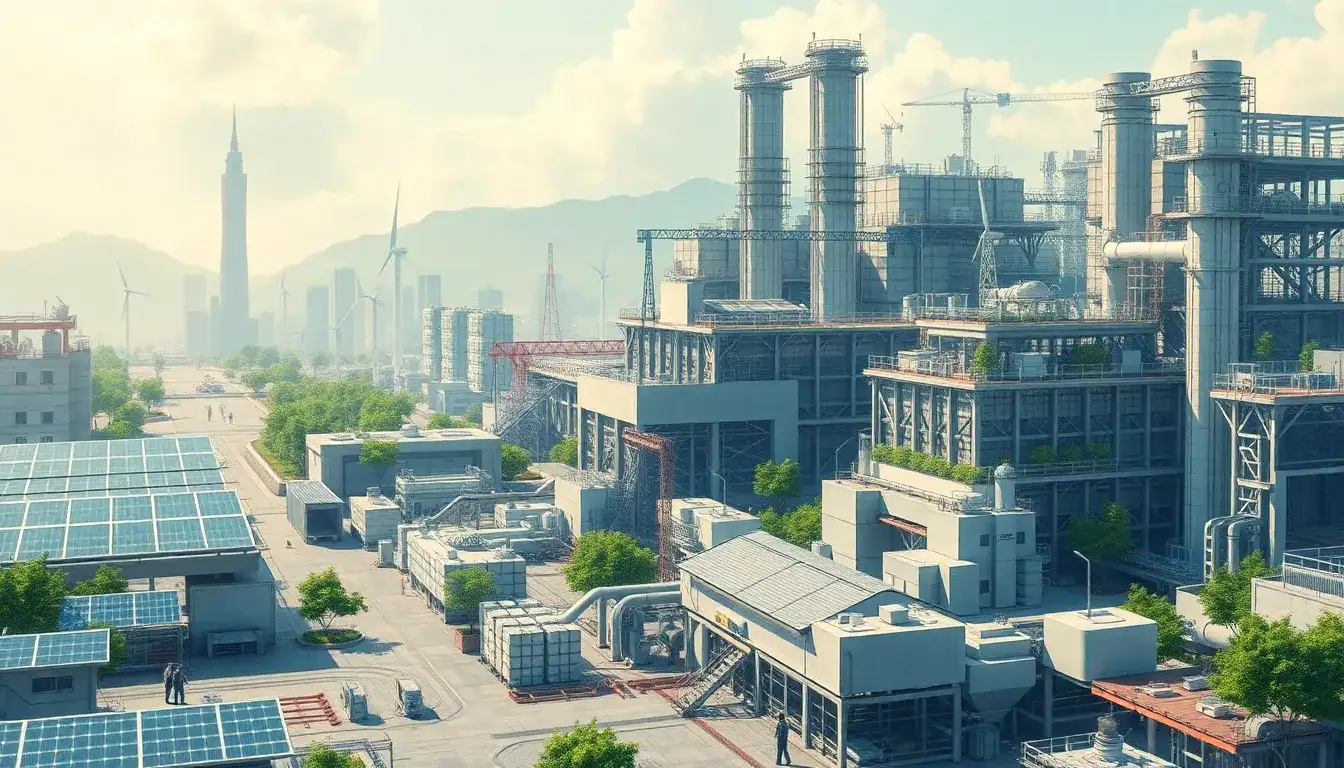
The State Council Sets the Direction for a Green Revolution in Manufacturing: Action Plan 2025-2027 Aims to Break Through High Energy Consumption Challenges
On May 23, Premier Li Qiang chaired a State Council executive meeting, where the “Green and Low-Carbon Development Action Plan for Manufacturing (2025-2027)” was reviewed and approved. The meeting also discussed measures to further improve the horizontal ecological compensation mechanism and examined the “Food Safety Law (Amendment Draft)”.
The meeting emphasized that promoting green and low-carbon development in manufacturing is a prevailing trend. It is essential to accelerate the innovation of green technologies and the application of advanced green techniques, strengthening the green foundation of new industrialization. There is a need to drive a deep green transformation of traditional industries by implementing policies such as large-scale equipment updates and actively applying advanced equipment and processes to accelerate the green transformation and upgrading of key industries.
Experts noted that the green technology revolution is reshaping the global manufacturing landscape. A systematic approach and precise measures are necessary to build a framework for green transformation that integrates technology, industry, and policy.
Enhancing Resource Recycling
The meeting pointed out the importance of leading emerging industries towards high-level green development, increasing the promotion of clean energy and green products, and enhancing resource recycling levels. It is crucial to strengthen common technical research, improve standards in key areas, optimize relevant policies, and establish a robust green manufacturing and service system to better support and assist enterprises in their transformation and upgrading.
“Promoting the green and low-carbon transformation of manufacturing is an inevitable choice to address the global climate crisis and overcome resource and environmental constraints,” stated Pan Helin, a member of the Expert Committee on Information and Communication Economy of the Ministry of Industry and Information Technology, in an interview with reporters. Currently, the energy consumption of China’s manufacturing sector accounts for 65.4% of the country’s total energy consumption, with traditional high-energy-consuming industries contributing over 70% of carbon emissions. Through green transformation, it is possible to directly reduce energy consumption and carbon emissions intensity per unit of GDP, alleviate environmental issues such as air and water pollution, and avoid international green trade barriers like the EU carbon border tax, thereby safeguarding the security of the industrial chain.
“In the long run, promoting the green and low-carbon transformation of manufacturing is a strategic measure for building a modern industrial system and cultivating new productive forces,” Pan added. The green technology revolution is reshaping global manufacturing dynamics, with industries like new energy vehicles, photovoltaics, and hydrogen energy becoming new arenas for international competition. Through green and low-carbon transformation, the manufacturing sector can shift from a focus on ‘scale and speed’ to ‘quality and efficiency,’ fostering emerging business models such as carbon capture and energy management, and creating trillion-yuan level green industry clusters.
Moreover, advancing the green and low-carbon transformation of manufacturing will also reshape the global value chain position of Chinese manufacturing, establishing a sustainable industrial foundation for future generations.
How to Promote the Green Transformation of Manufacturing?
Pan Helin suggested that a systematic and precise approach is necessary to build a three-dimensional framework for green transformation encompassing technology, industry, and policy.
Specifically, first, driving green transformation through technological innovation will become a new pathway to achieve the “dual carbon” goals. The meeting emphasized strengthening common technical research to tackle the “bottleneck” issues in the green transformation of manufacturing while improving the platform for the transformation of green technology achievements to shorten the “last mile” from the laboratory to the production line.
Second, achieving a “dual drive” through the transformation of traditional industries and the development of emerging green industries is essential. For traditional industries, this involves achieving “phoenix rebirth” through equipment updates; for emerging industries, high starting point requirements must be established to avoid repeating the mistakes of polluting first and treating later.
The third point is to build a policy system for green transformation that combines soft and hard measures. Pan stated that enhancing the standards system serves as the “hardware” support, and there is a need to accelerate the establishment of energy efficiency benchmarks for key industries and rules for green product certification, as well as foundational infrastructure like carbon footprint databases. Optimizing policies will act as the “software” guarantee, exploring innovative green financial tools in the future, such as incorporating ESG (Environmental, Social, and Governance) ratings into credit approval processes and offering value-added tax refunds for green technology upgrades.
By combining policies for large-scale equipment updates, Pan believes this can guide enterprises to choose more energy-efficient and low-carbon-compliant new equipment while encouraging them to undertake process modifications to reduce carbon emissions. He pointed out that industries such as energy extraction, data centers, and chemicals need to accelerate their green transformation and upgrading.
Attracting More Social Capital Participation
The meeting highlighted the significance of establishing a horizontal ecological protection compensation mechanism that shares costs, benefits, and cooperative governance to strengthen ecological and environmental protection and promote coordinated regional development.
It is essential to promote the establishment of a horizontal ecological protection compensation mechanism that covers more comprehensively, clarifies responsibilities, diversifies methods, and enhances governance efficiency. This includes further detailing key tasks and implementation measures to achieve beneficial interactions between ecological product suppliers and beneficiaries. The meeting also emphasized advancing the construction of a horizontal ecological protection compensation mechanism for major rivers and expanding compensation areas while actively exploring compensation methods for forests, grasslands, air, and other ecological elements.
To enhance the system of clear rewards and penalties, it is necessary to adhere to the principle of “whoever pollutes, whoever governs; whoever protects, whoever benefits,” and to research and refine incentive and constraint policies that attract more social capital to engage in ecological civilization construction.
Ma Jun, director of the Public and Environmental Research Center, mentioned in a phone interview that there are mainly two forms of ecological compensation: vertical and horizontal. Vertical compensation is typically handled by the central government through transfer payments, and significant practical application has occurred in recent years. However, relying solely on vertical compensation is insufficient to sustain future protection needs.
“Horizontal compensation mechanisms involve compensation between regions,” Ma explained. For example, if the upstream is able to effectively protect the water source, the downstream will benefit. In this scenario, downstream areas have both the willingness and responsibility to compensate the upstream regions, as the latter incurs governance costs and may face opportunity costs by forgoing some development opportunities. Some successful attempts have already been made in this regard in China, such as the initiation of the first inter-provincial watershed compensation mechanism between Anhui and Zhejiang provinces to jointly protect the water quality of Qiandao Lake.
“Currently, China needs to further expand this horizontal compensation mechanism to other fields,” Ma stated, adding that the protection of forests, grasslands, and air also requires collaborative efforts. However, the benefits derived from protection are often difficult to quantify, and identifying beneficiaries can be challenging, necessitating active exploration in this area.
Ma emphasized that creating effective incentive and constraint mechanisms can attract more social capital participation. “Government investment alone cannot support large-scale, high-level protection. Therefore, various mechanisms need to be established to promote market development.”
He mentioned that globally, there are successful examples, such as forest carbon trading, where regions protecting forests can gain certain revenues, thus enhancing the motivation for conservation. Domestically, if more ecological resources can be integrated into carbon markets and other trading mechanisms, it could also create certain incentives for protection.
Original article by NenPower, If reposted, please credit the source: https://nenpower.com/blog/chinas-green-revolution-in-manufacturing-action-plan-for-2025-2027-to-tackle-high-energy-consumption/

