

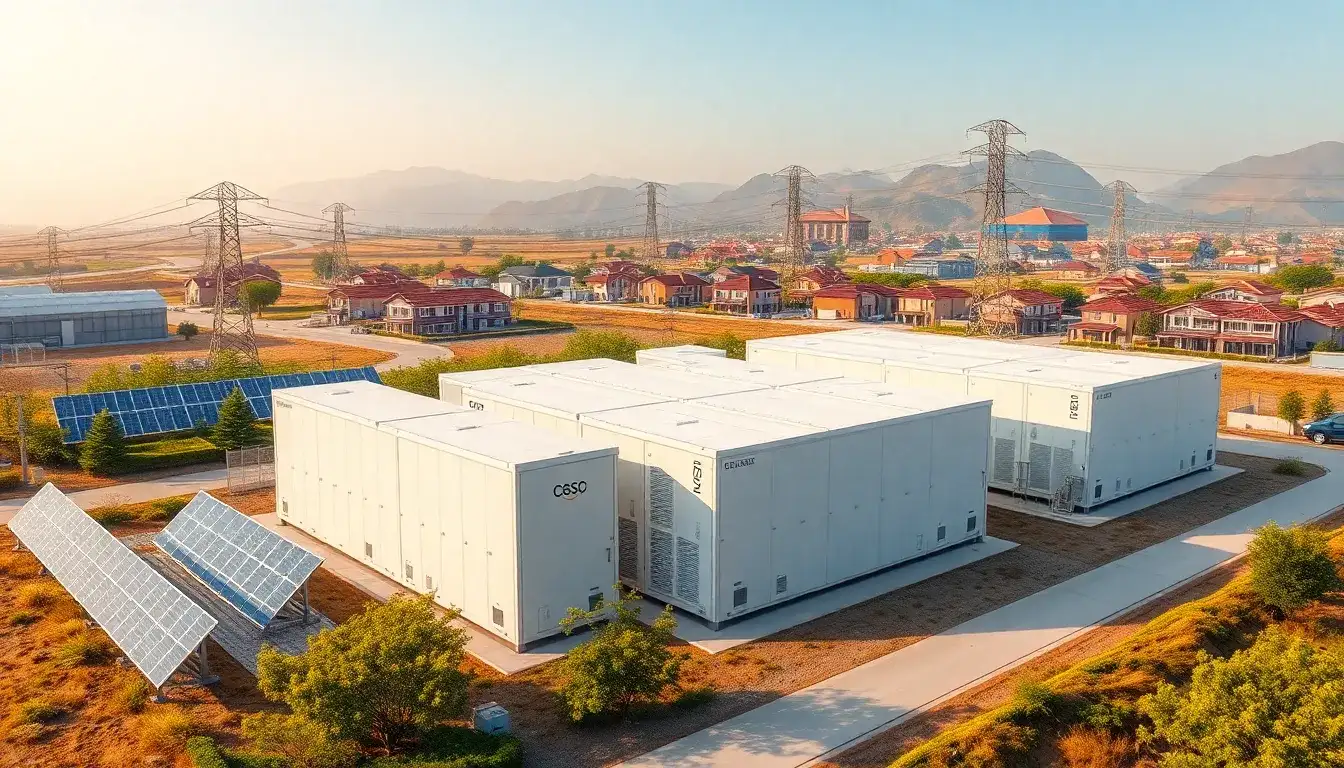
Today, on May 25, the Southern Grid’s Baoci Energy Storage Station officially commenced operations in Yunnan, marking the launch of China’s first large-scale lithium-sodium hybrid energy storage station. Located in the Wenshan Zhuang and Miao Autonomous Prefecture of Yunnan, the Baoci Energy Storage Station spans the equivalent of five football fields and boasts an installed capacity of 400 megawatt-hours. It is capable of adjusting an annual electricity output of 580 million kilowatt-hours, which equates to the yearly electricity consumption of approximately 270,000 households, with a remarkable 98% of this electricity coming from green sources.
Yunnan is a prime example of a region with a high share of renewable energy, having surpassed 60 million kilowatts of installed renewable capacity and achieving a penetration rate of nearly 70% in its power system. This high proportion of renewable energy results in greater fluctuations in the grid, necessitating robust energy storage solutions.
Wu Bin, the deputy manager of the Baoci Energy Storage Station project at Southern Grid Energy Storage Company, stated that the station serves over 30 wind and solar power plants across Yunnan. The hybrid lithium-sodium technology is designed to better support the stable integration of substantial amounts of renewable energy into the grid and facilitate participation in electricity market transactions, thereby promoting the efficient utilization of renewable resources.
The newly operational energy storage facility integrates the advantages of both lithium and sodium battery technologies, further expanding the application scenarios for sodium-ion battery storage in China and accelerating the development of the new energy storage industry chain. Currently, lithium-ion battery storage dominates the market, accounting for 97% of the energy storage technology due to its maturity and cost-effectiveness. However, as the demand for lithium batteries continues to rise, the availability of lithium resources is becoming a concern.
Chen Man, a member of the National Power Storage Standardization Technical Committee, noted that 70% of the materials used in China’s lithium battery production are sourced from overseas, highlighting a high dependency on imports. In contrast, sodium battery raw materials can be extracted from salt mines, seawater, and salt lakes. For instance, the sodium resources from the Qarhan Salt Lake are estimated to be 500 times greater than the global lithium resources.
Experts emphasize that sodium resources not only have significant reserves but also exhibit numerous advantageous properties, such as stable performance in temperature variations of up to 45 degrees Celsius. The Baoci Energy Storage Station utilizes the world’s first large-capacity sodium-ion battery developed in China, which boasts a response speed six times faster than existing sodium-ion batteries. The combination of advanced sodium batteries with mature lithium technology enhances the station’s ability to regulate energy.
Wan Minhui, a researcher at Southern Grid Energy Storage Company, explained that this network-type sodium battery system can flexibly adjust charging and discharging modes based on the integration of renewable energy sources, helping to balance their inherent volatility. This technology has the potential for further applications in regions with high renewable energy shares, such as Tibet, Xinjiang, Gansu, and Ningxia, supporting the stable transmission of electricity from large-scale renewable energy bases in arid areas.
Original article by NenPower, If reposted, please credit the source: https://nenpower.com/blog/chinas-first-large-scale-lithium-sodium-hybrid-energy-storage-station-powers-270000-homes/

