

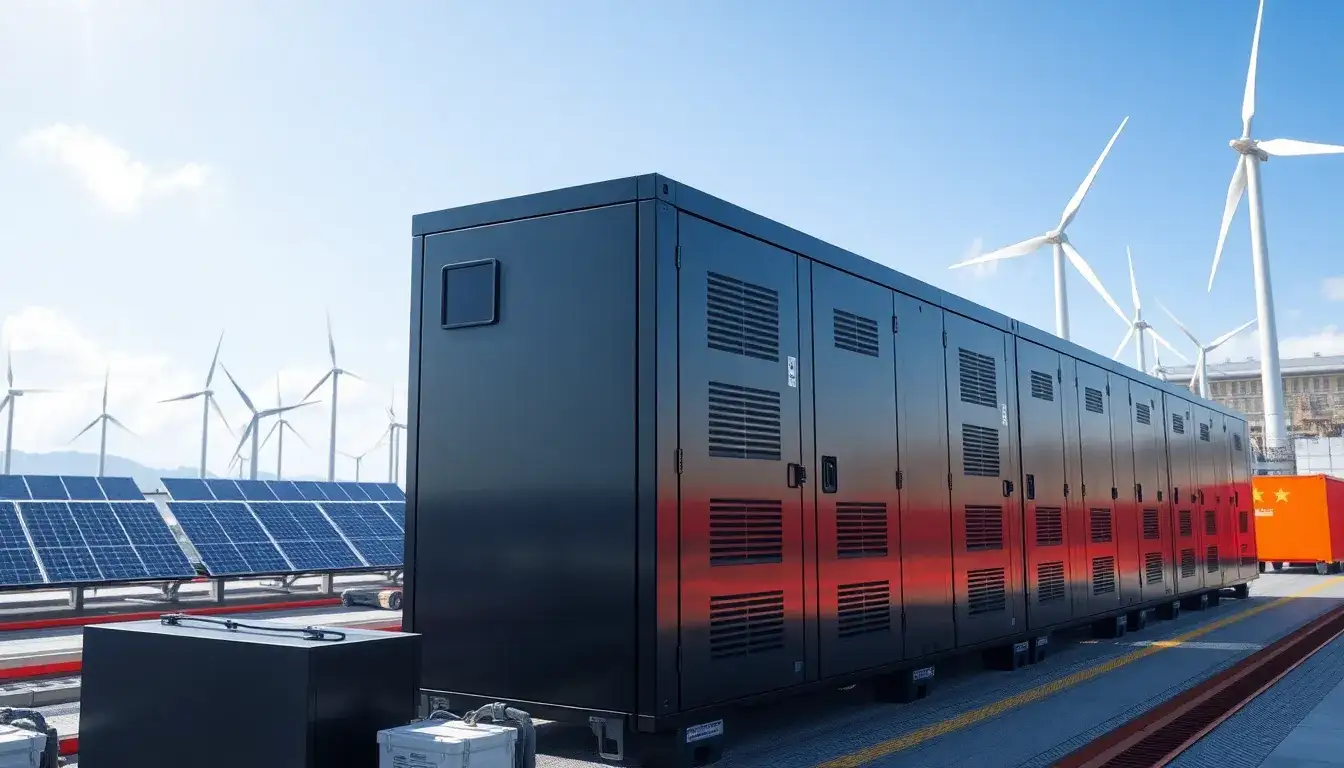
In the first quarter of 2025, overseas orders for energy storage exceeded 82 GWh! The ongoing trade war between China and the United States is expected to conclude by the end of the year.
Despite a turbulent international environment, China’s foreign trade demonstrated remarkable resilience in the first quarter of 2025, with exports surpassing 6 trillion yuan, marking a 6.9% increase. The new energy sector shone brightly, with exports of wind turbines, lithium batteries, and electric vehicles increasing by 43.2%, 18.8%, and 8.2%, respectively.
Australia emerged as the biggest growth market for overseas energy storage orders in the first quarter. According to statistics from the CESA Energy Storage Applications Subcommittee, China secured 59 new overseas energy storage orders in Q1 2025, totaling 82.39 GWh. This includes 7.54 GWh of lithium batteries and 73.77 GWh of storage systems (including the DC side), along with some flow batteries, solid-state batteries, and EPC contracts.
Among these, the largest energy storage order was signed with Australia, amounting to 25.7 GWh, which accounts for 31.19% of the total. Companies like CATL, Narada Power, Canadian Solar, and Trina Solar signed relevant project orders in Australia in Q1 2025. Notably, CATL’s collaboration with Quinbrook has resulted in the launch of the world’s first 8-hour long-duration storage battery, EnerQB, with a total project cluster capacity of 3 GW/24 GWh set to be deployed across Australia.
In the Middle East, energy storage orders reached 21.31 GWh, with the largest being the UAE’s Abu Dhabi RTC project, which includes 5.2 GW of solar and 19 GWh of storage. CATL has been selected as the preferred supplier for the 19 GWh TENER energy storage system. Larsen & Toubro and China Power Construction Group have been chosen as the preferred EPC contractors responsible for the entire project’s construction and delivery. Additionally, companies like Leap Energy, SNEC Electric, Trina Solar, and others signed or delivered energy storage projects in the Middle East during Q1 2025.
There were five energy storage orders from the United States, including one from Narada Power and four from Canadian Solar. Among the disclosed projects, the total capacity amounts to 562.6 MW/2580 MWh, representing 3.13% of the total. In March 2025, Narada Power achieved a breakthrough with one of the world’s largest software companies, following a successful bid for a 120 million yuan lithium battery equipment procurement project for a data center in the U.S. The client has recently added a 240 million yuan order, although the scale of the energy storage has not yet been disclosed.
According to incomplete public data, CATL’s newly secured overseas energy storage orders for Q1 2025 reached an impressive 43.3 GWh, accounting for over half of the total. This includes the EnerQB 3 GW/24 GWh project cluster in Australia, the 5.2 GW solar and 19 GWh storage project in Abu Dhabi, a 300 MWh battery procurement contract with TAOKE, and a strategic agreement with DHL Group. Haicheng Storage signed a global cooperation agreement with Samsung C&T to collaborate on approximately 10 GWh of energy storage systems worldwide. Guoxuan High-Tech has signed sales framework agreements with several energy companies in Japan, achieving over 7 GWh of cooperation. Canadian Solar has successively signed supply and long-term service agreements with companies like CIP Infrastructure Fund and Aypa Power, primarily providing the SolBank 3.0 energy storage system, with a total project scale of 1.8 GW/5.54 GWh, including 2.58 GWh for the U.S., 1 GW/2 GWh for the UK, and 240 MW/960 MWh for Australia.
Looking ahead, it is expected that China’s lithium battery exports to the U.S. will decline by over 80% in 2025. The U.S. has historically been the largest market for China’s lithium-ion battery exports, but pressures on the Chinese lithium industry began with the IRA legislation in 2022. By 2024, direct exports of power batteries from China to the U.S. are projected to account for only 1.4% of the total (1.8 GWh). Additionally, U.S. car manufacturers, restricted by the IRA legislation, are increasingly favoring suppliers from Japan and South Korea, resulting in a relatively minor impact from the trade war. In contrast to power batteries, the trade war has a more significant impact on energy storage.
In 2024, China’s exports of lithium batteries to the U.S. are expected to reach $15.3 billion (25% of total exports), with energy storage batteries accounting for 57%. Due to the trade war, some orders may shift to Japanese and Korean companies, with industry experts predicting a decline in export volumes to the U.S. by over 80% in 2025. As the U.S. energy storage market relies on Chinese lithium iron phosphate (LFP) batteries for 90% of its needs and domestic production remains insufficient (with a self-supply rate of less than 20%), alternatives will be difficult to implement in the short term.
It is anticipated that the construction of domestic battery production capacity in the U.S. will take 3-5 years, with manufacturing costs estimated to be 2-3 times higher than those in China, and reliance on imported raw materials (such as lithium and cobalt). The increase in battery costs due to the trade war could delay the tipping point for cost parity in new energy vehicles and hurt the economic viability of energy storage projects. Some U.S. energy storage integrators, like Fluence, are attempting to avoid some tariffs through local assembly, but overall costs are still significantly rising.
Currently, companies like Samsung SDI and LG Energy are accelerating their LFP battery development to fill the production gap left by China. The U.S. is the largest export market for South Korean energy storage systems, with lithium-ion battery exports for storage systems from Korea expected to rise from $1.75 billion in 2023 to $2.19 billion in 2024. Although South Korean energy storage battery prices range from $100 to $150 per kWh, compared to the dominant Chinese prices of $37 to $49 per kWh, the potential tariffs of up to 173.4% may allow Korean companies to effectively compete in the U.S. market.
Samsung SDI has noted an increase in demand for Korean ESS batteries due to heightened geopolitical tensions between the U.S. and China. Reports indicate that U.S. companies are increasingly engaging with Korean firms like LG Energy Solution and SK On, leading to a surge in order inquiries across local sales departments.
In addition, LG Energy Solution plans to establish a dedicated production line for these batteries at its Michigan facility in the second half of this year. LG Chem has also signed an agreement with SK Innovations to supply battery separators for SK’s North American plants. SK On aims to secure supply contracts and establish production facilities in North America within the year. While the expansion of Japanese and Korean companies’ production capacity in the U.S. (like LG’s 100 GWh North American factory) may alleviate some supply pressures, their capacity and technological maturity will be insufficient to replace the Chinese supply chain in the short term, putting U.S. energy storage projects at risk of rising costs or delays.
Moreover, the U.S. government continues to wield trade tariffs as a tool. Recently, the U.S. government warned that due to China’s retaliatory tariffs of 125% on American products, tariffs on Chinese goods could rise from the current 145% to 245%. While former President Trump has indicated that he is “not in a hurry” regarding tariffs, analysts believe the U.S. is in a difficult position concerning the trade war. The Associated Press has pointed out that the trade war could lead to an economic recession, with Trump recently hinting at potentially lowering tariffs on China to reach a trade agreement.
Morgan Stanley has indicated that if the current tariffs on China remain above 100% for an extended period, they will significantly disrupt bilateral trade and hinder economic growth. In the baseline scenario, it is expected that China and the U.S. will resume negotiations in the coming months and gradually reduce the average new tariff rates to 34% by the end of the year. To relieve supply chain pressures and promote agreements, the U.S. may lift the 20% tariff imposed due to issues related to fentanyl within the next one to two months and reduce the reciprocal tariff rate from 125% to 60%. As more exemptions are introduced before the end of the year, average tariffs are expected to decline further.
Overall, the impact of the U.S.-China trade war on the energy storage industry is primarily focused on rising export costs, potential market share losses to Japanese and Korean companies, and challenges in establishing a domestic supply chain in the U.S. In the short term, these factors are likely to negatively affect China’s exports of lithium and energy storage products. Chinese energy storage companies must focus on technological innovation, industrial chain collaboration, and global布局 to overcome tariff barriers and transition from “product export” to “technology standard export.”
The growth potential in emerging markets is substantial. In recent years, regions like Asia, Africa, and Latin America have begun to accelerate their demand for new energy installations, driven by multiple factors including energy transition strategies. Over the past three years, China has seen a significant increase in exports of new energy vehicles, lithium batteries, and photovoltaic products to countries like Brazil, Mexico, Pakistan, and Southeast Asia. By 2024, these emerging markets are expected to account for one-third to one-half of China’s total export value (in USD).
In terms of application scenarios, while distributed energy storage is experiencing rapid growth, large-scale storage remains the primary focus of new installations globally, driven by increasing renewable energy targets and the need for grid modernization to withstand extreme weather. China is transitioning from a policy-driven approach to a “market-driven + power market construction” model, while the U.S. is incentivizing energy storage project development through market price differences and tax incentives. Europe is pushing project development through power market reforms and ancillary service mechanisms.
In Southeast Asia, the Vietnamese government officially approved the revised “National Power Development Plan No. 8” (PDP8) on April 15, 2025, planning to invest approximately $136.3 billion by 2030 to significantly increase the share of renewable energy, with total installed capacity projected to reach 236 GW, a 50% increase over the previous version. By 2030, solar energy is expected to become the primary source of electricity, surpassing coal, reflecting Vietnam’s commitment to achieving a low-carbon energy system.
Furthermore, the Ministry of Industry and Trade (MOIT) in Vietnam has issued several resolutions, officially approving the price framework for hydropower, natural gas thermal power, and solar power generation in 2025. For the first time, the solar energy policy introduces energy storage systems and regional differentiated pricing mechanisms, requiring a minimum storage capacity of 10% of the solar power station’s capacity, with a charge and discharge duration of 2 hours, and at least 5% of annual generation must be used to charge the energy storage system.
Despite current challenges such as low electricity return rates, high storage costs, and exchange rate risks, Vietnam is gradually emerging as a key green energy hub in Southeast Asia as it continues to enhance its infrastructure and policy frameworks.
From other segmented markets, India has introduced mandatory storage policies, and with subsidies and government-led bidding initiatives, large-scale new energy storage (power side) and grid-side projects are expected to accelerate. In Germany, the penetration rate of industrial and commercial storage installations is anticipated to gradually increase with the opening of ancillary service markets and diversification of profit models, while demand for large-scale storage installations is also expected to initiate.
In Chile, driven by favorable factors such as capacity mechanisms and energy bidding, demand for large-scale storage installations primarily based on solar storage is expected to continue growing rapidly through 2025. In Saudi Arabia, the energy transition strategy will support large-scale storage demand, and hydrogen projects will also spur significant storage needs.
Regions like Africa and off-grid island nations face electricity shortages and instability, impacting local livelihoods and economic activities of Chinese enterprises, especially in energy-intensive sectors like mining. These areas are well-suited for the promotion of photovoltaic and energy storage systems, as they not only offer environmental benefits over diesel generators but also provide better cost efficiency and shorter investment payback periods.
Currently, some domestic energy storage companies are addressing the challenges of unstable power supply in island regions by offering microgrid system solutions that actively construct stable voltage and frequency support, providing reliable electricity and addressing the volatility and intermittency of renewable energy generation.
It’s important to note that the power systems in emerging market regions differ from those in mature markets like Europe and North America. The Middle East faces harsh climate conditions, Southeast Asia has clear off-grid demands, and distributed energy and storage needs are more pronounced in regions like Africa and Latin America. These characteristics define the regional market traits and are crucial directions for Chinese energy storage companies to invest their efforts.
In Australia, a subsidy program for 1 million household and community energy storage systems is set to launch this year. Ahead of the May 3, 2025 elections, Australian Prime Minister Anthony Albanese announced a “Cheaper Home Batteries Program” worth 2.3 billion Australian dollars (approximately 1.39 billion USD). The program aims to subsidize the cost of installing solar energy storage batteries for households, reducing electricity expenses for residents. Albanese and Climate Change and Energy Minister Chris Bowen stated that households, small businesses, and community facilities will be eligible for a 30% discount on battery installation costs, with typical systems (11.5 kWh) expected to save around 4,000 Australian dollars.
The total subsidy amounts to 2.3 billion Australian dollars and is included in the 2025-26 fiscal budget. Each household is limited to one subsidized “virtual power plant (VPP) ready” battery system with a capacity between 5-50 kWh (usable capacity); however, users can install systems with capacities up to 100 kWh. Small businesses and community facilities can also apply. If the Labor Party wins the federal election, the subsidy will take effect on July 1 and will also apply retroactively to systems that have been installed but not activated before that date. Users with installed energy storage systems may also receive an additional subsidy regardless of whether it is their first installation or a second system.
The subsidy mechanism will be disbursed through Australia’s existing Small-scale Renewable Energy Scheme (SRES), alongside rooftop solar subsidies. It can be combined with existing subsidies in various states (such as New South Wales, Victoria, and Western Australia) and has no overall limit, encouraging multiple installations for various properties. The specific subsidy will be approximately 370 Australian dollars per usable kWh (about 30% of installed costs), disbursed after deducting related management fees. As market costs decline, the subsidy percentage will decrease year by year and will end by 2030.
Data shows that Australia has the highest rooftop solar penetration rate globally, with installations surpassing 4 million systems. Households with existing rooftop solar can save up to 1,100 Australian dollars annually, while homes installing new “solar + battery” systems can save as much as 2,300 Australian dollars per year—equivalent to 90% of the typical household’s electricity costs. Currently, one-third of Australian households have installed photovoltaic modules, but only about 1 in 40 have energy storage batteries, indicating significant market potential.
While the opposition party has yet to announce specific plans, it has promised to propose a similar home battery subsidy policy. If this subsidy program becomes a reality, it is expected that by 2030, over 1 million household and community energy storage systems could be installed, providing tangible electricity savings for residents and significantly advancing Australia towards a clean energy future.
Original article by NenPower, If reposted, please credit the source: https://nenpower.com/blog/chinas-energy-storage-exports-surpass-82gwh-in-q1-2025-amid-anticipated-end-to-us-china-tariff-war/

