

The vitality of the automotive market continues to be released, with new energy vehicles becoming the main driver of growth. According to data from the China Association of Automobile Manufacturers, during the first four months of this year, China achieved production and sales of 10.175 million and 10.06 million vehicles, respectively, marking year-on-year increases of 12.9% and 10.8%. This is the first time in history that both production and sales have exceeded 10 million units during this period.
Chen Shihua, the deputy secretary-general of the China Association of Automobile Manufacturers, stated, “This year, our economy has shown positive momentum, with various macro policies working in synergy to provide solid support for the stable growth of the automotive market.” The implementation of policies such as “Two New” and continuous upgrades in product technology have effectively promoted ongoing vitality in the automotive sector.
New energy vehicles have become the main force for growth. Data indicates that in the first four months of this year, production and sales of new energy vehicles reached 4.429 million and 4.3 million units, respectively, with year-on-year growth of 48.3% and 46.2%. New energy vehicle sales accounted for 42.7% of total new vehicle sales.
Xin Guobin, vice minister of the Ministry of Industry and Information Technology, noted, “New energy vehicles are becoming a major force driving the stable growth and transformation of our automotive market.” The rapid development of new energy vehicles is attributed to the industry’s commitment to innovation, overcoming technical challenges, enhancing product performance, and gaining increasing consumer recognition. It is also supported by a global division of labor, collaborative progress, and the establishment of a high-quality, efficient international supply chain.
In terms of product performance, the average range of new energy vehicles in China is close to 500 kilometers, while advancements in intelligent driving assistance and human-machine interaction technologies make driving more enjoyable. Features such as active suspension and smart lighting systems are becoming more common in mainstream vehicles. Consequently, new energy vehicles are increasingly becoming the top choice for consumers.
“Recently, we launched four new models: the updated NIO ES6, EC6, ET5, and ET5T. These models are referred to as ‘5566’ and are the main contributors to NIO’s sales,” said Li Bin, founder and chairman of NIO. The “5566” models utilize the self-developed Shenqi NX9031 intelligent driving chip, achieving five significant upgrades in design, cabin, driving control, intelligence, and safety, promising a comprehensive new driving experience for users.
Geely’s newly launched Galaxy Star 8, equipped with the ShenDun battery safety system, implements the industry’s first “oil-electric separation design” along with a “six horizontal and four vertical oil-electric insurance chamber” for enhanced safety. “Although Geely’s Galaxy sales have exceeded 356,000 units in the first four months, the mid-to-high-end hybrid market still has considerable competition,” said Geely Auto Group CEO Gan Jiayu. “The Galaxy Star 8 aims to gain a new competitive advantage not just through pricing but also by leading high-quality development with advanced technology and superior quality.”
In the first quarter, XPeng Motors delivered 94,000 vehicles, marking a year-on-year increase of 330.8%, making it the sales champion among new energy vehicle brands. “The core reason for this is the continuous improvement of XPeng’s systematic capabilities in organization, product, marketing, and technology,” stated He Xiaopeng, founder and chairman of XPeng Motors. “We are integrating AI-driven innovations in areas such as the AI chassis, Turing AI-assisted driving, and the next generation of smart cockpits. Our growth potential has just begun to be released.”
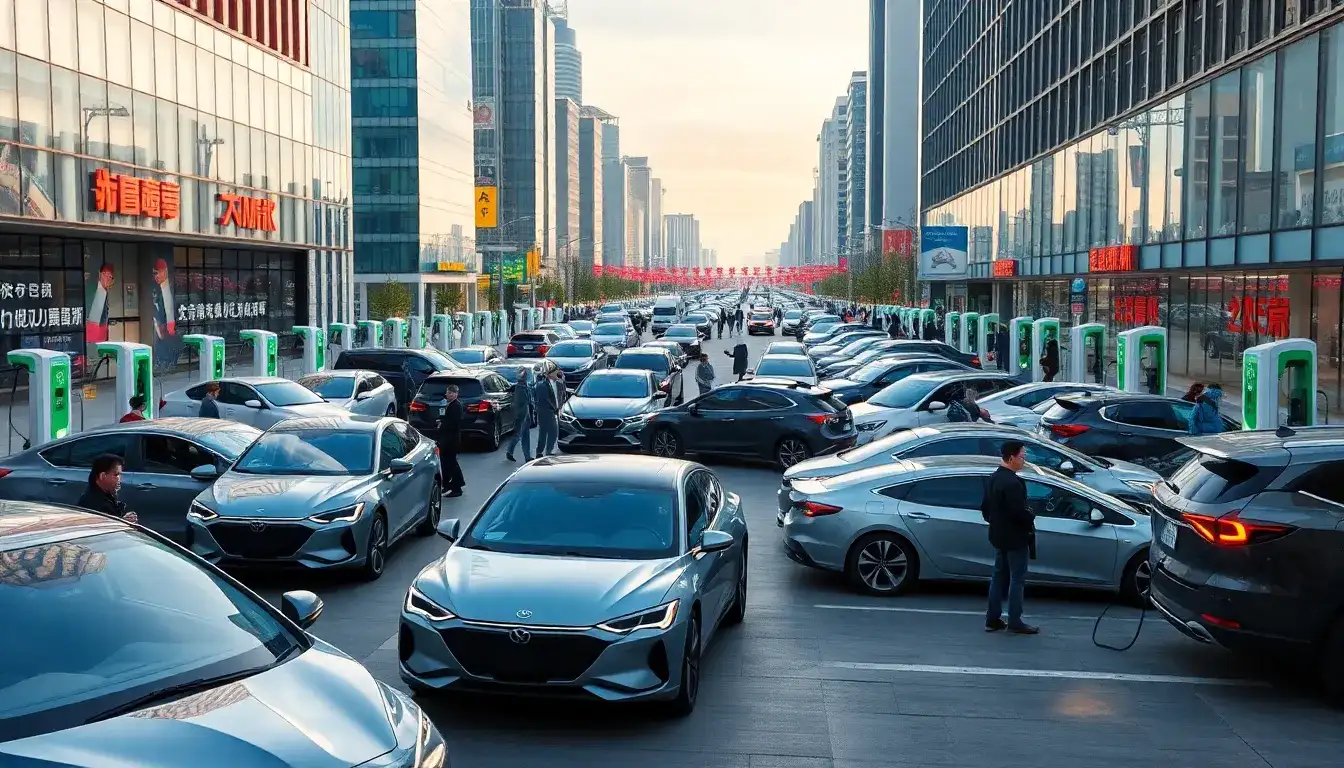
Furthermore, in terms of industrial systems, China has established a comprehensive and efficient industrial system covering basic materials, components, complete vehicles, and manufacturing equipment. The country supplies 70% of the world’s battery materials and 60% of power batteries. In terms of convenience, a charging network of 12.818 million charging piles and 4,443 battery swap stations has been created, forming the world’s largest charging network, with fast-charging technology allowing for 80% charge in just 15 minutes. These advantages in the industrial chain and infrastructure development have effectively promoted the production, sales, and use of new energy vehicles.
Trade-in programs boost market confidence. “I have wanted to buy a new car for a while but couldn’t make up my mind. Once I learned about the policy incentives, I immediately placed an order,” said consumer Du Wei, who recently ordered a new energy vehicle at a dealership in Dalian, Liaoning, benefiting from a trade-in subsidy.
Since the introduction of the national action plan to promote large-scale equipment updates and trade-ins in 2024, relevant departments have established specialized work teams to enhance coordination and collaboration. The trade-in program has played a vital role in supporting steady growth and expanding consumption in China’s automotive market. This year’s policy has expanded the scope of trade-in eligibility from fuel vehicles meeting the National III emission standards to include qualifying National IV emission standard fuel vehicles. This marks the first time that subsidies for scrapping vehicles have been extended to National IV models.
The combination of “scrapping subsidies + trade-in subsidies” and “national subsidies + local subsidies” can directly reduce the cost of purchasing a vehicle, igniting consumer enthusiasm for trading in. Data released by the Ministry of Commerce shows that by May 11, 2025, the number of trade-in subsidy applications had reached 3.225 million, including 1.035 million for vehicle scrapping and 2.19 million for trade-ins. Since the implementation of the trade-in policy in 2024, the total number of subsidy applications has surpassed 10 million.
In addition to subsidies, some automakers have increased promotional efforts. In the AITO Wenjie and GAC Aion experience stores, sales staff mentioned that consumers will receive points redeemable for gifts in the official mall when purchasing a vehicle. Existing car owners trading in can also earn additional points, making the discounts more tangible.
“This year, the national trade-in policy was launched early, and the subsidy policy was implemented comprehensively. Under the guidance of national consumption promotion policies, many localities have introduced and gradually implemented corresponding measures, combined with increased manufacturer subsidies, financial support, and the full launch of offline events such as auto shows,” stated Cui Dongshu, secretary general of the Passenger Vehicle Branch of the China Automobile Dealers Association. “Overall, since March, the automotive market in China has begun to strengthen. During the May Day holiday, the automotive consumer market experienced a surge in foot traffic.”
Car trade-ins are not just about simple “upgrading,” but represent a transformation and upgrading of consumption and industry. In the first four months of this year, new energy vehicles accounted for over 53% of trade-in activities; retail sales of new energy passenger vehicles totaled 3.324 million units, a year-on-year increase of 35.7%, achieving a market penetration rate of 48.4%.
Currently, the trade-in policy has shifted from a broad, indiscriminate approach to a more precise one. Experts indicate that the injection of over 150 billion yuan in special government bonds in 2025 will further expand the coverage of subsidies, with expectations that it will drive annual automotive retail sales to exceed 580 billion yuan, continuing to invigorate the automotive market.
Addressing the challenge of increasing revenue without increasing profits. On May 23, BYD launched a limited-time “fixed price” or limited-time subsidy promotion for a total of 22 intelligent driving version models under the Dynasty and Ocean series, offering discounts of up to 53,000 yuan.
This significant promotional effort is part of BYD’s push towards achieving its sales target of 5.5 million units by 2025, representing a nearly 30% year-on-year increase, with an overseas sales target of approximately 800,000 units. In the first four months of this year, the domestic automotive market’s “price war” has shifted from an intense state to a more moderate one. Data from the China Automobile Dealers Association shows that 65 models have seen price reductions in the first four months, a decrease of 56 models compared to the same period last year.
Despite the impressive double-digit growth in automotive production and sales in the first four months, data from the National Bureau of Statistics reveals that total retail sales of consumer goods reached 16.1845 trillion yuan, a year-on-year increase of 4.7%, while automotive consumption value fell by 0.5% to 1.484 trillion yuan. The profit margin of the automotive industry in the first quarter was 3.9%, lower than the average profit margin of downstream industrial enterprises at 5.6%, indicating a widening gap.
Luo Lei, vice president of the China Automobile Dealers Association, admitted that the current automotive market is characterized by “increasing volume without increasing revenue and increasing revenue without increasing profit,” indicating persistent insufficient demand. Some cities with strong consumer demand and purchasing power are still constrained by purchase restrictions. The primary challenge facing the industry is how to fully and reasonably unleash consumer potential and enhance consumption quality.
Original article by NenPower, If reposted, please credit the source: https://nenpower.com/blog/chinas-automotive-market-thrives-as-new-energy-vehicles-drive-growth/

