

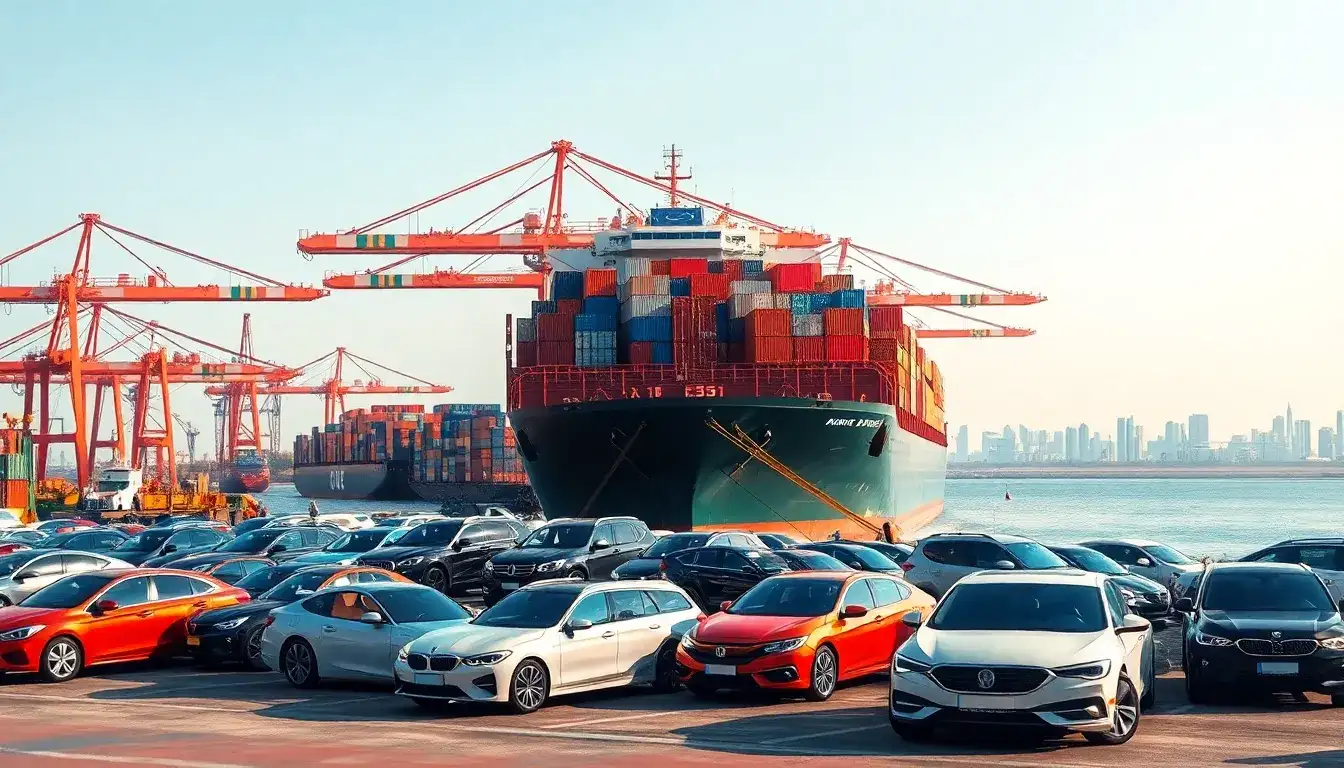
Strong Momentum for Chinese Automobiles Going Global: New “Weapon” Provides “Chinese Solution” for Global Automotive Shipping
In the first four months of 2025, China’s automobile production and sales exceeded 10 million units for the first time, with over 640,000 electric vehicles exported. The “Yuan Haikou” vessel has joined China’s automotive transportation fleet, adding new momentum for Chinese automobiles to set sail internationally.
The “Yuan Haikou” is currently the largest photovoltaic energy and LNG dual-fuel automobile transport ship in the country. It utilizes a hybrid power system combining liquefied natural gas and traditional fuel, which allows for an annual energy savings of approximately 20%.
With a capacity of 7,000 vehicle spaces, the “Yuan Haikou” commenced its maiden voyage on the “China-Mediterranean” shipping route, with destinations including Greece, Turkey, and Italy—countries along the “Belt and Road” initiative. This journey reduces travel time by nearly one-third, with a one-way trip lasting about 30 days.
By 2024, China is projected to export 1.284 million electric vehicles. These vehicles are considered one of the “new three” export products in China’s foreign trade. With the delivery of the “Yuan Haikou,” the China COSCO Shipping automobile fleet will expand to 20 vessels, with plans to increase to 30 by 2026, significantly boosting the momentum for Chinese automobiles to venture overseas.
Liu Yunwu, Secretary of the Party Committee at COSCO Shipping Guangzhou, stated that the export of Chinese electric vehicles is currently thriving. The addition of the “Yuan Haikou” further strengthens the national fleet for automobile transport. It features a range of green, intelligent, and automated technologies that meet the latest standards, enhancing the ability to serve China’s automotive exports while providing a “Chinese solution” for global automotive shipping.
Data shows that in the first four months of 2025, both production and sales of Chinese automobiles surpassed 10 million units for the first time in history, with year-on-year growth exceeding 10%. Electric vehicles continued to grow rapidly, with production and sales reaching 4.429 million and 4.3 million units, respectively, representing year-on-year increases of 48.3% and 46.2%. New electric vehicle sales accounted for 42.7% of total new vehicle sales.
During this period, electric vehicle exports reached 642,000 units, reflecting a year-on-year growth of 52.6%. The impressive performance of electric vehicles in China’s automotive industry is primarily driven by technological advancements and supportive policies.
In terms of technology, the penetration rate of L2 level passenger vehicles, which have combined driving assistance features, is expected to reach 57.3% by 2024, with assistance features gradually being added to vehicles priced under 100,000 yuan. Since 2025, major domestic car manufacturers have accelerated the adoption of smart technologies, with charging speeds entering the “minute era” and the widespread use of 800-volt high-voltage silicon carbide platforms.
The “two new” policies have also played a crucial role in stimulating domestic automotive market consumption. In 2024 alone, over 6.5 million vehicles were scrapped or replaced. The “trade-in” policy will be expanded in 2025, with expectations that these policies will generate even more growth in automotive consumption.
Original article by NenPower, If reposted, please credit the source: https://nenpower.com/blog/chinas-automotive-industry-expands-globally-with-new-shipping-solutions/

